
The hospital says your parent can't go home. You have days to figure out what it costs — and no private options exist.
Your parent fell, or the dementia worsened, or a stroke changed everything overnight. The hospital social worker hands you a pamphlet about "continuing care placement" and mentions a daily charge that started the moment your parent was designated Alternate Level of Care.
You search "NWT long-term care costs" and find fragments. A government PDF from Health and Social Services explaining the Territorial Admissions Committee. A separate department — Education, Culture, and Employment — handling subsidies through a different office with different forms. A medical travel policy that might cover the flight from your parent's remote community to Yellowknife, or might not, depending on paperwork you didn't know existed.
And unlike every other province, there are no private facilities. No option to pay more and bypass the waitlist. All nine long-term care homes in the territory are publicly owned. Everyone enters the same system. The question isn't which facility — it's whether you understand the system well enough to avoid the financial traps built into it.
The NWT Care Cost Navigator
This guide turns the Northwest Territories' fragmented continuing care system into a single financial plan you can act on. It covers every cost your family will face — from the $1,021 monthly accommodation charge through ECE subsidy applications, hospital wait-bed billing, medical travel reimbursement, and the legal documents that unlock decision-making authority over your parent's finances and healthcare.
Most families don't realize that the NWT's financial assessment for care subsidies is income-tested, not asset-tested in the way they fear. Your parent's home is an exempt fixed asset. Their primary vehicle is exempt. The liquid asset threshold is $75,000 — and specific income sources like RDSP withdrawals and Canada Disability Benefit payments are completely excluded from the calculation. The guide shows you exactly how that works, then walks you through every subsidy and benefit your parent may qualify for — including the spousal separation declaration that can increase GIS payments by hundreds per month.
What You Get
- Current 2026/2027 rates and hospital wait-bed billing rules — the exact monthly accommodation charge, when ALC billing starts, what happens if your parent refuses a bed offer, and how the Consumer Price Index adjustment works
- The ECE subsidy application walkthrough — every form (A through M), every document you need to bring to the regional Service Centre, and the $75,000 liquid asset threshold with clear explanations of what counts and what is exempt
- Income exemption strategy — the earned income exemption ($500 plus 25% of the remainder), the $350 monthly unearned income exemption, and complete exemptions for residential school settlements, RDSP funds, and the Canada Disability Benefit
- The spousal separation playbook — when one spouse enters care, the "Spouses Living Apart" declaration through Service Canada triggers GIS recalculation as two single incomes; the guide gives you the exact forms and the ECE notification steps most families miss
- Medical travel navigation — how to secure non-medical escort approval under Policy 49.06, how boarding home stays work, the $400 co-payment and who is exempt, and the three-month filing deadline for reimbursement
- The legal authority kit — Personal Directive and Enduring Power of Attorney guidance specific to NWT law, including the dual-professional capacity assessment requirement, the witness rules, and what happens if your parent loses capacity without these documents in place
- The NWT benefits directory — the $196/month Senior Citizen Supplementary Benefit, Extended Health Benefits for Seniors, Senior Home Heating Subsidy, and MACA property tax relief — with eligibility criteria and application deadlines for each
- Sibling decision-maker hierarchy — the NWT ranks children eldest to youngest for default medical decision-making authority; the guide explains this statutory hierarchy and provides a collaborative care-management template to prevent family conflict
- 6 printable standalone tools — Monthly Care Budget Worksheet, ECE Application Document Checklist, ECE Forms Reference Card, Legal Authority Checklist, Key Contacts and Annual Deadlines fridge sheet, and NWT Facility Directory — print them, fill them in, and bring them to your appointments
Who This Is For
You're an adult child with a parent in the Northwest Territories — or managing care from outside the territory — and you're facing one of these situations:
- Your parent is in hospital designated ALC and the daily accommodation charges are accumulating while you scramble to understand the placement system
- Your parent lives in a fly-in community and may need to relocate to Yellowknife for specialized dementia or Level 4 care — and you need to navigate the medical travel system before the transfer
- Your parent's income is limited to OAS, GIS, and CPP, and you need to maximize every territorial subsidy without accidentally disqualifying them by selling the family home
- You want to get the legal documents in place while your parent still has cognitive capacity — before a court-contested guardianship becomes the only option
Why Not Just Use the Free Government Information?
The NWT government publishes the rules. It does not publish a plan.
The clinical placement process is managed by Health and Social Services. Financial subsidies are handled by Education, Culture, and Employment — a completely separate department with its own offices, forms, and eligibility criteria. Medical travel is coordinated through regional Health Authority travel offices. Legal authority documents fall under Justice. Tax credits involve the CRA.
Each department's website explains its own policies. None of them tell you what to do first, which forms to hold back, how to time your applications across departments, or how to verify that your parent's billing is correct. And none of them warn you about the traps — like the fact that selling your parent's home converts an exempt fixed asset into countable liquid assets that can disqualify them from subsidies.
This guide takes the policies scattered across five government departments and puts them in the order a family actually needs them — starting from "what will my parent pay?" and ending with "how do I build a monthly budget that accounts for every income source and every expense?"
Satisfaction Guarantee
If the guide doesn't give you a clearer financial picture of your parent's care transition within 48 hours, email us for a full refund. No forms, no questions.
Get Started
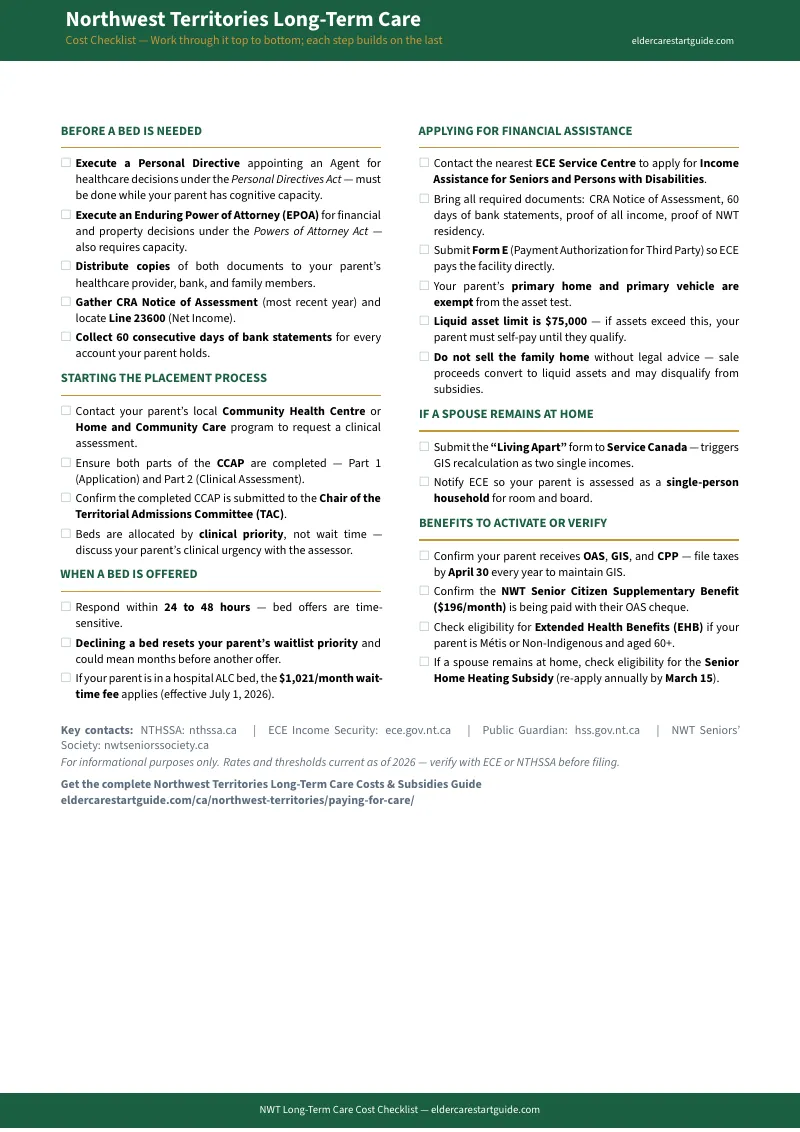
Download the free checklist for an immediate overview of every step in the NWT long-term care cost and subsidy process. When you're ready for the complete system — with ECE form walkthroughs, income exemption strategies, medical travel navigation, and the legal authority kit — the full guide is waiting.