Your Parent's Doctor Says They Can't Live Alone. The NWT Continuing Care System Has Nine Facilities, Three Health Authorities, and No One Who Will Walk You Through It.
The hospital flagged your parent as Alternate Level of Care. Or the home care nurse said the falls are getting too frequent, the medication is being missed, and the house is no longer safe. Either way, something has to change — and the Northwest Territories' continuing care system is not going to explain itself to you.
The Territorial Admissions Committee decides who gets a long-term care bed based on clinical priority, not when you applied. The InterRAI-HC assessment your parent is about to undergo generates scores across cognitive, physical, and psychosocial domains — and those scores determine everything from home care eligibility to waitlist ranking. The Committee for Applications to Supported Living handles a different pathway entirely. Medical travel to Yellowknife or Edmonton may be required, but the Extended Health Benefits enrollment that funds it must be completed before travel happens. And as of July 1, 2026, patients waiting in hospital for a placement pay $1,021 per month in accommodation fees.
You shouldn't need to piece this together from three different health authority websites and a stack of government PDFs while your parent's hospital bed is being billed daily.
— The NWT Continuing Care Roadmap
This is the NWT Continuing Care Roadmap — a step-by-step guide that maps the territory's centralized continuing care system into a single, sequential process you can follow from crisis to placement. It covers every decision point between "my parent needs help" and "my parent is in the right place, and I understand how it's paid for."
It's not a directory of phone numbers. It's not a generic "caring for aging parents" article written for southern Canada. It's the specific administrative, clinical, and legal process for the Northwest Territories — the territorial committees, the InterRAI scoring, the bed offer rules, the ALC fee timeline, the guardianship residency trap — organized in the order you'll actually need them.
What's Inside — 11 Printable PDFs
- The Complete 16-Chapter Guide (guide.pdf) — the full NWT continuing care system mapped into a single sequential process, from initial referral through placement, costs, medical travel, legal authority, facility evaluation, and caregiver respite.
- 72-Hour Emergency Response Checklist (emergency-response-checklist.pdf) — exactly what to do when the hospital says your parent can't go home or a home safety crisis forces the issue. Covers securing the home, establishing legal authority, contacting the right regional intake office (NTHSSA, HRHSSA, or TCSA), and understanding the ALC fee timeline so you know what your parent is being charged from day one.
- InterRAI-HC Assessment Preparation (interrai-assessment-prep.pdf) — the clinical evaluation that determines your parent's care level, service eligibility, and waitlist priority. What the nurse evaluates, how the Clinical Assessment Protocols flag issues like delirium, falls, and cognitive decline, and how to prepare written documentation of your parent's daily challenges before the visit — because if your parent "showtimes" for the assessor, the resulting scores will undercount their real needs.
- TAC Application Checklist (tac-application-checklist.pdf) — step-by-step tracker for the Territorial Admissions Committee long-term care application, including the medical form, TB screening, nursing assessment, physician input, consent requirements, and the priority-of-need ranking and bed offer rules.
- NWT Facility Comparison Worksheet (facility-comparison-worksheet.pdf) — a structured framework for evaluating each of the territory's nine long-term care facilities, covering community context, staffing ratios, clinical services, dementia care, cultural programming, family involvement, and additional costs. Print one per facility.
- Cost and Subsidy Calculator (cost-subsidy-worksheet.pdf) — maps the $34/day accommodation rate, the ECE financial assistance application, Extended Health Benefits enrollment for prescriptions, dental, and medical travel, income sources, and tax credits. Includes a fillable worksheet to model total out-of-pocket costs.
- Legal Authority Prep Kit (legal-authority-prep.pdf) — the NWT's most dangerous legal pitfall for out-of-province families. Covers Personal Directives, Enduring Powers of Attorney, the guardianship residency trap, and exactly how to establish legal authority while your parent still has capacity to avoid the Public Guardian scenario.
- Care Decision Tree (decision-tree.pdf) — a visual decision framework that walks you through home care vs. supported living vs. long-term care placement based on your parent's specific situation.
- Key Forms and Applications Reference (forms-reference.pdf) — a one-page quick-lookup table of every territorial form you may need, with form IDs, issuing agencies, purposes, and submission destinations.
- Home Care Intake Script (intake-script.pdf) — exactly what to say when you call the NTHSSA Home Care office to request a clinical assessment, including preparation tips and regional contact points.
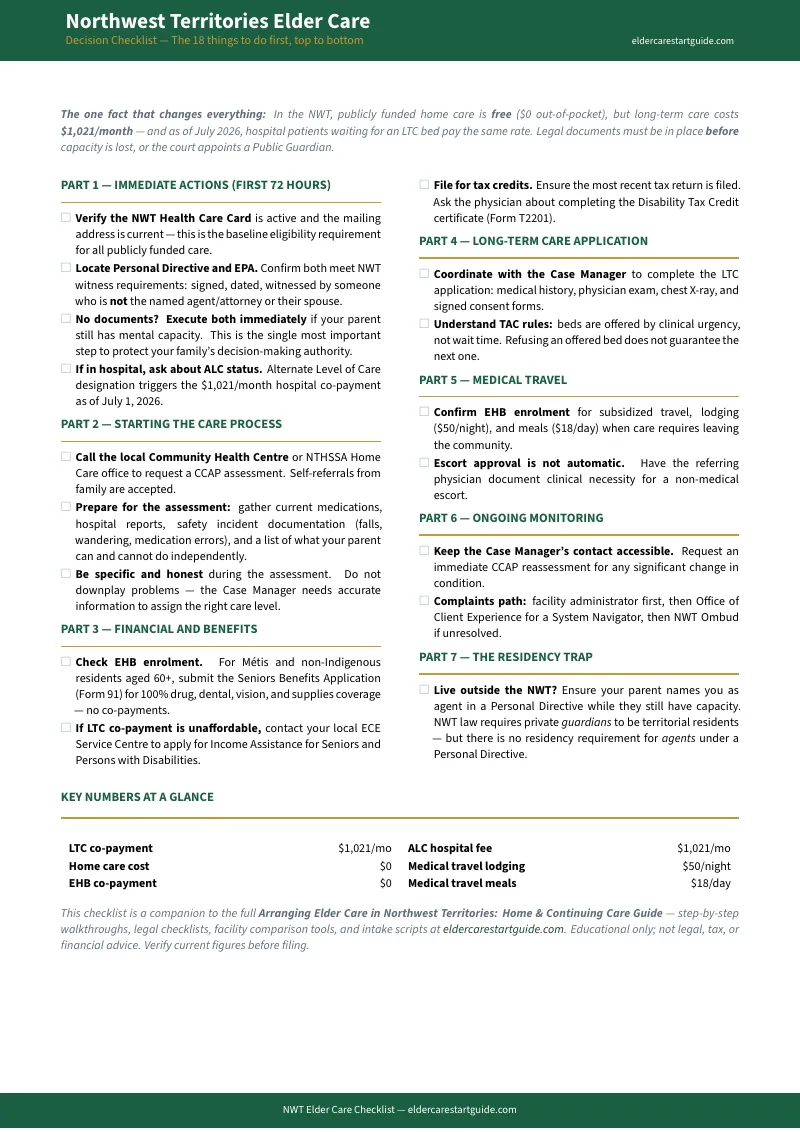
- Elder Care Decision Checklist (Free Download) (checklist.pdf) — a one-page action checklist covering the critical steps from recognizing decline through assessment, application, facility evaluation, and legal authority setup.
Who This Is For
- Adult children managing an aging parent's care transition in the Northwest Territories — whether it's a sudden hospital discharge at Stanton Territorial, Inuvik Regional, or Hay River Health Centre, or a slow decline that has become unsustainable
- Families deciding between home care, supported living, and long-term care placement in a territory with nine facilities spread across 1.2 million square kilometres
- Out-of-province coordinators in Edmonton, Calgary, Vancouver, or Toronto who are arranging everything remotely and need to understand the guardianship residency requirement before it's too late
- Caregivers navigating the InterRAI assessment, the TAC application, or the CASL supported living pathway for the first time
Why Not Just Use the Government Websites?
You can find pieces of this information across multiple territorial websites. The GNWT Health and Social Services site describes the continuing care programs. The NTHSSA website lists some home care services. The justice.gov.nt.ca portal covers guardianship law. The NWT Seniors Society publishes resource directories.
The problem isn't that the information doesn't exist — it's that it's scattered across three health authorities, multiple government departments, and non-profit organizations. It's written in bureaucratic language, organized by departmental function rather than by what you need to do next, and much of it hasn't been updated to reflect the July 2026 ALC fee policy or the May 2026 CASL establishment. When your parent is in a hospital bed being charged daily, reassembling that puzzle from scratch costs you days and potentially thousands of dollars.
National senior care portals like A Place for Mom list zero NWT facilities. They have no operational footprint north of 60. This guide covers the territory-specific system that actually governs your parent's care.
Satisfaction Guarantee
If the guide doesn't help you navigate the NWT continuing care system more effectively, email us within 30 days for a full refund. No forms, no questions.
Get Started Now
Download the free Elder Care Decision Checklist to see the critical action items at a glance. When you're ready for the full process — the InterRAI assessment prep, the TAC application walkthrough, the cost worksheets, the facility evaluation toolkit, and the legal authority kit — get the complete NWT Continuing Care Roadmap.