The Bank Froze Your Parent's Account. The Hospital Needs a Decision-Maker. And Nobody Told You What to Do First.
Your parent fell. Or the diagnosis came back. Or the bank teller just told you they can't discuss your mother's mortgage — even though you're the one paying it.
You searched "power of attorney Newfoundland" and found a free PLIAN booklet that explains the law in careful paragraphs — but doesn't tell you how to actually get the bank to cooperate, which document covers medical decisions versus financial ones, or what to do when your parent can no longer sign anything.
Welcome to the gap between understanding the law and navigating the system.
The NL Decision Authority System
This is not another legal overview you can find on a government website. It is the operational bridge between knowing what an Enduring Power of Attorney is and actually getting one accepted by a bank branch in St. John's, a personal care home in Corner Brook, or a hospital social worker asking who makes the decisions.
The kit covers both documents you need — the Enduring Power of Attorney (EPA) for finances and the Advance Health Care Directive (AHCD) for medical decisions — plus the guardianship fallback when capacity is already gone, the NL Health Services care system your parent will be routed through, and the specific institutional friction points where families get stuck.
What's Inside
- The Two-Document System — Newfoundland and Labrador splits financial and medical decision-making across two separate laws. An EPA under the Enduring Powers of Attorney Act handles bank accounts, property, and taxes. An AHCD under the Advance Health Care Directives Act handles treatment consent, care home placement, and end-of-life wishes. The guide explains which you need, when you need both, and how they interact with the NL Health Services system.
- EPA Setup With Bank-Proofing — Step-by-step execution: the enduring clause that keeps the document valid after capacity loss, the witnessing requirements (one independent witness who cannot be the named attorney or their spouse), activation models (immediate vs. springing), and a dedicated bank-compliance strategy based on Canadian Bankers Association commitments — including escalation scripts when a branch refuses to cooperate.
- AHCD and Substitute Decision Maker Appointment — How to appoint a single SDM to prevent the default nearest-relative list from triggering sibling disputes. Two-witness requirements, written acceptance obligations, limits on SDM authority, and the "It's Your Decision" framework used by NL Health Services.
- The Guardianship Fallback — When capacity is already gone, neither an EPA nor an AHCD can be signed. The guide walks through the Supreme Court guardianship application under the Mentally Disabled Persons' Estates Act: medical affidavits, the petition, the guardianship bond, Public Trustee involvement, court fees, and the critical gap in NL law around personal guardianship that most families only discover in the courtroom.
- NL Health Services Care Navigation — The single point of entry, three levels of subsidized care, the difference between personal care homes and long-term care, and current wait-time realities. How the clinical assessment process works and what legal authority you need at each stage.
- The Financial Assessment Decoded — NL Health Services uses CRA Line 236 Net Income to calculate subsidized care contributions — up to $2,990/month at maximum rate. The guide explains what is tested, what is excluded (bank balances, RRSPs, the family home), and why you cannot access the subsidy without an EPA if your parent lacks capacity to sign the assessment package.
- Sibling and Family Conflict Prevention — Customizable accounting and transparency clauses that mandate regular financial reporting and scheduled family meetings. Multi-attorney decision-making structures. How to document your actions to protect against accusations of financial abuse.
- Cross-Province and Snowbird Considerations — Whether an out-of-province EPA or AHCD works in Newfoundland, and the recommended approach for families split across multiple jurisdictions.
Plus: 9 Printable Standalone Tools
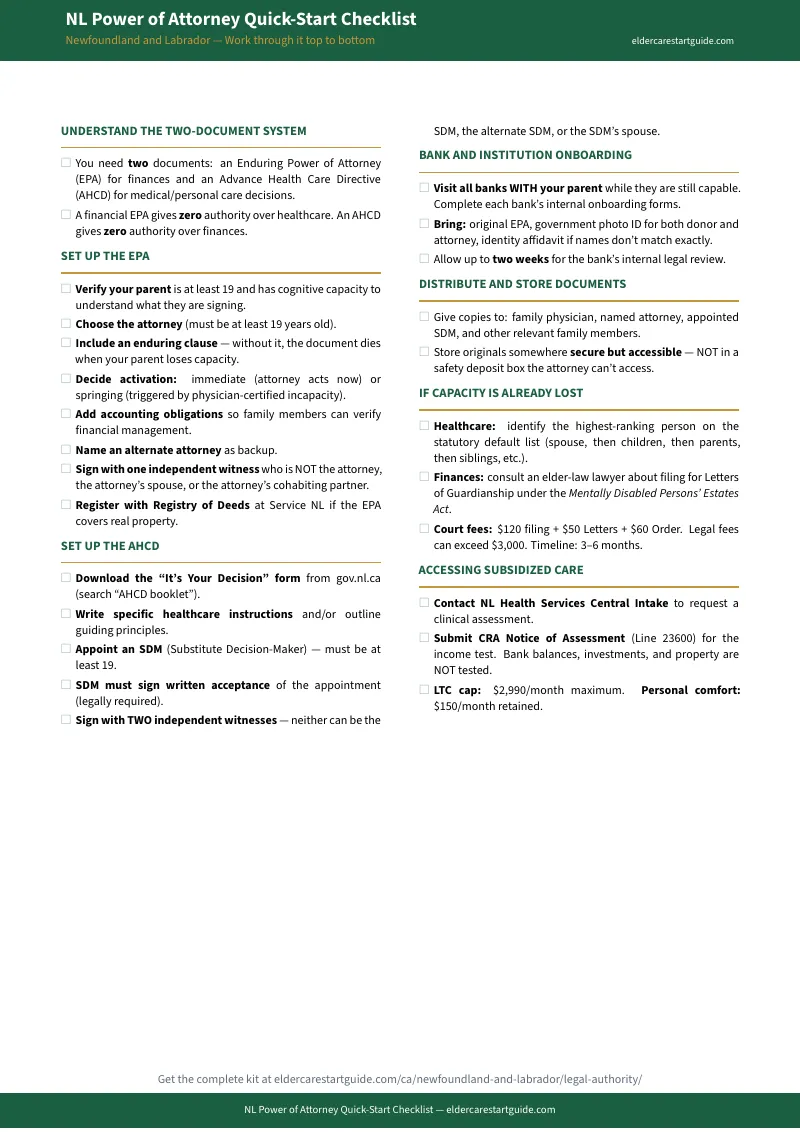
- Quick-Start Checklist — A one-page action list covering the 20 most critical items from capacity assessment through bank registration and NL Health Services placement
- Step-by-Step Action Plans — Three situation-specific plans: parent has capacity (Plan A), capacity is already gone (Plan B), and accessing subsidized care (Plan C)
- Bank Escalation Scripts — Word-for-word scripts and a 5-step escalation protocol for when a branch rejects your EPA, plus an escalation record log
- Capacity Assessment Worksheet — Physician-aligned evaluation for EPA and AHCD signing readiness, with a physician confirmation letter template
- Financial Assessment Decoder — What NL Health Services tests, what it excludes, key cost figures, and income optimization strategies to bring to your accountant
- Guardianship Filing Checklist — Step-by-step Supreme Court application checklist covering pre-filing, filing, bond, and post-appointment actions
- Sibling Conflict Prevention — EPA transparency clauses, AHCD best practices, a pre-signing family meeting agenda, and financial abuse warning signs
- Benefits Reference Card — Federal and NL benefits that offset elder care costs, including the RDSP option and income optimization reminders
- Forms and Resources Directory — Every official court form, government contact, and key statute on one printable sheet
Who This Is For
- Adult children whose parent is being discharged from hospital and someone needs to establish decision-making authority before the placement process stalls
- Families whose parent's bank has frozen their accounts or is refusing to discuss finances without legal documentation
- Caregivers navigating the NL Health Services income-tested financial assessment and discovering they cannot sign the paperwork without an EPA
- Siblings trying to agree on who acts as attorney before the statutory default list forces the decision for them
- Families whose parent has early-stage cognitive decline and needs to sign documents while capacity still exists
- Adult children whose parent has already lost capacity and need to understand the guardianship process instead
- Out-of-province family members coordinating care for a parent in Newfoundland and Labrador
Why Not Free Government Resources?
PLIAN publishes an excellent legal planning guide. NL Health Services explains the clinical assessment process. Local law firms in St. John's and Corner Brook offer consultations.
Here is what none of them provide:
- A step-by-step EPA execution walkthrough with the specific bank-compliance strategy that prevents branch-level refusals — not a general note to "consult a lawyer"
- The operational link between the EPA, the AHCD, and the NL Health Services financial assessment — showing exactly where each document gets demanded and what happens if you don't have it
- The complete guardianship process under the Mentally Disabled Persons' Estates Act when it's too late for proactive planning, including the personal guardianship gap that NL's legislation does not fully address
- Conflict-prevention clauses and family transparency structures designed for the specific disputes that arise when multiple children disagree about a parent's care
Government sites explain the rules. Law firms apply them for $700 to $1,450 per engagement. This guide bridges the gap — translating provincial legislation, health authority processes, and banking compliance into a sequence you can execute in an evening.
Satisfaction Guarantee
If the guide doesn't give you a clearer path forward, email [email protected] and we'll make it right.
— Less Than One Hour of an NL Elder Law Lawyer's Time
An initial consultation with a Newfoundland elder law lawyer runs $250 to $500. A full guardianship application through the Supreme Court can cost $5,000 or more in legal fees, court costs, and bonding. Paying the maximum long-term care rate because you couldn't sign the financial assessment costs $2,990 every month.
This guide won't replace a lawyer for complex trust litigation or contested guardianship proceedings. But for the EPA and AHCD setup, bank compliance, NL Health Services navigation, and guardianship walkthrough that most Newfoundland families need, it covers 90% of the work at a fraction of the cost — and if you do need a lawyer, you'll arrive with organized documentation instead of scattered questions.
Start with the free checklist to see if the approach fits your situation. The full guide goes deeper — every statutory requirement, every institutional process, every escalation step.