
Your parent's bank just locked you out. The hospital won't share their records. And every door you try requires a document nobody told you existed.
It usually starts with a phone call. A fall, a sudden diagnosis, a hospital admission — and within hours you discover that being the closest family member gives you exactly zero legal authority over your parent's finances, medical care, or living arrangements. The bank won't discuss their accounts. The doctor won't share test results. The nursing home won't let you sign the admission paperwork. Every institution asks for a power of attorney, a directive, a court order — and your parent signed none of them.
New Brunswick makes this harder than most provinces. The Enduring Powers of Attorney Act, in force since July 2020, splits decision-making authority into separate documents with entirely different execution rules. A property EPA — covering bank accounts, real estate, and taxes — must be signed in front of a practicing New Brunswick lawyer with a formal capacity certificate. A personal care EPA — covering health decisions, accommodation, and daily care — can be done at home with two adult witnesses. A health care directive records treatment preferences but cannot appoint anyone to enforce them. And if your parent has already lost capacity without any of these documents, you need the Court of King's Bench — and potentially a court-appointed stranger managing their affairs instead of you.
The Pre-Legal Authority System
The New Brunswick Power of Attorney & Personal Directive Kit is not a DIY legal form. It is the preparation system you complete before you sit down with the lawyer — and the crisis manual you use when it is already too late for a simple signature. It covers the full arc: from proactive document preparation through capacity assessments to court-ordered representation under the SDMRA, including the financial rules that determine how care is paid for.
Lawyers charge by the hour. Every minute you spend in their office asking "what is a property EPA?" is a minute you are paying for information that belongs in a preparation guide, not a billable consultation. This kit organizes every document, every execution requirement, and every court process into one sequential plan — so your lawyer appointment is focused on execution, not education.
What's Inside
- The 2020 EPA Act Execution Map — The exact requirements for each document type: which needs a lawyer (property EPA), which needs two witnesses (personal care EPA), and which needs neither but is useless without the other (health care directive). Witness eligibility rules, signing order, and the lawyer's certificate requirements — all in one reference so you are not piecing together rules from four different government PDFs.
- The SDMRA Three-Tier Framework — When capacity is already lost, the Supported Decision-Making and Representation Act provides three levels of court-ordered authority. Decision-Making Assistance Authorizations for seniors who can still choose with help. Supported Decision-Making Orders for those who can participate interdependently. Representation Orders for complete incapacity. The guide explains each tier's application process, the Form 3 Capacity Assessment Report, and the ongoing duties a court-appointed representative must fulfil.
- Bank and Institutional Pushback Protocol — A pre-visit preparation checklist for the meeting where your parent's bank reviews the EPA. Covers the original document with the lawyer's certificate, required identification, and a capacity letter. Includes escalation strategies when a valid EPA is incorrectly rejected — because compliance departments routinely refuse documents that are legally sufficient.
- Capacity Assessment Walkthrough — Who can assess capacity, what they measure, how to activate a springing power of attorney, and the critical distinction between personal care capacity and financial capacity. Your parent may be capable of choosing their meals while unable to manage a portfolio — and the law treats those as separate determinations.
- Nursing Home vs Special Care Home Financial Rules — The two systems use completely different formulas. Nursing home contributions are income-only — the family home and savings are exempt. Special care home subsidies impose strict liquid-asset limits. The guide explains both systems with worked financial examples so families do not make placement decisions based on wrong assumptions about cost.
- The Public Trustee — Understanding the Last Resort — What triggers Public Trustee involvement, how the referral and evaluation process works, and why establishing family-directed authority proactively prevents a court-appointed stranger from managing your parent's life. Includes the typical timeline (weeks to months) and the inventory and accounting duties.
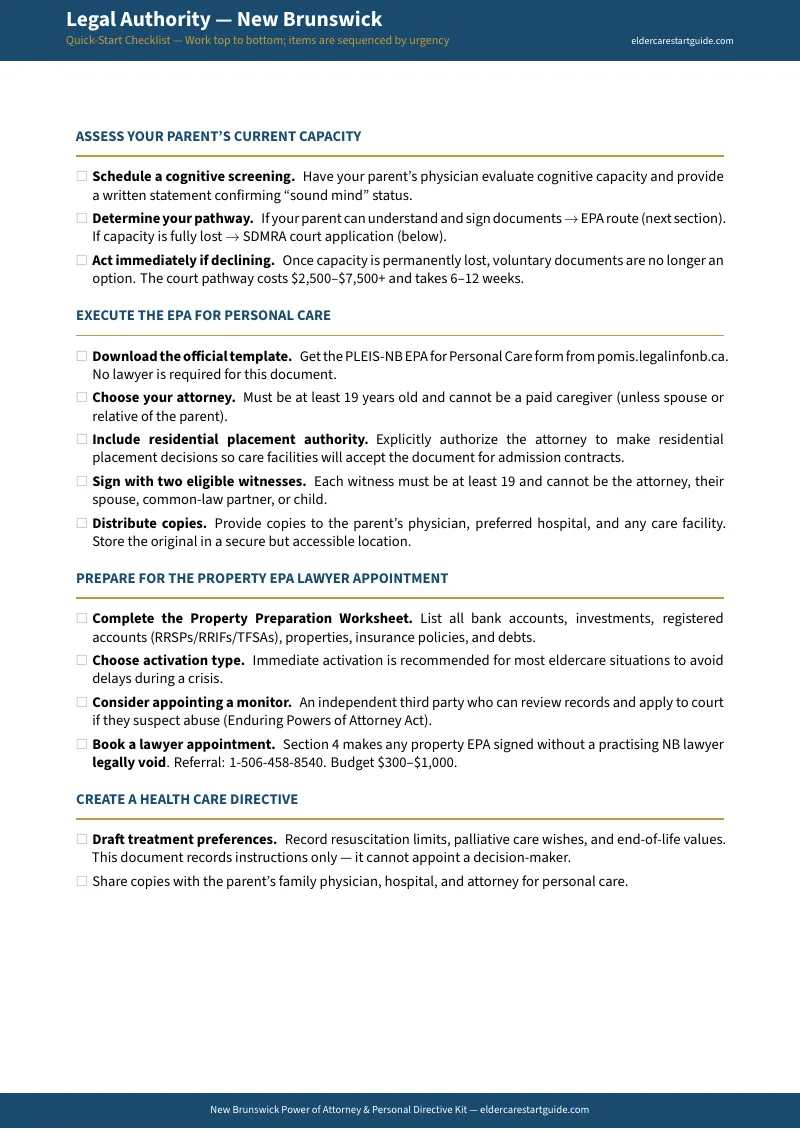
- Quick-Start Checklist — A one-page reference with every critical action item in priority order. From gathering documents for the lawyer appointment through executing each EPA, filing the health care directive, and preparing for a potential court application. Every deadline, witness requirement, and contact reference at a glance.
- Eight Standalone Planning Worksheets — Printable, fill-in-by-hand tools for each stage of the process: a lawyer-ready property preparation worksheet, an EPA activation tracker, a long-term care assessment preparation checklist, a family contribution calculator for the nursing home formula, a property management ledger, a personal care decision journal, an agency communication log, and a court application document checklist for SDMRA filings.
Who This Is For
- The family setting up authority while there is still time. Your parent is showing early cognitive changes, and you know the window for a valid property EPA is closing. You need to understand the execution requirements, prepare for the lawyer appointment, and get the personal care EPA signed at home — before a crisis makes all of this ten times harder and more expensive.
- The caregiver locked out of every institution. The bank, the hospital, the utility company — none of them will talk to you. You either have no documents or the documents you have are being rejected. You need the pushback protocol and the escalation strategies so you stop hearing "we can't help you" and start hearing "we'll process this."
- The family dealing with lost capacity and no documents. Your parent can no longer sign anything. You need to understand the SDMRA court process, which tier of representation to apply for, how to obtain the capacity assessment, and what the court requires — before the Public Trustee becomes the default.
Why Not Just Use the Free Government Resources?
PLEIS-NB publishes excellent plain-language guides — but they are scattered across separate PDFs covering separate topics. The Social Supports NB portal handles applications but does not explain legal documents. Willful generates standard POA forms but does not cover what happens when your parent has already lost capacity, or how to handle a bank that rejects a valid EPA, or how the financial assessment works when it is time for a nursing home.
This kit connects the pieces that no single free resource covers: the legal documents, the execution requirements, the institutional pushback, the court processes, and the financial rules — in the order you actually encounter them.
Satisfaction Guarantee
If the kit does not give you a clearer picture of your family's legal authority options within the first read-through, email us and we will make it right.
Get Started
Download the free checklist to see the one-page action sequence — from the lawyer appointment through each EPA, the health care directive, and the court application timeline. When you are ready for the full system, the complete kit is available for — less than 15 minutes of a New Brunswick lawyer's billable time.