
The Hospital Wants That Bed Back. You Have 48 Hours to Learn a System That Splits Elder Care Across Two Departments Nobody Told You About.
Your parent had a fall or a stroke. They are in a hospital bed in Moncton, Fredericton, or Saint John, and someone just told you they have been flagged as "Alternate Level of Care" — meaning the hospital considers them medically stable and wants them moved. A discharge planner is pushing a nursing home bed offer, and if you refuse it twice, your parent loses their spot on the waitlist for 12 weeks.
But here is what makes New Brunswick uniquely confusing: elder care is not one system. Medical home care — nursing, physiotherapy, wound care, palliative care — is run by the Extra-Mural Program under Medicare, at no cost. Personal care — bathing, dressing, meals, housekeeping — and all facility placements are run by the Department of Social Development, with a separate application, a separate assessment, and an income-tested financial contribution. The two departments do not share intake processes, and no one in the hospital maps both of them for you.
That is why families make decisions they regret. They accept a nursing home 90 kilometres away because they did not know the interim placement preserves their preferred-home waitlist position. They miss the Self-Managed Support option that would have let them hire their own caregiver with provincial funding. They discover their parent needed an Enduring Power of Attorney before they lost capacity — and now the family is headed to court.
The Dual-System Navigation Blueprint
The Arranging Elder Care in New Brunswick Guide is a process-navigation manual built for the adult child standing between two government departments and a hospital discharge deadline. It maps both care systems — Social Development and Extra-Mural — into one sequential plan with the exact intake numbers, the assessment criteria the social worker uses, and the waitlist mechanics most families learn about too late.
This is not a pamphlet. It is not a generic "how to care for aging parents" guide. It is a 13-chapter, New Brunswick-specific reference that covers the Level 1-4 classification system, the first-offer rule under Regulation 85-187, the income-only financial assessment that protects the family home, and the legal authority documents you need under the 2020 Enduring Powers of Attorney Act — all written for someone who needs answers this week, not next month.
What's Inside
The Two-Department Map
How Social Development and the Extra-Mural Program divide responsibility, where they overlap, and the single intake number (1-833-733-7835) that starts the process. Most families call one department when they need the other — or miss that they need both.
The Functional Assessment — Decoded
A Social Development assessor visits your parent's home and evaluates Activities of Daily Living, mobility, cognition, and safety hazards. Seniors routinely "perform" during these visits — minimizing their limitations in front of professionals. The guide shows you what the assessor actually scores, what documentation to prepare in advance, and how to present the full picture without overstating or understating needs.
The Level of Care Classification
Level 1-2 (Special Care Home), Level 3-4 (Nursing Home), Level 3B (Memory Care) — each with different facility types, staffing ratios, and cost structures. The guide explains how the functional assessment maps to each level and what happens when a parent's needs cross the boundary between levels.
The Waitlist System — First-Offer, 100 km, Two-Refusal Penalty
The regulation most families learn about in a hospital hallway. Under Regulation 85-187, Section 9.04(1), an ALC patient must accept the first available bed within 100 km that matches their language. Decline two valid offers and you lose waitlist priority for 12 weeks. But — accepting an interim placement preserves your position on the preferred-home transfer list. The guide explains how to use these rules defensively, not reactively.
The Financial Contribution Formula
New Brunswick calculates care costs based on regular monthly income — not assets. The family home, bank accounts, and investments are exempt under the Standard Family Contribution Policy. But the income those assets generate — interest, dividends, rental income — counts. The guide walks through the spousal contribution rules, the personal comfort allowance, and the tax decisions that can inflate assessed income without families realizing it.
Home Care Options — Public, Private, and Self-Managed
Three paths to keeping your parent at home: subsidized home support through Social Development, free medical nursing through the Extra-Mural Program, and the Self-Managed Support option that gives families a monthly lump sum to hire their own caregiver — including non-resident family members. The guide compares all three against private agencies and explains the eligibility criteria for each.
Legal Authority Under the 2020 EPA Act
A Property EPA requires a practicing New Brunswick lawyer. A Personal Care EPA requires two independent adult witnesses. A Health Care Directive states medical preferences but does not appoint a decision-maker. If your parent has lost capacity without these documents, the path leads to court guardianship and the Public Trustee. The guide covers exactly which documents you need, who must sign them, and how to assess remaining capacity before it is too late.
Respite, Appeals, and the ALC Discharge Timeline
How to access provincially funded respite care, the formal appeal process when a classification or financial assessment is wrong, and a realistic breakdown of what hospital discharge coordinators can and cannot require — including the daily residential charge that starts accumulating when your parent is declared ALC.
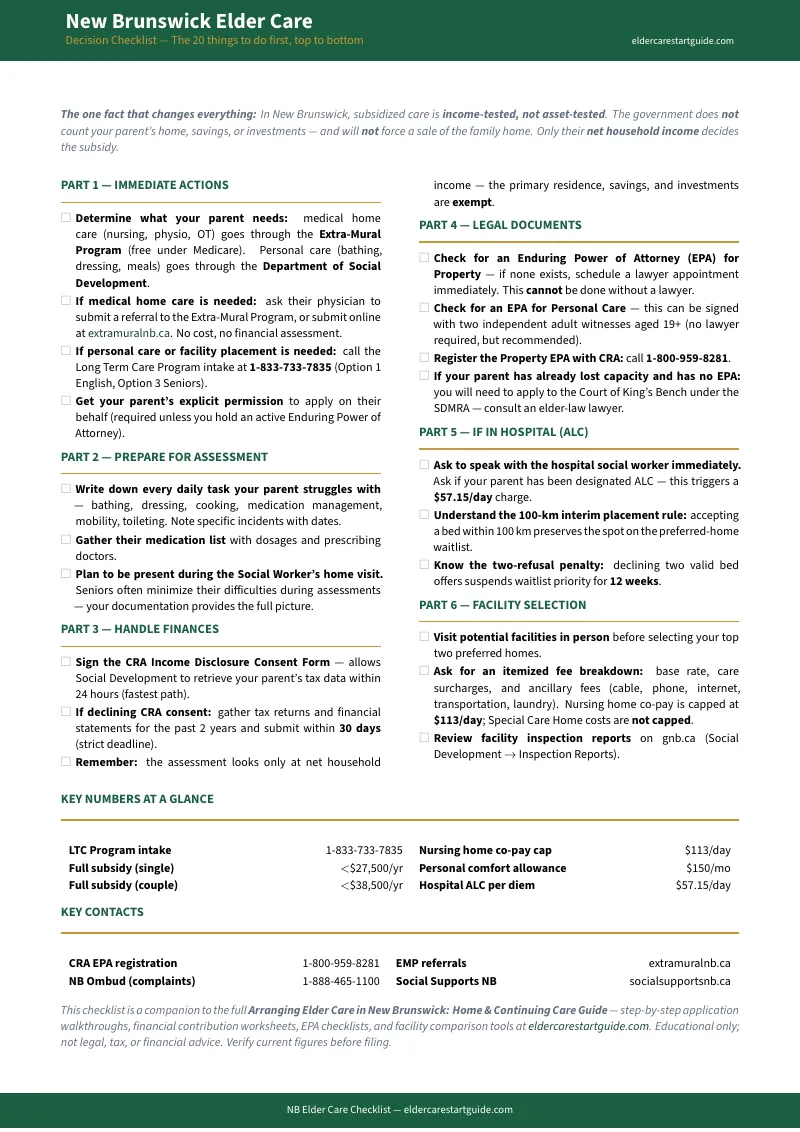
The New Brunswick Elder Care Checklist
One page. Priority order. Every action item from the first intake call through the functional assessment, financial contribution, preferred-home selection, and waitlist rules. The phone numbers, the regulation references, the deadlines — everything you need to track at a glance.
9 Standalone Printable Worksheets
Every section you would want to print separately and bring to an appointment, a facility visit, or a family meeting — already extracted as its own PDF:
- Assessment Preparation Worksheet — document ADL and IADL deficits before the social worker visits
- Financial Contribution Worksheet — calculate assessed income and check subsidy thresholds
- Cost Reference Sheet — every care cost, co-payment, and subsidy cap on one page
- Facility Visit Checklist — staffing, environment, fees, and inspection questions to ask on-site
- EPA and Legal Authority Checklist — Property EPA, Personal Care EPA, Health Care Directive, and the SDMRA court process
- Key Forms and Documents Reference — every government and court form with issuing department and purpose
- Decision Flowchart — visual flowchart for the hospital path, at-home path, and legal authority check
- Information Gathering Worksheet — collect medical, legal, and financial details before a crisis
- Home Safety Modification Checklist — room-by-room fall prevention with NB tax credit info
Who This Is For
- The adult child in a discharge crisis — your parent is ALC, the hospital is pushing a bed offer, and you need to understand the first-offer rule and the two-refusal penalty before you sign anything.
- The family trying to keep a parent at home — you are paying a private agency out of pocket and you need to know what the province will fund, including the Self-Managed Support option nobody mentioned.
- The sibling without legal authority — the bank will not talk to you, the hospital will not share records, and you need to understand EPAs under the 2020 Act before your parent's capacity declines further.
- The long-distance coordinator — your parent lives in New Brunswick and you are arranging everything from another province. The guide maps the contacts, the steps, and the timelines so you can coordinate remotely.
- The pre-crisis planner — your parent is declining but not in crisis yet. The guide helps you get the legal documents in place, understand the assessment criteria, and structure the financial picture now.
Why Not Just Use the Government Website?
The Social Supports NB portal lists program criteria and eligibility rules. It does not tell you how to prepare for the functional assessment so your parent is not under-evaluated. It does not explain the waitlist mechanics or the two-refusal penalty. It does not map both departments into one sequential plan. And it does not cover the legal authority documents you need — EPAs, Health Care Directives, guardianship avoidance — because those fall under a completely different government office.
Hospital social workers are invaluable, but their mandate is to free up acute care beds. They are structurally constrained from offering financial planning advice or asset-protection strategies. An elder-law lawyer in Moncton or Fredericton charges $300 to $500 per hour — money well spent for executing a Property EPA, but an expensive way to learn the basics of how the care system works.
This guide fills the gap between free government portals that list rules without explaining strategy and professional consultations that bill by the hour. It is the pre-consultation preparation that saves families time and money before they spend on billable hours.
100% Satisfaction Guarantee
If the guide does not help you navigate the New Brunswick care system, email [email protected] for a full refund. No forms, no waiting period.
— Less Than One Hour With an Elder-Law Lawyer
An elder-law consultation in New Brunswick runs $300 to $500 per hour. A private care coordinator charges $100 to $200 per hour. This guide covers both systems — Social Development and Extra-Mural — the waitlist mechanics, the financial contribution formula, and the legal authority documents, for a fraction of one professional billable hour.
Start with the free checklist to see the action items. When you are ready for the full 13-chapter guide with the assessment preparation, waitlist strategy, and EPA walkthrough, the complete toolkit is one click away.
Instant PDF download. Printable. Every contact number, regulation reference, and deadline in one place.