
Your Parent Needs More Care Than the Family Can Provide. Manitoba's System Has the Answer — But Nobody Gave You the Instructions.
The Case Coordinator reduced your parent's home care hours again. Your mother fell last Tuesday and the hospital social worker is talking about "paneling" and "First Available Bed" and daily charges — and you're expected to make a decision about where your parent will live for the rest of their life before the weekend.
You called the RHA intake line. You read the Manitoba Seniors Guide. You found the Shared Health home care brochure. But none of them told you what to do first. None of them explained why being a devoted caregiver actually reduces your parent's public care hours. None of them walked you through the paneling process step by step, or showed you how the daily residential charge is calculated from your parent's CRA Notice of Assessment.
The Manitoba Care Navigation System
This guide translates Manitoba's continuing care bureaucracy into a sequential action plan. It covers the entire pipeline — from the first RHA intake call through home care assessment, Case Coordinator negotiations, PCH paneling, waitlist management, facility admission, and the daily charge calculation — organized in the order you will actually face each decision.
It is built specifically for Manitoba's five Regional Health Authorities, the provincial Home Care Program, the Personal Care Home system, and the legal instruments that govern decision-making authority when a parent's capacity declines. Every form reference, every rate table, every appeal deadline is Manitoba-specific — not a generic Canadian elder care overview with a provincial footnote.
What's Inside
- The RHA Assessment Preparation Kit — The Case Coordinator's in-home assessment determines how many publicly funded care hours your parent receives. But the assessment also weighs your family's "available informal supports" — which means being present and capable can reduce your parent's allocation. This section explains how to document your own health concerns, work commitments, and caregiving limitations so the assessment reflects your parent's actual needs, not just what the assessor observes during a one-hour visit.
- Home Care Program Coverage Map — Manitoba's program covers personal care, home support, nursing care, and therapy assessments at no cost. But it does not cover everything families assume it does. This section details exactly what is covered, what falls outside the program, and when Self and Family-Managed Care (SFMC) direct funding is a better option for hiring your own care workers.
- The PCH Paneling Process — From Assessment to Admission — When home care is no longer enough, the RHA initiates paneling. This section maps the entire process: clinical eligibility criteria, the Medical Data Sheet, cognitive testing requirements, how the assessment panel decides, how waitlists are managed, and the critical operational differences between being paneled from a hospital versus from home. Being paneled from the community lets you wait for your preferred facility. Being paneled from hospital triggers the First Available Bed policy.
- First Available Bed Decision Framework — A patient paneled in hospital must accept the first available PCH bed anywhere in the region, even if it is not their preferred facility. Refusing can trigger acute-care per diem charges or discharge without supports. This section explains your options at each decision point, how interim placements work, and the strategies for managing a temporary placement while keeping your position on the preferred facility's waitlist.
- Daily Residential Charge Calculator — Manitoba's PCH charges are income-tested: $43.10 to $104.20 per day for the 2025–2026 rate year, calculated from your parent's CRA Notice of Assessment. The community spouse retains a protected annual allowance of $44,892. The resident keeps $412.50 per month in personal disposable income. This section walks through the formula with worked examples for single residents and married couples, demonstrating that the province does not seize the family home.
- Legal Authority Package — Enduring POA and Health Care Directive — If your parent loses mental capacity without an Enduring Power of Attorney and Health Care Directive, no family member can manage their finances, direct the Case Coordinator, or select a care facility. The only remedy is a Committeeship application through the Court of King's Bench — typically $10,000 to $12,500 in legal fees and medical assessments, plus months of delay while banks and the RHA refuse to communicate with you. This section covers Manitoba's specific witnessing requirements and what makes each document legally valid.
- Manitoba Health Appeal Board Guide — If your parent's home care hours are reduced or denied, you can appeal within 30 days. This section details the appeal process, what evidence strengthens your case, how to complete the Notice of Appeal form, and what to expect at the hearing.
- Caregiver Tax Credits and Financial Benefits — The $1,400 Primary Caregiver Tax Credit, the Homeowners Affordability Tax Credit, income supplements, and other Manitoba-specific financial supports that most families never claim because nobody told them they exist.
- Care Coordinator Interview Scripts — Pre-written language for conversations and emails with RHA Case Coordinators, hospital discharge planners, and PCH admissions staff. Asking the right questions at the right time changes the outcome.
- Quality Standards, Safety, and Reporting — Provincial licensing standards for PCHs, resident rights and protections, and the process for reporting abuse or neglect if something goes wrong after admission.
Who This Is For
- Adult children in Manitoba arranging care for an aging parent — whether you are managing a gradual decline at home or responding to a sudden hospital crisis
- Families facing a hospital discharge under the First Available Bed policy who need to understand their options before the deadline
- Caregivers whose parent's home care hours have been reduced and want to know how to prepare for a reassessment or file an appeal
- Out-of-province adult children coordinating a parent's care remotely from Ontario, Alberta, or abroad
- Families who have not completed Enduring Power of Attorney or Health Care Directive documents and want to act before capacity is lost
Why Not Just Use Free Government Resources?
Manitoba Health publishes the "Your Guide to Home Care Services" brochure. The WRHA has a hospital discharge page. CLEA offers a free legal education pamphlet on powers of attorney. These are all authoritative — and they are all reference catalogs that describe what policies exist without telling you what to do first, what to say when you call, or how to avoid the mistakes that cost families thousands.
The government brochures won't explain that being a supportive family caregiver can actually reduce your parent's publicly funded hours. They won't tell you that being paneled from a hospital versus from home creates radically different placement rules. They won't walk you through the daily charge calculation with worked examples so you can see exactly what your parent will pay. And they won't give you the scripts and templates that turn a confusing bureaucratic process into a manageable sequence of concrete steps.
This guide organizes hundreds of pages of provincial policy into a step-by-step action plan designed for the adult child who needs to coordinate care — not the healthcare professional who already knows the system.
The Alternative Is Expensive
An elder law lawyer in Manitoba charges $300–$500 for basic power of attorney and health care directive preparation. A Committeeship application runs $10,000–$12,500 in legal fees and medical assessments. A private geriatric care manager charges $50–$100+ per hour to navigate the RHA system on your behalf. This guide does not replace legal counsel for complex estate matters — but it prevents the common mistakes that make expensive professional intervention necessary, and gives you the framework to handle the assessment, paneling, and transition process yourself.
Satisfaction Guarantee
If the guide does not give you a clearer path forward within 24 hours of downloading it, email us for a full refund. No forms, no hoops.
— Less Than One Hour of Professional Care Navigation
For a fraction of what a single professional consultation costs, you get the complete system: RHA assessment preparation, home care coverage details, the PCH paneling roadmap, First Available Bed strategies, daily charge calculations, legal authority templates, appeal instructions, tax credit guides, and every script and template you need to navigate your parent's care transition safely.
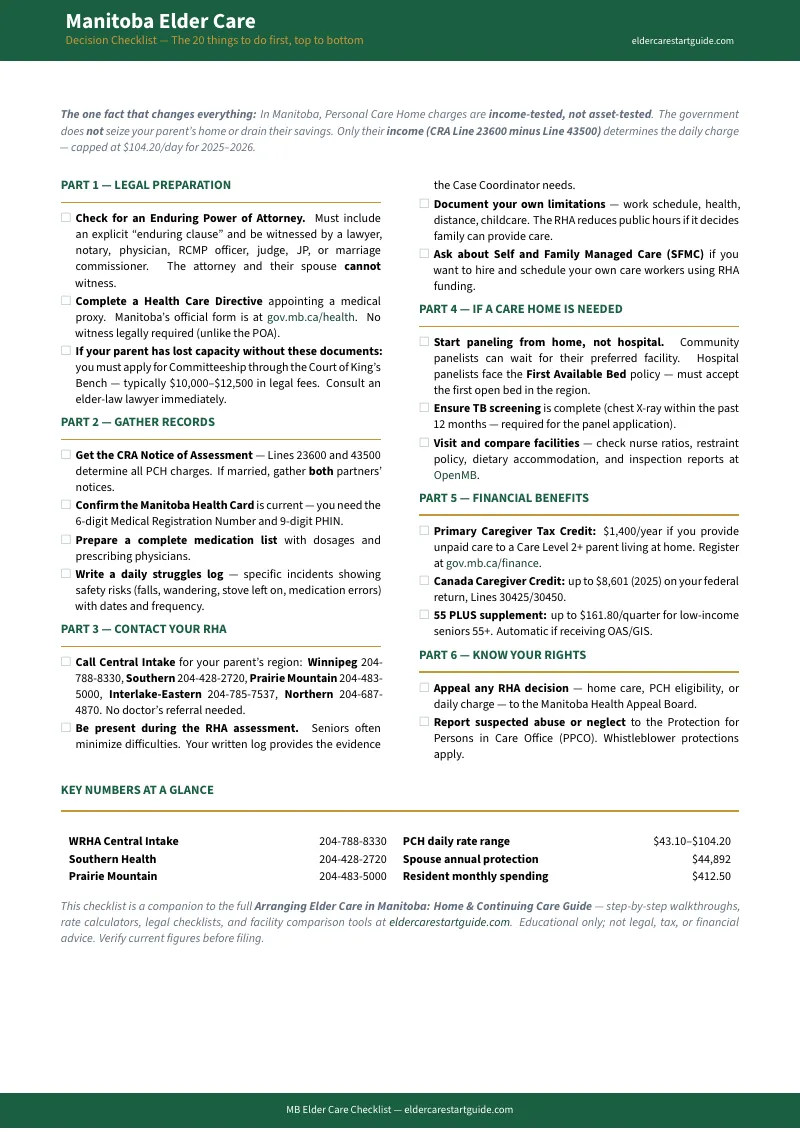
Download the free one-page checklist to see the framework, or get the full guide with all 13 chapters plus 9 standalone printable tools — the RHA Assessment Preparation Kit, Home Care vs. PCH Decision Framework, First Available Bed Decision Tree, Daily Charge Calculator, Legal Authority Checklist, Appeal Guide, Care Coordinator Scripts, Caregiver Tax Credits Reference, and Facility Selection Worksheet — covering every step from the first RHA intake call through PCH admission and legal preparation.