
The BC Long-Term Care Financial Navigation System — Every Rate, Formula, and Spousal Protection Strategy in One Manual
Your parent's hospital team just flagged them as Alternate Level of Care. A case coordinator is pushing for discharge. Somewhere in the conversation, someone mentioned that subsidized care costs "up to 80% of income" — but nobody explained whose income, which income line, or what happens to the spouse still living at home.
You went to the provincial website and found fragments: a fee schedule here, a regulation reference there, a brochure that mentions "income testing" without showing the actual formula. You called the health authority and waited 45 minutes for a callback that raised more questions than it answered. Meanwhile, the hospital's 30-day cooperation window is shrinking, and you're one refused bed offer away from uninsured ward rates exceeding $1,500 a day.
The British Columbia Long-Term Care Costs & Subsidies Guide is a complete financial navigation system for the adult child standing in the middle of this. It pulls together the provincial rate structure, the income-testing formulas, the spousal protection strategies, the legal authority gaps, and the waitlist tactics that are scattered across dozens of government PDFs, health authority portals, and legal non-profit websites — and organizes them into the sequence you actually need them.
What's Inside
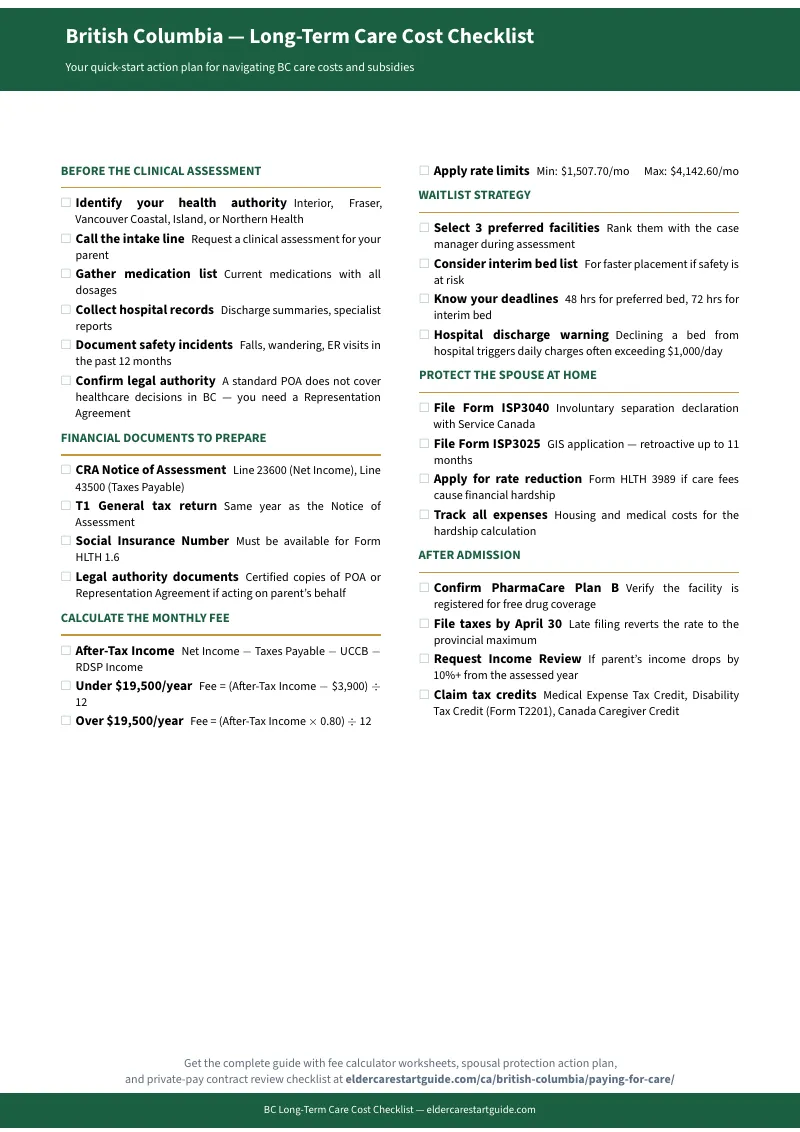
The Provincial Rate Structure — $1,507.70 to $4,142.60 Per Month
The full subsidized rate range for publicly funded residential care, with real-world calculations showing what families at $25,000, $50,000, and $80,000 annual income actually pay. How this compares to private-pay facilities charging $6,000 to $12,000+ per month during the 287-day average wait for a subsidized bed. What the rate covers (24-hour nursing, meals, housekeeping) and what it does not (cable, personal items, premium medications).
The 80% After-Tax Income Formula — Decoded
The two mathematical formulas the province uses to calculate your parent's monthly client rate, both tied to Line 23600 on the CRA Notice of Assessment. Formula A for net income under approximately $19,500. Formula B for those above. The guide walks through both with worked examples — because the difference between understanding this formula and not understanding it can be thousands of dollars per year in overpayment.
The Capital Gains Trap
BC's system is entirely asset-blind — the family home, bank accounts, and investments are exempt. But selling a rental property or cottage triggers a taxable capital gain on Line 23600, and that single spike can push the monthly fee to the $4,142.60 provincial cap for the entire following year. The guide shows how to see it coming and time the decision so the tax year works in your favour.
Spousal Involuntary Separation — The GIS Unlock
When one spouse enters care and the other stays in the community, the family faces a severe income imbalance. The Involuntary Separation provision under the Old Age Security Act lets the couple be assessed as single individuals for federal pension purposes — often unlocking the Guaranteed Income Supplement or increasing existing payments by hundreds of dollars monthly. Step-by-step instructions for filing.
Home Care Daily Rate Formula
The 0.00138889 multiplier buried in the Continuing Care Fees Regulation, converted into plain-language calculations. The $300 monthly cap for earned-income households. When annual home care costs (median: approximately $15,081) start to rival a subsidized bed — the crossover point most families miss.
The First-Appropriate-Bed Policy
BC mandates families accept the first vacancy within the health authority, often with only 24 to 48 hours' notice. How to state preferences while staying compliant, what happens if you refuse, and the risk of waitlist deprioritization if you opt for a private-pay bridge.
Representation Agreements — The Legal Gap Most Families Miss
A standard Power of Attorney has zero authority over healthcare decisions under BC law. The guide covers Section 7 and Section 9 Representation Agreements under the Representation Agreement Act, the witnessing requirements, and the critical window to execute an RA7 before cognitive decline closes it — saving the family from an expensive, adversarial Committeeship application.
The Temporary Rate Reduction (Hardship Waiver)
When the calculated client rate creates serious financial hardship, the province offers a temporary reduction. Eligibility criteria, documentation requirements, and how to frame the application so it addresses the health authority's definition of hardship directly.
Tax Credits That Offset Care Costs
How to optimize the Medical Expense Tax Credit (METC) alongside the Disability Tax Credit (DTC). When to claim 100% of nursing home fees versus splitting the DTC and attendant care deductions. Federal pension adjustments that reduce taxable income before the province runs its calculation.
Who This Is For
- The adult child in a hospital-discharge crisis — your parent is flagged ALC and the health authority's cooperation window is shrinking. You need the sequential roadmap: clinical assessment, financial application, bed response — before uninsured ward rates kick in.
- The family watching home care costs climb — your parent's daily home support fees are approaching the cost of a subsidized facility bed, and you need to understand when the crossover happens and how to start the placement process.
- The spouse worried about being left with nothing — one parent is entering care and the other still has a household to run. You need the Involuntary Separation process, the rate reduction application, and the pension coordination strategy.
- The pre-crisis planner — your parent isn't in crisis yet, but you want to structure tax filings, execute a Representation Agreement, and understand the system before a hospital admission forces you to learn it under pressure.
- The sibling coordinating from out of province — you live away and need to know which health authority covers your parent's area, which documents to gather, and which deadlines matter — without flying to BC to piece it together.
Why Not Free Government Resources?
BC's health authorities, the Office of the Seniors Advocate, and legal non-profits like Nidus all publish useful information. The problem is that it is fragmented across dozens of portals — and none of them connect the dots between the healthcare pathway, the financial formula, the legal authority requirements, and the tax optimization strategies.
A hospital social worker manages the immediate clinical placement — but is institutionally restricted from advising on asset preservation, tax deductions, or the Involuntary Separation filing. An elder law lawyer handles the Representation Agreement — at $350 to $600 per hour — but does not assist with health authority waitlist management or home care rate calculations. A CPA optimizes your tax return — but has no idea how the Continuing Care Fees Regulation works.
This guide integrates all three systems — healthcare, legal, and financial — into one manual. For , you get the playbook that would cost $1,500+ to assemble from three separate professionals.
100% Satisfaction Guarantee
If the guide does not help you understand and navigate BC's long-term care cost system, email [email protected] for a full refund. No forms, no waiting period.
Get Started Now
Download the free BC Long-Term Care Cost Checklist for a one-page overview of the most critical rates, deadlines, and action items. Ready for the complete system? Get the full guide — instant download, 9 printable PDFs including standalone worksheets (Fee Calculator, Spousal Protection Action Plan, Private-Pay Contract Checklist, Health Authority Contacts, Forms Directory, Admission Checklist, Financial Disclosure Document Checklist), and every formula you need before your next call to the health authority.