
Your parent is in a hospital bed. Three institutions need three different documents — and you have none of them.
The bank wants an Enduring Power of Attorney before it will discuss your parent's accounts. The hospital wants a Representation Agreement before it will let you consent to surgery. The health authority wants a CRA Notice of Assessment before it will calculate the subsidized care co-pay — and without it, they are charging the maximum rate of $4,142.60 per month.
British Columbia does not have a single "power of attorney" that covers everything. The province splits decision-making authority across three separate statutes, each with its own document, its own capacity threshold, and its own execution rules. An Enduring Power of Attorney under the Power of Attorney Act handles finances. A Representation Agreement under the Representation Agreement Act handles healthcare. An Advance Directive under the Health Care (Consent) and Care Facility (Admission) Act records treatment preferences. Miss one, and you are locked out of the exact institution you need most.
The BC Authority Navigator — every document, every pathway, every institutional obstacle in one sequential plan
The British Columbia Power of Attorney & Personal Directive Kit does not hand you a stack of blank forms and wish you luck. It is a 12-chapter implementation guide that walks through every legal instrument, every subsidized care formula, and every institutional barrier in the order you will actually face them — from the first capacity conversation through bank acceptance and care facility admission.
Free resources like Nidus and People's Law School are excellent at explaining what a Representation Agreement is. They do not tell you how to get the bank to accept your Enduring Power of Attorney when the compliance department rejects it, how to restructure income-splitting arrangements after your parent enters care, or what to do when the hospital assigns a Temporary Substitute Decision Maker and your siblings cannot agree.
What's inside
The Enduring Power of Attorney — financial authority that survives incapacity
The EPOA is the instrument that gives a designated attorney authority over banking, investments, taxes, and real estate — but only if the document includes an explicit "enduring" clause and meets the six-part capacity threshold under Section 12 of the Power of Attorney Act. The guide covers the witnessing requirements for the Land Title and Survey Authority, the Section 56(1) exclusion clause for property transactions, and Nidus Registry registration — plus what happens if your parent signs a standard (non-enduring) power of attorney that terminates the moment they lose capacity.
Section 9 vs Section 7 Representation Agreements — the document the hospital actually needs
BC does not use "healthcare proxies." A Section 9 agreement grants broad authority over major healthcare, end-of-life decisions, and care facility placement, but requires traditional cognitive capacity to sign. A Section 7 agreement uses an inclusive capacity standard designed for adults whose cognition is already declining — it covers routine banking, bill payments, and most healthcare decisions, but cannot authorize end-of-life choices or real estate transactions. The guide includes a detailed comparison table, a decision tree for choosing the right agreement, and the exact witnessing and execution requirements for each.
When capacity is already gone — the emergency pathways
If your parent has already lost the ability to sign a standard power of attorney, the guide walks through three paths: the Section 7 Representation Agreement's inclusive capacity standard (which may still be available for moderate cognitive decline), the Temporary Substitute Decision Maker hierarchy (a statutory ranked list where all adult children are equal and sibling disagreements escalate to the Public Guardian and Trustee), and the Supreme Court committeeship process under the Patients Property Act (two medical affidavits, a $525 PGT review fee, and months of court-supervised proceedings).
The subsidized care co-pay formulas — what your parent actually pays
BC calculates subsidized long-term care at 80% of after-tax income (2026 range: $1,507.70 to $4,142.60/month). Assisted living uses 70% of after-tax income (minimum $1,070.90). The guide walks through both formulas with worked financial examples, explains the CRA Notice of Assessment requirement, covers what happens when the Notice is missing (the health authority charges the maximum), and shows how income-splitting arrangements change after a parent enters care.
Bank pushback — why they reject valid documents and how to escalate
Banks routinely refuse valid Enduring Powers of Attorney citing "stale" documents, demands for proprietary forms, joint-attorney logistical traps, and retroactive capacity proof. The guide details the five most common rejection triggers and provides a step-by-step escalation protocol — from the branch level through the bank's estate services department to the Ombudsman for Banking Services and Investments.
Waitlists, respite, and interim solutions
The provincial average wait for a subsidized long-term care bed is 131 days overall and can reach 284 days for non-urgent community admissions. The guide covers the interim bed list, respite care options, the Choice of Facility process, and private-pay bridge arrangements that can cost $10,000 to $12,000 per month while you wait.
Plus: standalone planning worksheets
Nine printable, fill-in-by-hand worksheets — a capacity assessment preparation worksheet, an EPOA pre-registration checklist, an RA selection decision guide, a TSDM identification worksheet, a subsidized care rate calculator for both formulas, a TRR documentation checklist, a bank escalation script with statutory references, a CSIL employer responsibilities tracker, and an agency communication log.
Who this is for
- Families acting before capacity is lost — your parent can still sign, and you need all three instruments (EPOA, Representation Agreement, Advance Directive) executed correctly the first time, before the window closes.
- Caregivers locked out of institutions — the bank will not discuss accounts, the hospital will not share records, and the health authority is charging the maximum care rate while you search for missing paperwork.
- Families facing a capacity crisis — your parent can no longer sign a standard power of attorney, and you need to understand the Section 7 pathway, the TSDM hierarchy, or the committeeship application process.
- Siblings navigating disagreements — the family cannot agree on who should have authority, and you need to understand how the court evaluates suitability and when the PGT steps in.
- Long-distance children — you are in another province and need to set up legal authority for a parent in British Columbia, including which documents require physical presence and how to verify authority remotely through the Nidus Registry.
Why not the free resources?
Nidus provides free Representation Agreement forms (RA7 and RA9) — but explicitly does not provide Enduring Power of Attorney forms, forcing you to a notary or lawyer for your parent's financial authority. People's Law School publishes clear, readable guides — but does not package them into a single sequential plan you can follow from start to finish. LawDepot generates generic, national templates that often miss BC-specific statutory requirements like the Section 7 inclusive capability standards. And notaries charge $1,075 to $1,700 for a complete planning package that requires in-person appointments — introducing days or weeks of delay during an active care crisis.
This kit fills the gap between "we explain the law" and "we charge $1,200 to execute it." Every instrument, every formula, every institutional escalation path — organized in the order you will face them, with the worksheets to act on each one immediately.
Full refund, no time limit
If this kit does not give you the clarity you need, email [email protected] for a full refund. No time limit, no questions about why.
Get the kit and stop guessing which document the bank needs
The British Columbia Power of Attorney & Personal Directive Kit — — gives you every BC-specific instrument, every care formula, and every institutional escalation path in one sequential plan. Instant download. Printable PDF. Start with the decision tree tonight.
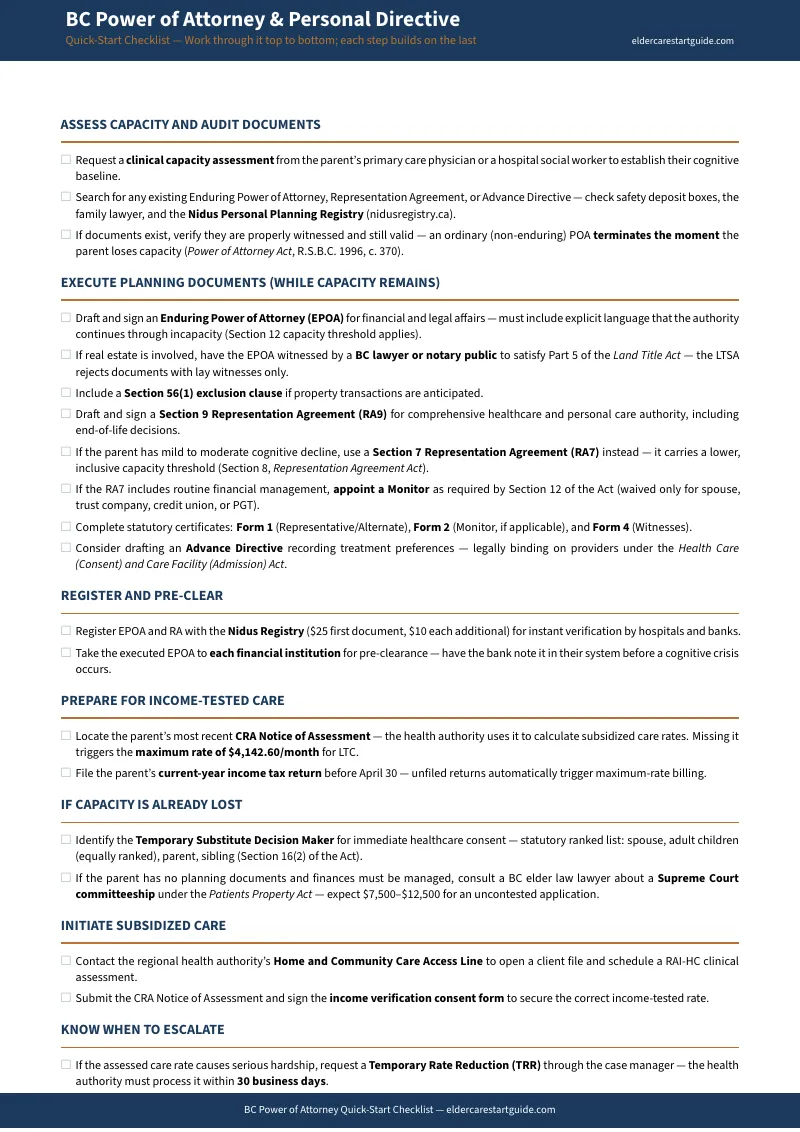
Not ready for the full guide? Download the free British Columbia — Power of Attorney Quick-Start Checklist and start with the essentials.