
The Hospital Just Called — Now What?
Your parent is being discharged. Or the home care aide didn't show up again. Or you just realized that nobody in the family has the legal authority to talk to the bank, the doctor, or the health authority on your parent's behalf — and the system doesn't care that you're their child.
British Columbia's continuing care system is publicly funded and income-tested, which makes it one of the better systems in the country — if you know how to use it. The problem is that the rules are buried across five separate health authority websites, dense policy manuals, and PDFs that haven't been updated since the last rate change. Free information exists. It's scattered, technical, and organized by bureaucratic department rather than by what you actually need to do next.
The BC Continuing Care Navigator
This is the complete process guide for adult children arranging care for an aging parent in British Columbia. Not a brochure. Not a directory. A step-by-step navigation system that follows the order you'll actually encounter these decisions — from the first call to your regional health authority through facility placement and everything the provincial system throws at you in between.
It covers all five regional health authorities (Vancouver Coastal, Fraser, Island, Interior, Northern), the income-testing formulas the Ministry of Health uses to calculate what your parent pays, the legal divide between Enduring Power of Attorney and Representation Agreements, hospital discharge rules and your rights when you're being pressured, and the complaint escalation pipeline when the system fails.
What's Inside
- The Complete Intake-to-Placement Roadmap — how to get your parent into the system without a doctor's referral, what the case manager's clinical assessment measures, and how to prepare so the assessment reflects your parent's worst days, not their best
- Income-Testing Decoded — the two subsidy formulas for long-term care, the daily rate calculation for home support, the $300 earned-income cap, the GIS exemption, and the "involuntary separation" filing that can save a community-dwelling spouse thousands per year
- Legal Authority Chapter — the strict BC divide between financial authority (Enduring Power of Attorney) and healthcare authority (Representation Agreements Section 7 and Section 9), the capacity threshold that determines which type your parent can still sign, and what happens when no documents exist and the Temporary Substitute Decision Maker hierarchy kicks in
- Hospital Discharge Survival Guide — what "Alternate Level of Care" means, the daily uninsured ward fees the hospital can charge, the "first appropriate bed" policy, and the specific questions to ask a discharge planner before agreeing to anything
- Facility Evaluation Framework — how to compare subsidized care homes using the province's own inspection reports, what to look for during a tour, and how the preferred-facility selection policy works (you can select up to three homes and remain on the transfer list if you accept an interim bed)
- Respite and Caregiver Relief — subsidized short-stay respite beds at a flat daily rate (no income test), adult day programs, and how to access the CSIL program to hire your own care providers instead of using health authority staff
- Tax Credits You're Probably Missing — the Canada Caregiver Credit, Disability Tax Credit, and Medical Expense Tax Credit as they apply to continuing care costs in BC
- Complaint and Escalation Pipeline — the four-step process from case manager through Patient Care Quality Office, Patient Care Quality Review Board, and the BC Ombudsperson, with the 40-business-day response requirement at each stage
Who This Is For
- Adult children whose parent has had a fall, a hospitalization, or worsening cognitive decline — and who need to understand what the BC system offers before the next crisis forces a decision under pressure
- Families dealing with a hospital discharge timeline where the social worker is pushing for bed acceptance and daily charges are mounting
- Caregivers providing unpaid home support who have reached a breaking point and need to know how to access subsidized services or transition to facility care
- Out-of-province family members coordinating care remotely across one or more health authority regions
- Anyone trying to sort out whether their parent needs an Enduring Power of Attorney, a Representation Agreement, or both — and what happens if they can no longer sign documents
Why Not Free Resources?
Health authority websites are the definitive source for their own regional policies. But they're written in policy-manual language, organized by department, and fragmented across dozens of PDFs that assume you already know what you're looking for.
Legal non-profits like Nidus and Clicklaw provide excellent Representation Agreement templates — but they don't cover facility placement, waitlist navigation, or financial planning.
Commercial placement directories like A Place for Mom and BCCareHomes earn referral commissions from private-pay facilities. They have no reason to mention subsidized home support, the CSIL self-directed care program, or how to get onto the public long-term care waitlist.
Private care managers and elder law attorneys charge upward of $150 per hour. Many families need the information, not the ongoing professional relationship.
This guide consolidates the entire process — legal, financial, clinical, and administrative — into a single path with no referral relationships, no commission bias, and no bureaucratic language. Every dollar figure is sourced from current provincial regulations, not estimated.
Your Purchase Is Risk-Free
Full refund, no time limit. If the guide doesn't help you navigate your parent's care situation, email [email protected] and you'll get your money back. No forms, no conditions.
Get the Free Checklist First
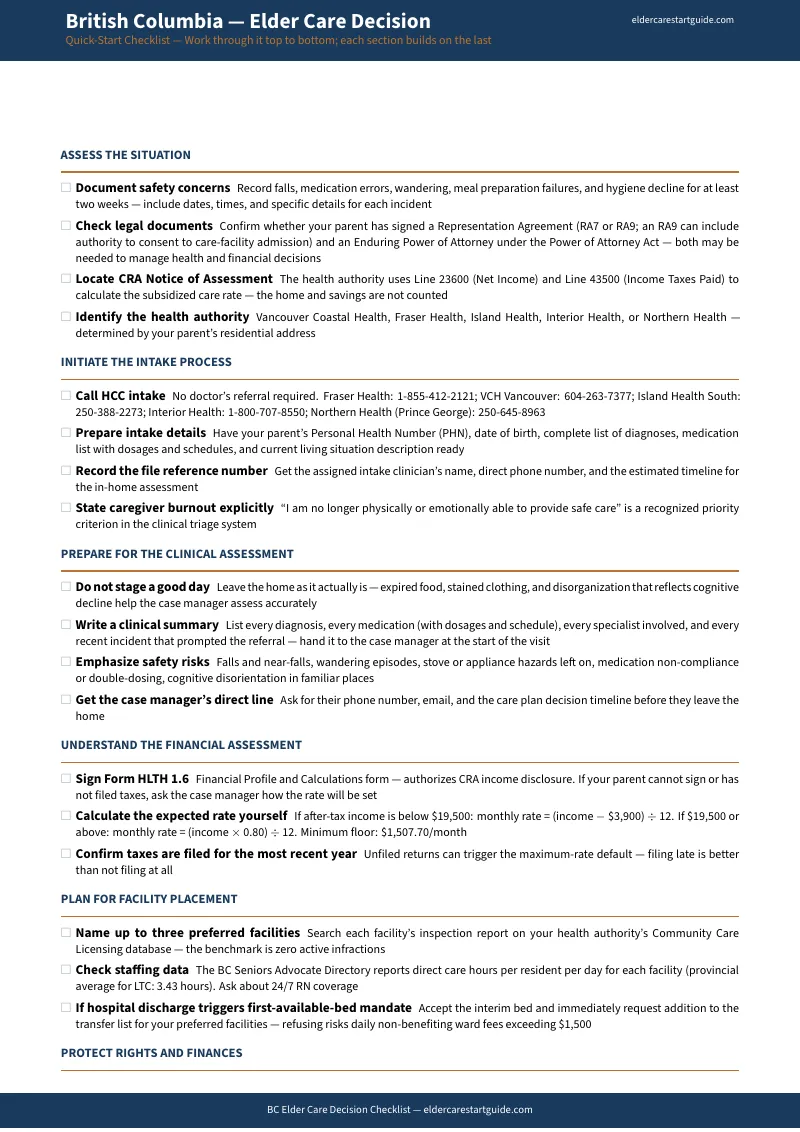
Not sure yet? Download the free BC Elder Care Decision Checklist — a 23-item action list covering the first steps in the continuing care system. If the checklist gives you what you need, great. If you want the full roadmap, worksheets, and legal authority breakdown, the complete guide picks up where the checklist leaves off.
Get the Complete Guide
The full BC Home & Continuing Care Guide — 13 chapters, income-testing calculators, facility comparison worksheets, and the legal authority framework — for . Delivered as PDF downloads immediately after purchase.