The hospital says your parent is ready for discharge. You have 24 hours to pick a care home — and no idea what it will cost.
Your parent fell. Or had a stroke. Or the dementia got worse overnight. Now the hospital social worker is handing you pamphlets about "continuing care options" and telling you to choose a facility — fast.
You Google "long-term care costs Alberta" and get fragments. A government PDF that hasn't been updated since the 2024 Continuing Care Act rewrote the rules. A directory that only lists private facilities charging $7,000/month. A Reddit thread where someone says the province can take your parent's house (they can't).
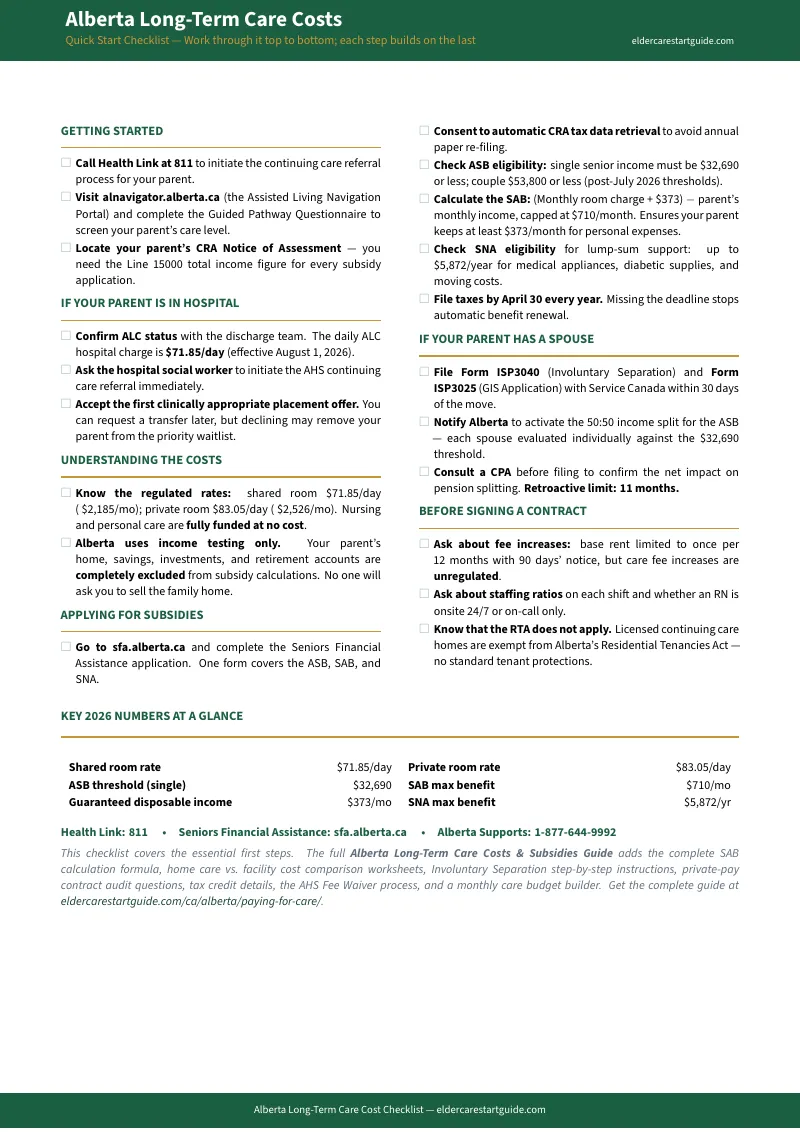
Meanwhile, the hospital is billing an Alternate Level of Care charge of $70.60 per day while your parent waits. Refuse their placement offer, and that number can jump to $2,000/day for the acute care bed.
You don't need more information scattered across six government ministries. You need a step-by-step financial plan that tells you what your parent will actually pay, what Alberta will cover, and what you need to file — in the order you need to file it.
The Alberta Care Cost Navigator
This is the guide that turns Alberta's continuing care system from an opaque bureaucracy into a financial plan you can act on. It covers every cost your family will face — from regulated accommodation charges to home care alternatives to private-pay facilities — and gives you the worksheets to calculate your parent's specific numbers.
Most families don't realize that Alberta's public care system is income-tested, not asset-tested. Your parent's home, savings, and investments are completely excluded from the accommodation charge calculation. The guide shows you exactly how that works, then walks you through every subsidy and benefit your parent may qualify for — including strategies (like the Involuntary Separation declaration) that case managers rarely mention.
What You Get
- Current 2026/2027 regulated rates with the August 1 increase — the exact daily and monthly caps for shared rooms, private rooms, and suites in Type A and Type B facilities, so you can stop guessing and start budgeting
- The SAB calculation worksheet — enter your parent's Line 15000 income and calculate their Supplementary Accommodation Benefit to the dollar, including the $373/month guaranteed disposable income floor
- The Involuntary Separation playbook — when one spouse enters care, this federal declaration can increase the remaining spouse's GIS by hundreds per month; the guide gives you the exact forms (ISP3040 and ISP3025) and the provincial notification steps most families miss
- Home care cost reality check — AHS basic home care is free, but there are hidden costs; learn about Client-Directed Home Care Invoicing and Self-Managed Care so you can compare facility placement against staying at home with real numbers
- 25-question contract audit checklist — the 2024 Continuing Care Act removed the historical minimum staffing requirement of 1.9 hours per resident per day; this checklist tells you exactly what to verify before signing any care agreement
- The 2026 tax credit breakdown — the province consolidated the caregiver and infirm dependent credits into the new Alberta Caregiver Credit (eliminating eligibility for 16,500 families); know whether you still qualify and how to stack it with the federal Canada Caregiver Credit and Disability Tax Credit
- AHS Fee Waiver application guide — if your parent faces genuine financial hardship, there is a waiver process, but the application must reach AHS Collections within 75 days; the guide tells you what to document and how to submit
- Monthly care budget worksheet — map every income source (CPP, OAS, GIS, private pension, Alberta Seniors Benefit) against every expense to see the monthly shortfall or surplus before your parent moves
Who This Is For
You're an adult child in Alberta — or you have a parent in Alberta — and you're dealing with one of these situations:
- Your parent is in hospital and the discharge team is pressuring you to accept a continuing care placement within hours
- You've been managing home care for months or years and you need to know what facility care will actually cost before the transition becomes an emergency
- Your parent's income is modest and you want to maximize every provincial benefit — SAB, Alberta Seniors Benefit, Special Needs Assistance — but you can't figure out how they interact
- You and your siblings are trying to plan ahead while your parent still has capacity, and you need the financial picture in one place to avoid family conflict later
Why Not Just Use the Free Government Information?
Alberta Health Services and the Government of Alberta publish the rules. They do not publish a plan.
Government sites are designed to explain policy. They present accommodation charge tables on one page, subsidy eligibility criteria on another, and tax credit rules on a third — spread across Seniors, Community and Social Services, AHS, and the CRA. They don't tell you what to do first, what forms to hold back, how to time your applications, or how to verify that your parent's billing is correct.
This guide takes those hundreds of pages of bureaucratic policy and puts them in the order a family actually needs them — starting from "what will my parent pay?" and ending with "how do I build a budget that accounts for everything?"
It also covers strategies that public case managers are neutral on. The Involuntary Separation declaration. Pension income splitting to reduce the assessed amount. The first-time exception for income estimates. The fact that Alberta's assessment is income-only (while most families assume assets are at risk because of American Medicaid rules they've seen online).
Not a Replacement for Professional Advice
If your parent's situation involves complex trusteeship, contested guardianship, or estate litigation, you need an elder-law attorney. This guide does not replace legal counsel.
What it does is ensure you walk into that lawyer's office — or that AHS case manager meeting — fully prepared. With your parent's income documented, their benefit eligibility calculated, their contract questions ready, and their monthly budget projected. You'll complete in one prepared meeting what would otherwise take three or four sessions of expensive back-and-forth.
— Less Than One Hour of Professional Consultation
Elder-law attorneys in Alberta charge $195 to $500 per hour. Private eldercare planners charge thousands. This guide gives you the preparation framework to cut those billable hours down — and for families navigating the public system without professional help, it's the step-by-step plan that Alberta's government sites don't provide.
Includes the complete 15-chapter guide plus 10 standalone printable PDFs — the SAB Calculation Worksheet, Involuntary Separation Playbook, 25-Question Contract Audit, Home Care vs. Facility Cost Comparison, Monthly Care Budget Worksheet, Tax Credit Navigator, Regulated Rate Tables, AHS Fee Waiver Guide, Subsidy Application Checklist, and Essential Contacts & Forms reference card — plus the Alberta Care Cost Checklist you can print and work through tonight.