
Your parent needs care. Alberta's system expects you to already know how it works. You don't — and you have days, not months.
It usually starts with a hospital bed. Your parent fell, or stopped eating, or wandered out of the house in January. The discharge planner says "ALC" and "interRAI" and hands you a pamphlet. Within 48 hours you're expected to evaluate facility offers, understand accommodation charges, and navigate a care system that was completely restructured in April 2024. The old rules your parent's doctor still uses — "nursing home," "designated supportive living" — aren't even the correct terminology anymore.
Most families learn the rules in the wrong order. They agree to a placement they haven't toured, discover ALC charges of $71.85 a day after they've already accumulated, or spend $2,000 on a guardianship application because nobody mentioned the $225–$300 lawyer-drafted Personal Directive and Power of Attorney that would have covered everything — if they had been signed six months earlier.
The Alberta Care Transition System
This guide works the way Alberta's care system actually works under the 2024 Continuing Care Act: assessment first, care options second, financial and legal protections third. It's not a pile of government brochures restated in friendlier language — it's a sequenced playbook, current to August 2026 rates and policies, that tells you what to call this week, what to bring to the assessment, and what to verify before signing anything.
What's Inside
- The 811 Intake and interRAI Assessment Playbook — exactly how to start the process (no physician referral required), what the case manager evaluates using the CPS and MAPLe scoring tools, and the preparation checklist that ensures the assessor sees your parent's worst days, not the brave-face performance they give visitors.
- The Home Care Funding Chapter — everything the province funds at zero cost (nursing, physio, personal care), the CDHCI program that lets you choose your own private agency at the funded rate of $34.03/hour billed directly to Blue Cross, and the self-managed care option for families who want direct control.
- The Facility Placement Decision Framework — the five care categories decoded (Type A, Type B, Type B Secure Spaces, Type C, plus Seniors Lodges), how the waitlist actually works, the 48-hour decision window for facility offers, and the touring checklist so you evaluate a home on staffing ratios and compliance history, not just the lobby.
- The Hospital Discharge Pressure System — ALC designation explained, the daily charges ($71.85 as of August 2026), your parent's rights against premature discharge, and a worked example showing how charges accumulate during a transition delay. Because the hospital's urgency is not the same as your parent's best interest.
- The Financial Protection Module — government-set accommodation rates (shared: ~$2,155/month; private: ~$2,491/month), the disposable income guarantee that protects at least $373/month, and five provincial and federal support programs: Alberta Seniors Benefit, Special Needs Assistance, SHARP grants and loans, AADL equipment subsidies, and how OAS/GIS interact with provincial care charges.
- The Legal Authority Chapter — Enduring Power of Attorney versus Personal Directive, when to create each, and the AGTA guardianship process when capacity is already gone. Includes the cost comparison ($225–$300 for advance documents versus $2,000–$5,000+ for a court application), the 6-month capacity assessment rule, and the Form 4 requirements.
- The Complaints and Appeals Toolkit — accommodation complaints (site manager → Resident and Family Council → CCLO), clinical complaints (care team → AHS Patient Relations → Patient Concerns Officer → Alberta Ombudsman), and the PPCA mandatory abuse reporting process with direct phone numbers.
Plus 10 printable planning tools you can use this week: the Daily Care Tracking Log, Assessment Preparation Checklist, Facility Tour Checklist, Cost Comparison Worksheet, Benefits Eligibility Worksheet, AGTA Application Tracker, Family Conversation Planner, Complaint Documentation Worksheet, Appeal Letter Template, and Agency Communication Log — each a standalone PDF you print and fill in alongside your parent's documents.
Who It's For
Adult children in Alberta who are suddenly coordinating care for a parent. The daughter who just got the call from the hospital. The son staring at a 48-hour placement offer and wondering if he can even visit the facility before deciding. The sibling in Calgary trying to arrange care for a parent in Lethbridge. The family whose parent is still at home but clearly declining, and who wants to understand the system before a crisis forces them into it.
Why Not Just Use Alberta.ca and Health Link?
Alberta.ca explains each program clearly — on separate pages, in administrative language, in the order the legislation is organized rather than the order events actually hit your family. The government site won't hand you a pre-assessment preparation checklist, a facility comparison worksheet, or an appeal letter template. Health Link will triage your call, but the nurse on the line is not going to walk you through ALC charges, the CDHCI enrollment process, or the difference between a Seniors Lodge and a Type B home.
This guide closes the gap between knowing the system exists and knowing how to work it. Every chapter ends in something you can do, send, or bring to a meeting. And it's honest about the things government resources leave unsaid — that the 2024 Act removed statutory minimum care hours, that facility operators set staffing ratios by funding policy rather than legislative mandate, and that a family who doesn't ask the right questions during a tour won't know what their parent is actually going to receive.
One wrong assumption — that home care isn't free, that a Personal Directive and a Power of Attorney are the same thing, that you have to accept the first placement offer — costs families months of stress and thousands of dollars. The guide costs , less than a single hour of the private home care it's about to help you navigate properly.
Start With the Free Checklist
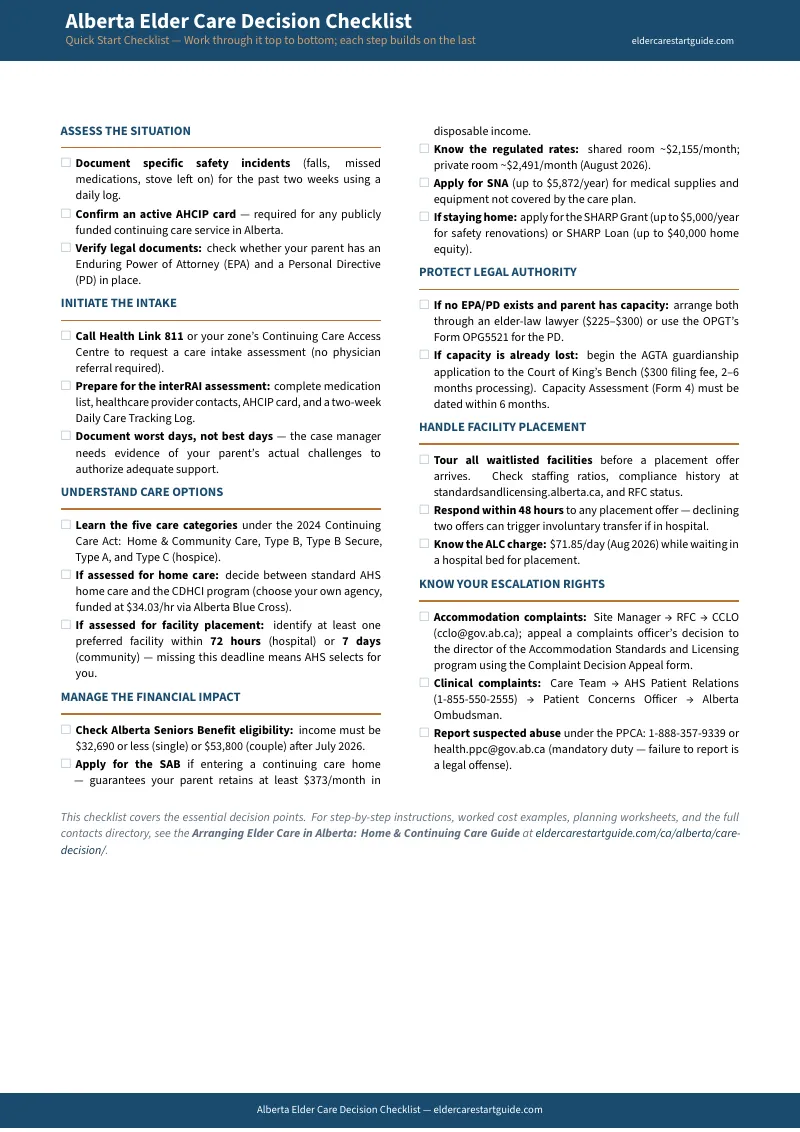
Not sure yet? Download the free Alberta — Elder Care Decision Checklist — 23 items covering every critical decision point, from confirming AHCIP eligibility through understanding the five care categories to knowing your escalation rights. It's the fast version of the same system. When you're ready for the full playbook — worked cost examples, planning worksheets, templates, and the complete guide to every care pathway — the full guide is waiting.
Get the complete Alberta Elder Care Guide now — instant download, printable tools, and a plan you can act on this week.