
Your Parent Needs More Help. South Carolina's System Won't Tell You What to Do Next.
You're sitting in a hospital hallway with 48 hours to figure out where your parent goes. Or you've been watching them decline for months — the falls, the forgotten medications, the bills piling up — and you know something has to change, but every Google search leads to a paid referral service trying to sell you their partner facilities.
South Carolina doesn't even use the term "assisted living" in its licensing code. The facilities you're researching are officially called Community Residential Care Facilities — and if you search the state database for "assisted living," you'll find nothing. The Community Choices waiver has a 15,000-person waitlist. The Medicaid income cap is absolute: one dollar over $2,982/month and your parent is ineligible unless you set up a Miller Trust you've never heard of.
The information exists — scattered across SCDHHS policy manuals, DPH licensing databases, and ten regional ombudsman offices, none of which cross-reference each other or tell you what to do first.
The Care Transition Roadmap — A Decision-Tree System for South Carolina Families
This isn't a generic advice book. It's a decision-tree system built specifically for South Carolina's care regulations. Answer three questions about your parent's functional status and monthly income, and you're guided down the exact state-approved pathway relevant to your family — whether that's private-pay home care, a CRCF placement, or the Medicaid Community Choices waiver.
Every dollar figure, every agency contact, every regulatory reference is current to 2026 — including the July 2024 DHEC-to-DPH restructuring that made every older guide on the internet obsolete.
What's Inside
- ADL-Based Care Level Scoring — objective functional assessment that maps your parent's daily abilities to the right care setting under South Carolina law, not a facility's marketing brochure
- CRCF vs. Nursing Home Decision Matrix — regulatory boundaries under Regulation 61-84, staffing ratios, retention limits, and exactly what clinical decline triggers a mandatory discharge from assisted living
- 2026 Medicaid Eligibility Worksheets — compute your parent's countable assets and income against the $2,982 cap, $2,000 asset limit, and $66,480 CSRA in fifteen minutes instead of fifteen hours on state websites
- Miller Trust Setup Protocol — when a Qualified Income Trust is required, how to structure it, and what the trustee must do monthly to maintain compliance with South Carolina rules
- Community Choices Waiver Roadmap — the CLTC referral process, NFLOC assessment criteria (what they actually test), current waitlist realities, and interim services you can access while waiting
- 48-Hour Hospital Discharge Checklist — the exact paperwork and conversation scripts to prevent your parent from being discharged to an unsafe home environment under time pressure
- Patient Liability Calculator — worksheet to compute your parent's exact monthly obligation to a nursing facility, including the $60 PNA, spousal income transfers, and unreimbursed medical deductions
- DPH Facility Verification Guide — how to pull inspection reports, complaint history, and enforcement actions under the new Department of Public Health system (post-DHEC split), including the March 2026 online complaint portal
- Ombudsman Directory + Filing Instructions — all ten regional offices, the central intake line (1-800-868-9095), and step-by-step instructions for complaints and involuntary discharge appeals
Standalone Worksheets You Can Print Separately
- Care Needs Assessment — ADL/IADL scoring worksheet to bring to your CLTC screening or facility tour
- Financial Snapshot and Lookback Audit — map income, assets, and 60-month transfers before the elder law attorney meeting
- Facility Tour Comparison Scorecard — rate and compare up to three facilities side by side on licensing, cost, and tour impressions
- Care Transition Tracker — phase-by-phase checklist from legal authority through Medicaid approval
- Monthly Cost Comparison — side-by-side cost worksheet for home care, CRCF, and nursing home options
- Crisis Roadmap (First 48 Hours) — one-page emergency protocol for hospital discharge situations
- Essential Contacts Directory — fridge-sheet reference with every state agency, PACE provider, and financial threshold
- Patient Liability Calculator — compute your parent's exact monthly nursing home payment after Medicaid approval
Who This Is For
- Adult children facing a hospital discharge deadline who need a clear sequence of actions — not a reading list
- Families who've been told their parent "can't stay home anymore" and need an objective framework that isn't designed to sell them a facility
- Anyone whose parent's income is near the $2,982 Medicaid cap and needs to understand Miller Trust mechanics before spending assets incorrectly
- Siblings who disagree on what level of care a parent needs and want a neutral, evidence-based assessment tool to align the family
- Families currently paying $5,000+ monthly for private care who need to evaluate whether a CRCF or waiver services could provide equivalent safety at sustainable cost
Why Not Free Resources?
State websites tell you what the laws are. They don't tell you what to do next.
SCDHHS policy manuals run hundreds of pages of legal language. DPH's licensing database doesn't tell you what inspection findings actually mean for your parent's safety. The Area Agency on Aging will call you back in two to six weeks. A Place for Mom will give you three options — all of which pay them a commission equal to your parent's first month's rent.
An elder law attorney costs $300–$500 per hour. A private geriatric care manager runs $150–$250 per hour out of pocket. This guide doesn't replace them — it's the preparation tool that prevents you from paying four figures in billable hours for basic information gathering. Show up with your parent's finances mapped, their functional status scored, and your legal documents organized, and the attorney focuses on strategy from the first minute.
100% Satisfaction Guarantee
If this guide doesn't save you time and confusion navigating South Carolina's elder care system, email us for a full refund. No forms, no hassle, no questions.
Get Started Now
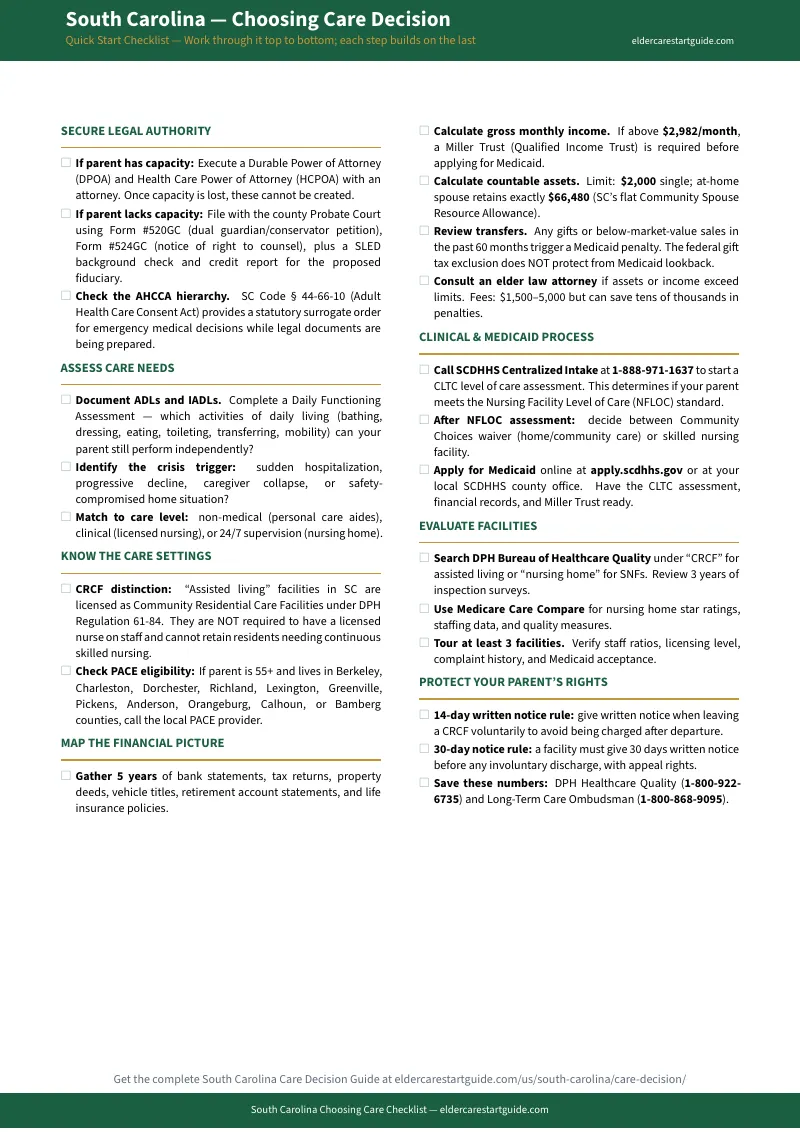
Download the free one-page Care Decision Checklist to see the assessment framework. When you're ready for the full system — worksheets, decision trees, scripts, and every 2026 dollar figure and agency contact — get the complete guide for .