Nebraska Has No Memory Care License — And That Gap Makes Choosing a Facility Dangerous
Your parent's doctor said "moderate-stage dementia." You started searching for memory care in Nebraska, and every facility within driving distance markets a "memory care unit." But here's what none of them volunteer: Nebraska doesn't license "memory care" as a separate category. Any assisted living facility can hang a memory care sign on a locked wing without meeting specialized staffing, training, or medical capability standards beyond the basic ALF license. The state treats memory care and standard assisted living identically in its regulatory framework.
Meanwhile, the financial system that's supposed to help — the Aged and Disabled Waiver — has a $4,000 asset limit, a $1,330/month income cap, and a medically needy spend-down formula that resets every single month. The 2026 proposed spending caps could force high-needs waiver recipients into institutional facilities if their care exceeds $138,657/year. And Nebraska's expanded estate recovery program (LB 268) can reclaim costs from assets that bypass probate entirely — TOD deeds, joint bank accounts, payable-on-death designations — which means the strategies families in other states use to protect a home or savings don't work the same way here.
The Nebraska Dementia Care Navigation System
This guide maps the complete pathway through Nebraska's dementia care system — from immediate safety (wandering prevention, the Endangered Missing Advisory) through legal authority (POA vs. guardianship), home-based services (AD Waiver, DPFS, LRI program, Medicare GUIDE model), facility evaluation, Medicaid financial eligibility, and the appeal process when managed care organizations deny or reduce services. Every dollar figure, agency name, eligibility threshold, and legal citation is specific to Nebraska DHHS, Nebraska Medicaid, and Nebraska county courts.
What separates this from generic "dementia care planning" resources and government websites written for surveyors: it connects the systems Nebraska treats as separate. Your parent's interRAI assessment result, their AD Waiver enrollment slot, the facility's Written Disclosure Statement, and your Medicaid spend-down documentation all interact — and families routinely discover mid-crisis that the ALF memory care wing they chose can't legally provide the nursing services their parent now needs, triggering a forced discharge. This guide shows how these pieces fit together so you can sequence each decision correctly.
What's Inside
- The Complete Guide (14 chapters) — covers everything from Nebraska's unique regulatory landscape through safety protocols, legal authority options, home and community-based services, facility evaluation, Medicaid financial eligibility, spend-down mechanics, appeals, and long-term planning
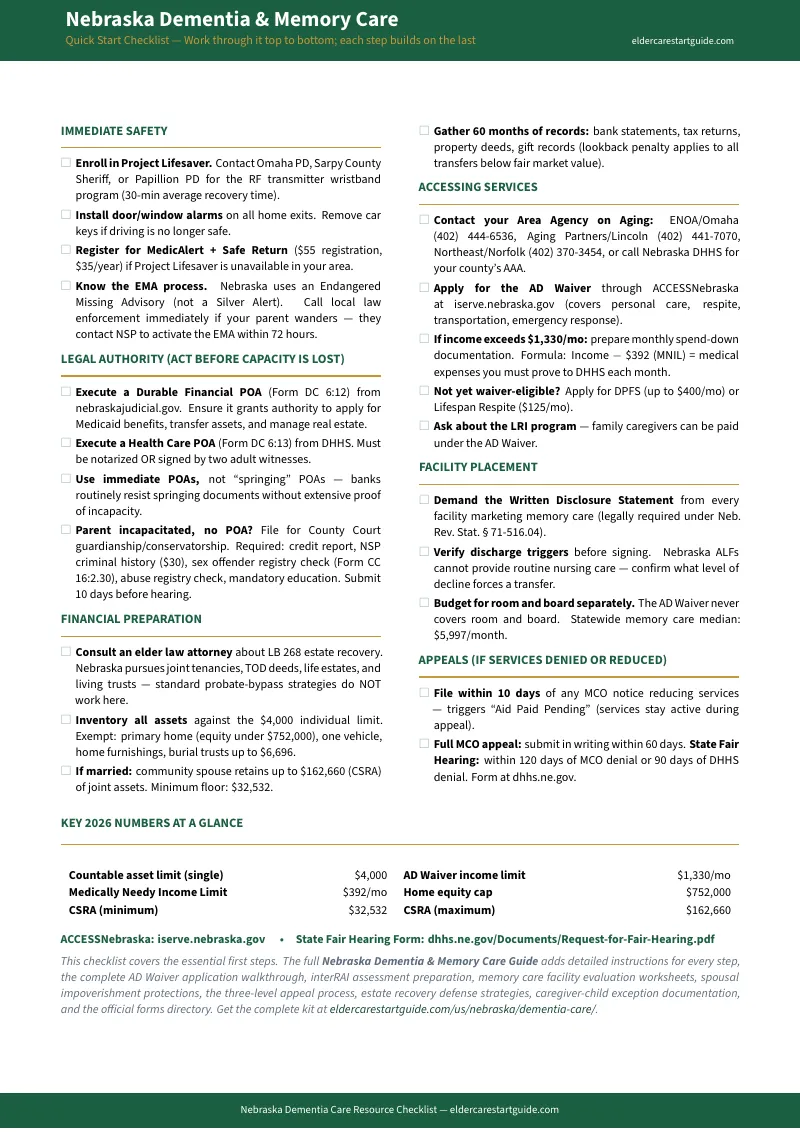
- Nebraska Dementia Care Resource Checklist — a standalone printable checklist covering immediate safety, legal authority, financial planning, accessing services, facility placement, and appeals with every form link, dollar threshold, and agency contact specific to Nebraska
- Memory Care Facility Vetting Checklist — bring this to every facility tour: online verification steps, questions to ask, discharge triggers to confirm, and the Written Disclosure Statement demand
- Medically Needy Spend-Down Worksheet — monthly expense tracker with the formula, qualifying expenses list, and receipt log for your DHHS caseworker
- Essential Contacts Directory — fridge-ready one-pager with all 8 Area Agencies on Aging, state helplines, Heritage Health MCOs, and key financial thresholds
- Legal Authority Decision Tree — one-page flowchart: POA vs. guardianship, costs, required background checks, and ongoing obligations
- Appeal Timeline Quick-Reference — the 10-day/60-day/120-day windows, Heritage Health MCO contacts, and State Fair Hearing form
- Action Timeline by Disease Stage — staged checklist from early diagnosis through facility placement with every Nebraska-specific action item
Who This Is For
- Adult children in Nebraska whose parent has been diagnosed with Alzheimer's or another dementia — and who need to understand what the state actually offers before a crisis forces a rushed decision
- Families trying to figure out if their parent qualifies for the AD Waiver, how the interRAI assessment works, and what happens if your parent's income exceeds the $1,330 cap
- Anyone evaluating "memory care" facilities in Nebraska who needs to know what questions to ask when the state doesn't regulate memory care as a distinct category
- Families navigating the medically needy spend-down who need to understand which expenses count, how to document them, and why Nebraska's one-month reset cycle catches everyone off guard
- Out-of-state adult children coordinating care for a parent in Nebraska who need the full regulatory picture — waiver programs, guardianship filing, estate recovery rules — in one place
- Caregivers who want to know about the Legally Responsible Individual program (get paid through the AD Waiver for care you're already providing) and other supports they didn't know existed
Why Free Resources Leave You Stuck
Nebraska DHHS publishes waiver program descriptions, Medicaid eligibility criteria, and facility licensing rules. But these resources are written in Nebraska Administrative Code for surveyors and caseworkers — not for a family member trying to figure out whether their parent's $1,600/month Social Security income disqualifies them or just requires a different application pathway.
Senior living referral services will match you with memory care facilities for free — because the facilities pay them a percentage of the first month's rent as a referral commission. They have a structural incentive to recommend private-pay communities over Medicaid-funded waiver programs, and they don't help families navigate the AD Waiver application through ACCESSNebraska or understand the interRAI clinical assessment profiles. Their recommendations follow their revenue model.
Elder law attorneys in Nebraska average $256/hour. For complex Medicaid planning — especially with LB 268's expanded estate recovery — professional counsel is essential. But you shouldn't be paying attorney rates to learn the basic difference between the AD Waiver and DPFS program or understand how the spend-down formula works. Using this guide to organize your situation and understand the system before your first consultation can save hours of billable time.
Satisfaction Guarantee
If the guide doesn't help you identify at least one program, eligibility pathway, or facility-vetting step you weren't already aware of, email us for a full refund. No forms, no waiting period.
Start Navigating Nebraska Dementia Care with Confidence
Download the free checklist to get the essential action items and agency contacts — or get the full guide for and have the complete 14-chapter reference covering every program, cost threshold, legal step, and appeal pathway your family needs to navigate Nebraska's dementia care system.