Your parent has dementia and Kansas expects you to navigate three MCOs, a brand-new waitlist, and a licensing system nobody explains.
Your father was found a mile from the house at 2 a.m. by a Sedgwick County deputy. The hospital discharge planner needs a placement decision by Thursday. You just learned that KanCare Medicaid won't pay for room and board in a memory care facility, which means $5,975 to $7,500 a month out of pocket even if Medicaid covers the care itself. Meanwhile you're toggling between the KDADS website, the KanCare portal, and three different MCO member pages — Healthy Blue, Sunflower, UnitedHealthcare — and none of them will tell you what to do first.
You are not overreacting. Kansas scatters the answers you need across a half-dozen state agencies, and the Frail Elderly waiver waitlist that went live on July 6, 2026, just added another layer of complexity that even most social workers haven't fully absorbed yet.
The rules exist. The roadmap doesn't.
KDADS publishes licensing rules. KanCare publishes eligibility thresholds. Maximus conducts the functional assessments. Your MCO coordinates the services. But no single agency hands you the step-by-step sequence that gets your parent safe, your family's assets protected, and you back in control of the timeline. They'll tell you the countable asset limit is $2,000. They won't tell you how to spend down legally without triggering the 60-month lookback penalty. They'll tell you memory care facilities operate "secured special-care sections" under K.A.R. Article 41. They won't hand you a 15-minute tour checklist to separate a genuinely safe unit from a nicely marketed one.
That gap — between the raw regulations and a family's action plan — is where Kansas families lose weeks they don't have and thousands of dollars they can't recover.
Introducing the Kansas Dementia Care Roadmap
This is a 16-chapter process guide, a one-page dementia care resource checklist, and 6 standalone printable worksheets — not another article, not a facility directory, not a referral funnel for a placement agency. It's the exact sequence of decisions, forms, and deadline checklists a Kansas family uses to secure legal authority, navigate KanCare Medicaid financial eligibility, work the Frail Elderly waiver application (including the July 2026 waitlist bypass), vet memory care facilities, coordinate with the right MCO, and protect the family home from estate recovery — without spending thousands on professional retainers you may not need yet.
What's inside — every chapter solves a specific problem
Chapters 1–2: Legal Authority Before Capacity Is Lost
The problem: Once your parent can no longer understand legal documents, you're locked out of their finances and medical decisions — and your only option is a court guardianship under Kansas's 2026 KUGCOPAA overhaul, which can cost $5,000 to $15,000 in legal fees alone.
Covers the Kansas Durable Power of Attorney (healthcare and financial), Advance Health Care Directive, when and how to document capacity during a "lucid interval," and the full guardianship/conservatorship process under the new Uniform Guardianship Act — including court costs, Guardian Ad Litem fees, and ongoing supervision requirements.
Chapter 3: Wandering, Safety, and Silver Alert
The problem: You need a concrete plan for the night your parent leaves the house, not a pamphlet about "keeping seniors safe."
Kansas Silver Alert protocol (no waiting period to file), the Medical Affidavit pre-completion process, door alarm and GPS tracker guidance, medication safety, driving cessation, and how to report suspected exploitation to the Kansas Protection Report Center.
Chapter 4: Memory Care Licensing — What to Look For
The problem: You can't tell the difference between an assisted living facility, a residential health care facility, and a Home Plus residence — and neither can most of the people advising you.
Kansas's three licensed adult care home types decoded. What KDADS inspects, what K.A.R. Article 41 actually requires of secured dementia sections (least-restrictive exit controls, awake staff, dementia-specific training), the Negotiated Service Agreement, and how to look up any facility's deficiency history online.
Chapters 5–6: Medicare vs. KanCare and the Frail Elderly Waiver
The problem: Everyone keeps saying "Medicaid will cover it" but nobody explains that KanCare covers the care services while room and board — $5,975 to $9,064 a month — comes out of your parent's pocket.
What Medicare covers (and doesn't), what KanCare Medicaid covers through each of the three MCOs, 2026 cost benchmarks, the Frail Elderly waiver application pipeline (ADRC Options Counseling, Maximus CARE Level I screening, KDHE financial evaluation), the July 2026 waitlist implementation, and the crisis exception bypass strategy.
Chapters 7–9: Medicaid Eligibility, Application, and PACE
The problem: Your parent's assets are above the $2,000 limit and you've heard the state can "take the house" — but you don't know what's exempt, what's countable, or how the Community Spouse Resource Allowance actually works.
The complete financial eligibility roadmap: countable vs. exempt assets, the $32,532–$162,660 spousal protection, the 60-month lookback, the KanCare Clearinghouse application process (45–90 day timeline), Kansas PACE programs that bypass the FE waiver waitlist (Ascension Living HOPE, Midland Care Connection, Bluestem PACE), and estate recovery rules.
Chapters 10–12: Appeals, Respite, and the Home-vs.-Facility Decision
Fighting MCO denials through internal appeal and State Fair Hearing. K-RAD respite care (up to $1,000/year through your local AAA). The Family Caregiver Support Program. And a decision framework that maps your parent's functional capacity scores against the honest trade-offs of home care versus residential placement — not the version you hear from a facility admissions coordinator.
Chapters 13–16: Contacts, Timeline, and Professional Escalation
The 11 local Area Agency on Aging service regions with contact information. A month-by-month planning timeline. When to hire an elder law attorney versus a Medicaid planner versus a geriatric care manager (and how to walk in prepared so you don't burn $300/hour explaining what KanCare is). Every Kansas-specific phone number, website, and form reference you'll need.
Who this is for
- The adult child suddenly handed a discharge deadline who needs a facility-vetting plan and a Medicaid eligibility check this week
- The burned-out primary caregiver who has hit the wall and needs to understand their options for paid in-home care or residential placement through KanCare
- The proactive planner acting while a parent still has the legal capacity to sign a Power of Attorney and document care wishes
- The out-of-state sibling who needs a single, objective reference to coordinate care decisions across a divided family
Why not just use the free tools?
Free placement services like A Place for Mom? When the service is free, your parent is the product. These directories earn commissions of up to one full month's rent per placement — $3,000 to $8,000 — paid by the facility. They're structurally incentivized to steer you toward expensive private-pay communities. They will not show you how to access Frail Elderly waiver hours, explain the crisis exception to the July 2026 waitlist, or mention that PACE can bypass the waitlist entirely — because those programs divert you away from their paying partners. This guide takes zero commissions and lays out every option.
State websites? KDADS, KanCare, and your county's aging services have the rules — but not the roadmap. No sequencing, no checklists, no step-by-step instructions. You'd be piecing together a Medicaid application, a Maximus assessment, and a facility compliance search across three disconnected portals on your own. The KDADS database lists licensed facilities but won't tell you which ones have a certified secured dementia section or which MCO networks they accept.
An elder law attorney? Essential for complex Medicaid asset protection and guardianship — but at $200–$500 an hour, their clock shouldn't be burned organizing your parent's financial documents and explaining what the Frail Elderly waiver is. Use this guide as a pre-legal preparation kit: walk in with your asset inventory, capacity documentation, and questions already organized, and compress a multi-hour engagement into one efficient consultation.
A fair, simple guarantee
If this guide doesn't give you a clearer, more confident path forward than the free tools you've been fighting with, reply to your receipt within 30 days and we'll refund you in full. No forms, no friction. You're already dealing with enough of both.
Start where you are
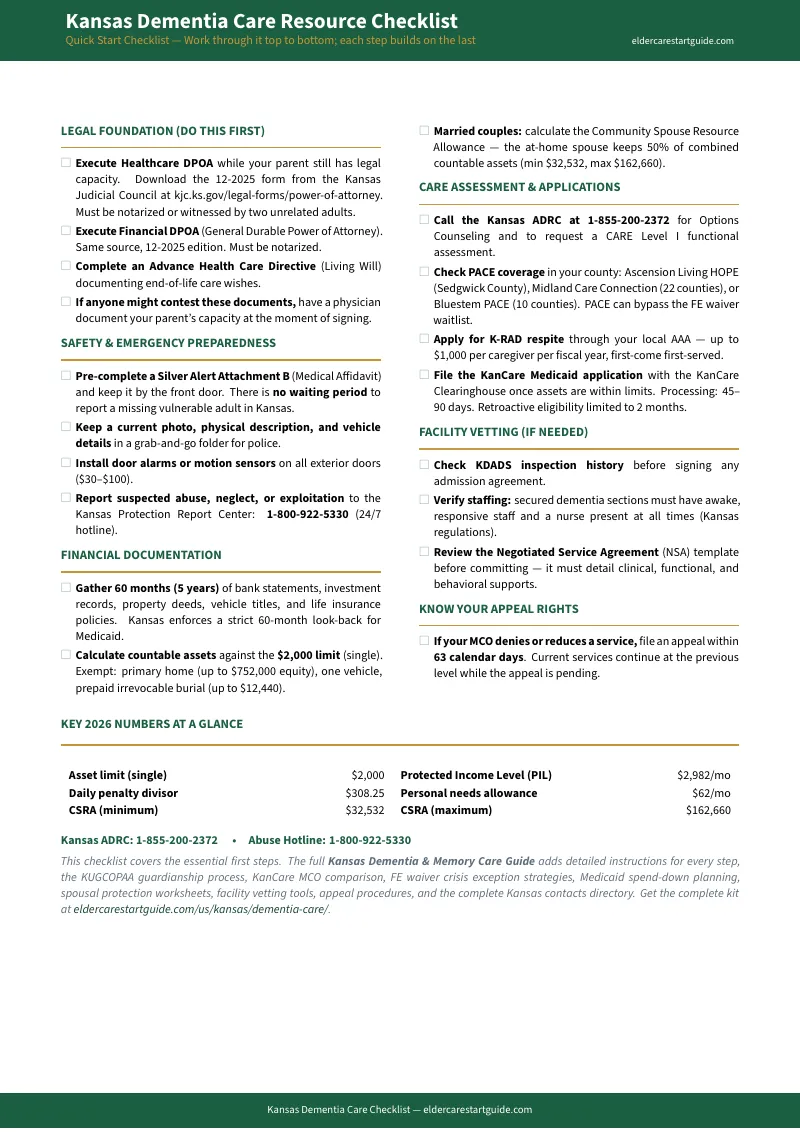
Not ready to buy? Start with the free Kansas Dementia Care Resource Checklist — a one-page map of the state programs, registries, and agencies you'll need. When you're ready to move from "what exists" to "here's exactly how I do it," the full Kansas Dementia Care Roadmap — 16-chapter guide, resource checklist, and 6 standalone printable worksheets — is , less than a single hour of an elder law attorney's time.
Get the guide today and stop losing weeks to a system that was never designed to help you find your way through it.