
Your Parent Needs Help at Home. California Will Pay for a Caregiver — If You Can Navigate the System.
Your parent fell. Or maybe they didn't fall — they just stopped cooking, stopped bathing, left the stove on twice last week. Either way, you're the one who noticed, and now you're the one trying to figure out what to do about it.
You Googled "home care California" and found out there's a program called IHSS that pays family members to provide care. You called the county office and got a voicemail. You found the application form — SOC 295 — but nobody told you what to write on it, how the county social worker scores the assessment, or what to say to get your parent approved for protective supervision hours.
Meanwhile, you priced out private home care. $40 per hour. $9,600 per month for 8 hours a day. Over $115,000 a year. And your parent's savings won't last 12 months at that rate.
The California Home Care Navigation System
This is not a list of eligibility rules you can find on the DHCS website. It is the process around the rules — the part that $475/hour elder law attorneys explain in billable consultations and that county social workers never have time to walk you through.
The guide covers every step from the first hospital discharge to securing state-funded home care, establishing legal authority, qualifying for Medi-Cal under the reinstated 2026 asset limits, choosing between IHSS and waiver programs, funding home modifications, protecting the family home from estate recovery, and managing paid caregivers — organized in the order you will actually need them.
California has a structural advantage most families never learn about: IHSS is a state-mandated entitlement with no waiting list. If your parent qualifies, hours are authorized and care begins. No lottery, no multi-year queue. But qualifying requires documenting functional limitations precisely enough to survive a county assessment, navigating a $130,000 asset limit that didn't exist two years ago, and understanding a look-back period that can trigger penalty periods on transfers you made three years ago.
What's Inside
- 15-Day Crisis Response Framework — Your parent is being discharged and someone just said "you need to arrange care." This section tells you exactly who to call (California Department of Aging: 1-800-510-2020), what to request from the hospital social worker, how to get a clinical assessment, and how to establish legal authority with a Durable Power of Attorney before your parent's capacity declines further.
- IHSS Application Walkthrough — The complete In-Home Supportive Services process in plain language. How to file Form SOC 295, what Form SOC 873 requires from the physician, how the county social worker's Functional Index Ranking determines your parent's authorized hours, and the specific strategies for documenting protective supervision needs when your parent has cognitive impairment. Up to 283 hours per month is available for the highest-need cases.
- Medi-Cal 2026 Asset Rules — The Full Picture — California reinstated Non-MAGI asset limits on January 1, 2026, after the asset-free period that ran through 2025. The guide explains the current $130,000 individual limit, the 2027 cliff when limits may drop to $21,000, what counts as an asset and what's exempt, the look-back period and how transfers trigger penalty periods, and the legitimate spend-down strategies that elder law attorneys charge thousands to explain.
- Waiver Programs Beyond IHSS — When IHSS hours aren't enough, the guide maps every alternative: the Home and Community-Based Alternatives (HCBA) waiver for nursing-facility-level care at home, the Assisted Living Waiver (ALW), the Multipurpose Senior Services Program (MSSP), PACE, and Community-Based Adult Services (CBAS). Each program's eligibility criteria, enrollment caps, waitlist status, and service packages — compared side by side so you know where to apply and in what order.
- Spousal Impoverishment Protections — When one spouse needs Medi-Cal for long-term care, the Community Spouse Resource Allowance protects up to half of the couple's combined countable assets (between $30,828 and $154,140 in 2026). The guide walks through the CSRA, the Minimum Monthly Maintenance Needs Allowance, the 90-day asset transfer window, and the post-eligibility renewal process — so the healthy spouse doesn't lose everything while the other receives care.
- Home Safety Modifications and Funding Sources — A room-by-room safety assessment checklist, plus the funding map: IHSS-related home modifications, the HCBA waiver's environmental accessibility adaptations, USDA Rural Housing Repair Loans, Veterans Affairs HISA grants, and county-level programs through the Area Agency on Aging.
- Consumer-Directed Care — Getting Paid to Provide Care — California allows family members to serve as paid IHSS caregivers. The guide covers the CDSS background check, provider enrollment, Electronic Services Portal timekeeping, workers' compensation requirements, county-specific IHSS wage rates, and how to structure the arrangement to satisfy both Medi-Cal compliance and employment law.
- Estate Recovery Shield — California's Medi-Cal Estate Recovery Program recovers costs from probate assets only. The guide details which ownership structures pass outside probate and are protected (joint tenancy, TOD deeds, beneficiary designations, funded trusts), the AB 2016 simplified routes for deaths on or after April 1, 2025 (a primary residence up to $750,000, plus a separate $208,850 small-estate affidavit for personal property), spousal and caregiver-child exemptions, and the Undue Hardship Waiver process.
- Hiring and Managing Home Care Safely — The complete comparison between hiring through a licensed Home Care Organization (HCO) and hiring an independent caregiver directly. HCO licensing verification through CDSS, the Home Care Aide Registry, background check requirements, employer obligations for independent hires (payroll taxes, workers' compensation, wage and hour compliance), and the California Home Care Services Consumer Protection Act.
- Community Resources Chapter — How to connect with your local Area Agency on Aging, the services they coordinate (Meals on Wheels, transportation, legal assistance, senior centers), California Caregiver Resource Centers for respite care grants and counseling, California Paid Family Leave for up to 8 weeks of partial wage replacement, and Non-Emergency Medical Transportation through Medi-Cal Managed Care.
Plus: 11 Printable Standalone Worksheets and References
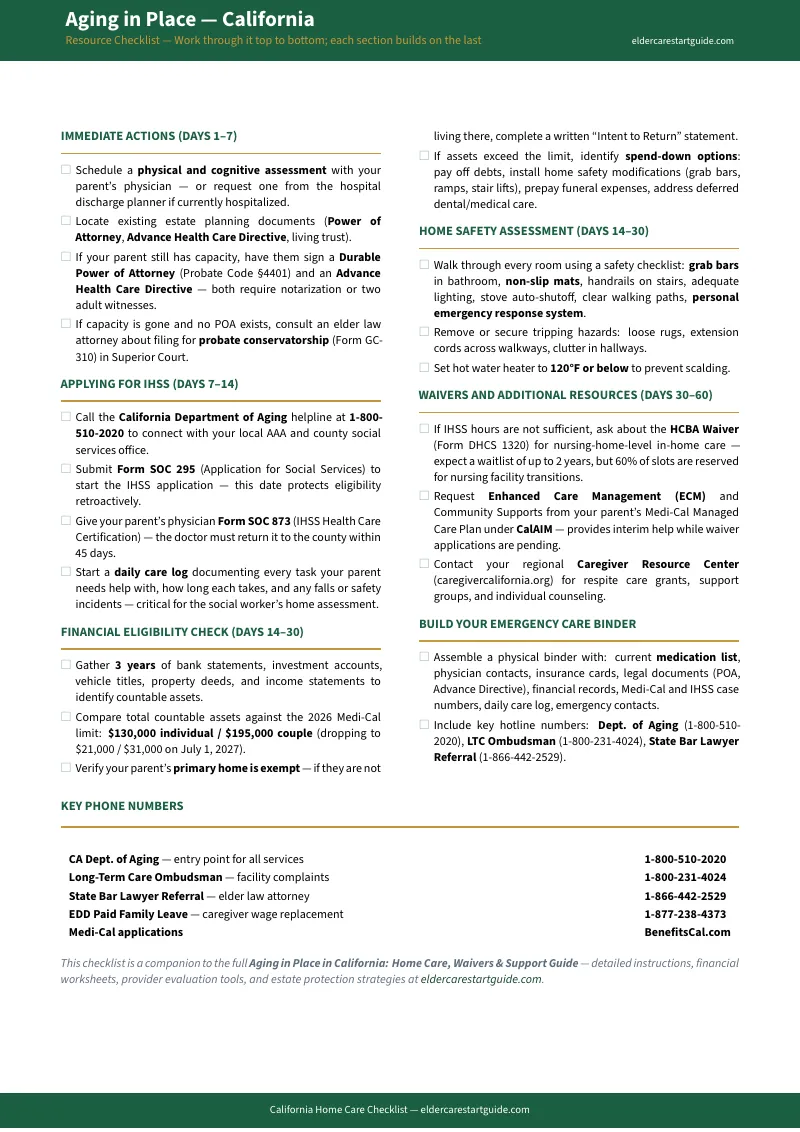
- California Aging in Place Resource Checklist — A 19-item action list organized by timeline: immediate legal authority steps (Days 1–7), IHSS application (Days 7–14), financial eligibility check against the 2026 asset limits (Days 14–30), home safety assessment, waiver program applications, and emergency care binder assembly.
- IHSS Application Worksheet — Track every step from Form SOC 295 through the county assessment, with a Functional Index Score tracker to compare your observations against the social worker's ratings.
- Medi-Cal Asset Worksheet — Tally every countable asset against the 2026 limits, with exempt/countable status and a spend-down strategy tracker.
- Waiver Comparison Chart — HCBA, ALW, MSSP, PACE, and CBAS compared side by side: who they serve, key services, waitlists, priority rules, and how to apply.
- Home Safety Assessment — Room-by-room checklist with California modification funding sources.
- Estate Recovery Shield — Which ownership structures survive probate, AB 2016 bypass thresholds, exemptions checklist, and key forms.
- Emergency Care Binder — Five-tab organizer template for medical, legal, financial, benefits, and care log records.
- Spousal Protections Worksheet — CSRA and MMMNA calculations, 90-day transfer window timeline, and asset transfer tracker.
- Family Caregiver Employment Guide — IHSS provider enrollment steps, county wage lookup, independent hire obligations, and HCO vs. independent comparison.
- Key Contacts Reference — State agency phone numbers, local contact fill-in fields, and community resource directory. Print and keep on the fridge.
- Official Forms Directory — Every IHSS, DHCS, and Judicial Council form number with its purpose. Keep in your care binder.
Who This Is For
- Adult children whose parent is being discharged from the hospital and someone needs to figure out how to pay for home care that costs over $115,000 a year
- Families who need to qualify a parent for IHSS but don't understand how the county social worker's functional assessment determines authorized hours — or how to document protective supervision needs
- Caregivers who want to get paid through IHSS as a family provider but don't know how to handle the background check, provider enrollment, or timekeeping compliance
- Families blindsided by the reinstated 2026 Medi-Cal asset limits after qualifying easily during the 2024–2025 asset-free period
- Anyone terrified that California Medi-Cal will seize their parent's home after death — and who wants to understand what estate recovery actually reaches
- Out-of-state siblings coordinating California home care applications remotely with no idea where to start
Why Not Free Government Resources?
The DHCS publishes eligibility limits. The California Department of Aging maintains a website. County IHSS offices have application forms you can download.
Here is what none of them provide:
- A step-by-step IHSS assessment preparation strategy showing you how the Functional Index Ranking actually works and how to document your parent's limitations precisely enough to maximize authorized hours — not just "apply and wait"
- A 2026 asset limit walkthrough that explains the spend-down strategies, exempt asset categories, and look-back period rules in plain language — not 47 pages of regulatory text spread across three different DHCS bulletins
- A waiver program comparison so you can decide between HCBA, ALW, MSSP, PACE, and CBAS based on your parent's actual needs and each program's waitlist reality — not the state's enrollment brochures
- An estate recovery analysis explaining which asset structures survive probate and which don't — not a "consult an attorney" note
- A complete employer compliance framework for hiring independent caregivers, including payroll tax obligations, workers' comp, and wage and hour requirements — because one missed classification can make you personally liable
Government sites publish regulations. This guide compiles fragmented county, state, and federal data into a single, sequential process you can follow from crisis to stable home care — without paying an elder law attorney to explain things you can learn yourself.
Your Parent's Safety Net
Every week you spend researching is a week your parent goes without the funded care they may already be entitled to. IHSS applications are retroactive to the date of filing — but only if you file.
Get the guide. File the forms. Start the clock.
Get the California Home Care Guide →
The free checklist gives you the 19-item action list to start immediately. The full guide gives you every chapter, every form reference, every spend-down strategy, and the complete IHSS assessment preparation framework.