
Your Parent Needs Help at Home. Arkansas Has Three Medicaid Pathways, Eight Regional Agencies, and Zero Instructions.
Your mom fell in the bathroom again. Or your dad left the stove on — the third time this month. Or the home health aide from Medicare just finished physical therapy and told you "we're done" while your parent still can't dress themselves or remember to take their medications. You know she needs daily help, but when you search "home care Arkansas," you find the ARChoices waiver, Regular Medicaid Personal Care, the Independent Choices consumer-directed program, eight separate Area Agencies on Aging, and a wall of lead-gen sites trying to place your parent in a facility.
Meanwhile, every month without Medicaid coverage is another $4,550 in private-pay home care at $26 per hour. Every week without the right legal documents is another week the bank won't let you manage her accounts and the doctor won't return your calls. Every unprepared ARIA assessment is a score that comes back too low — and a spot on the 11,500-slot waitlist instead of approved services.
The Arkansas Home Care Navigation System
This isn't a list of phone numbers stapled to a cover sheet. The Arkansas Home Care Navigation System maps every pathway to keeping your parent safely at home — from the first safety crisis through Medicaid qualification, the functional assessment, waiver enrollment, provider vetting, and long-term financial protection — in the order you actually need them.
The guide is built around the reality that Arkansas runs its aging-in-place system through three separate Medicaid options (ARChoices waiver, Regular Medicaid Personal Care, and the Independent Choices self-directed program), accessed through a network of Area Agencies on Aging and DHS county offices that most families don't know to contact. One wrong entry point — calling a home care agency before checking waiver eligibility, applying without a Miller Trust when income exceeds $2,982, or letting an assessor see your parent on their best day — can cost months of coverage and thousands out of pocket.
What You Get — 10 Printable PDFs
- The Complete Arkansas Home Care Guide (guide.pdf) — 13 chapters covering the full journey from crisis recognition through waiver enrollment, provider hiring, home modifications, and estate protection. Every dollar figure, asset limit, program threshold, and agency contact is Arkansas-specific and updated for 2026.
- ARIA Assessment Preparation Worksheet (aria-assessment-prep.pdf) — The state's 300-question MnCHOICES-based functional assessment determines whether your parent qualifies. This standalone printable gives you the documentation checklist, a daily care log template, clinical eligibility pathways, and assessment-day reminders so the assessor gets an accurate picture — not the rehearsed version your parent performs for visitors.
- Miller Trust Blueprint (miller-trust-blueprint.pdf) — Arkansas is a strict income-cap state. If your parent's gross monthly income exceeds $2,982 by a single dollar, they're disqualified — unless you establish a Qualified Income Trust. This printable gives you the income threshold check, step-by-step bank account setup, monthly transfer protocol, and a 12-month compliance tracker.
- Estate Recovery Prevention Worksheet (estate-recovery-worksheet.pdf) — Arkansas operates under a probate-only recovery rule. This printable walks you through asset classification, Beneficiary Deed execution, POD designations, and the specific steps to protect the family home before filing the Medicaid application.
- Independent Choices Program Templates (independent-choices-templates.pdf) — Templates and worksheets for the self-directed Medicaid program that lets you hire a family member — including yourself — as a paid caregiver. Includes the care agreement template, setup checklist, and ongoing compliance requirements to survive audit and the five-year look-back.
- $250 Respite Grant Fast-Track (respite-grant-fast-track.pdf) — Step-by-step application guide for the Arkansas Lifespan Respite Voucher Program, including the physician's diagnosis letter template and the 90-day survey tracker required to maintain future grant eligibility.
- 8-Region AAA Directory (aaa-directory.pdf) — Every Area Agency on Aging office mapped to Arkansas's 75 counties, with direct intake numbers, free care coordination contacts, and the specific services (Meals on Wheels, senior transit, caregiver support groups) available in your parent's region.
- DMS-618 Physician Referral Prep (dms-618-referral-prep.pdf) — Worksheet for organizing medical history, ADL documentation, and medication lists before the mandatory physician sign-off for Regular Medicaid Personal Care. Bring this to the doctor appointment so the form is completed accurately the first time.
- Cost Comparison Worksheet (cost-comparison-worksheet.pdf) — Calculate your current private-pay costs against what the ARChoices waiver covers. Includes Arkansas cost references and a decision framework showing when the application is worth the effort.
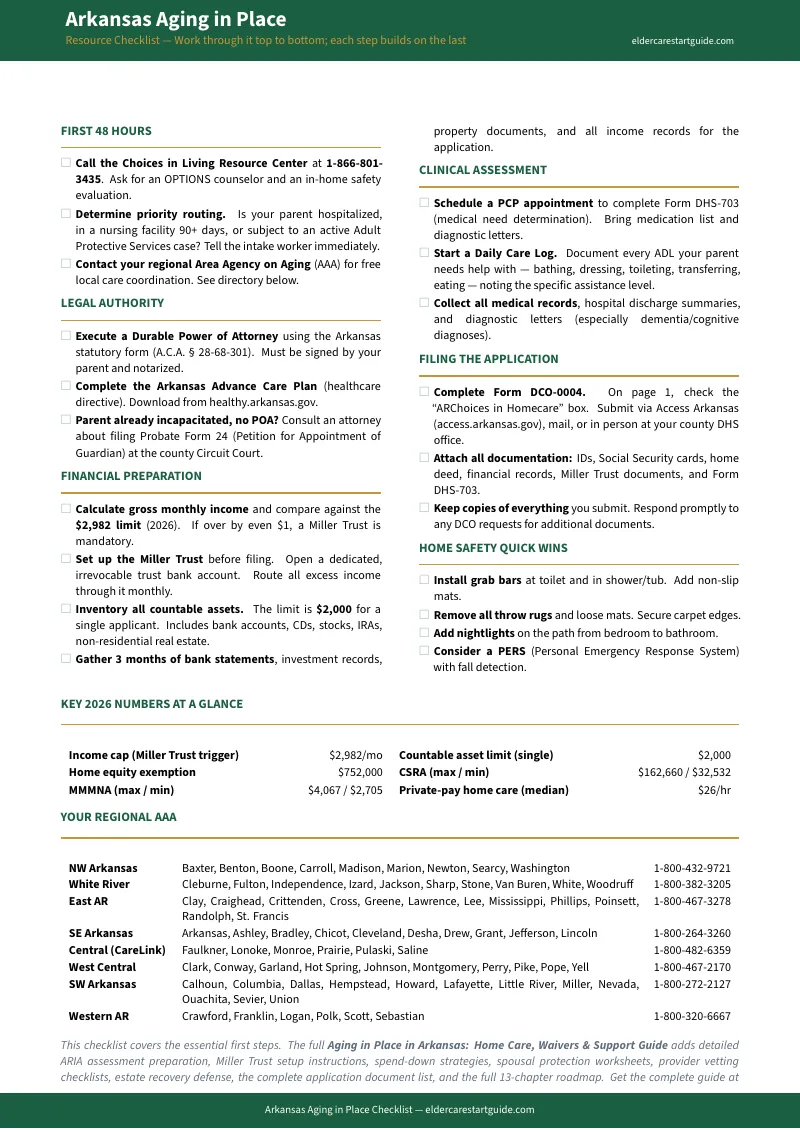
- Quick-Start Checklist (Free Download) (checklist.pdf) — 20 action items across safety, legal, financial, and program enrollment. Know exactly what to do tonight, this week, and this month — from immediate fall-prevention steps through Medicaid pre-screening and legal document gathering.
Who This Guide Is For
- Adult children in Arkansas helping a parent stay safely at home — from first safety concerns through full waiver enrollment
- Families watching private-pay home care costs drain savings at $4,550 per month and need to understand how to qualify for state-funded alternatives
- Caregivers providing 20+ hours per week of unpaid care who want to get paid through the Independent Choices program or access respite funding
- Anyone told "your parent is over the income limit" who needs to understand how a Miller Trust legally resolves Arkansas's strict income cap
- Families terrified that applying for Medicaid means losing the family home to estate recovery — and need to understand the probate-only rule before they make irreversible mistakes
Why Googling "Arkansas Home Care" Doesn't Work
The information exists — scattered across DHS program manuals, eight AAA websites with different layouts and phone trees, the Access Arkansas portal, a handful of elder law attorney marketing blogs, and national lead-gen platforms that end every page by asking for your phone number so a facility can call you.
Here's what free sources won't give you:
- The specific order of operations — which agency to call first, which assessment depends on which application, and what happens when you do steps 2 and 3 in the wrong sequence
- How to prepare for the ARIA assessment so the score reflects your parent's worst days, not the performance they put on for strangers
- How to set up and maintain a Miller Trust when your parent's income is $50 over the cap — without paying an elder law attorney $6,000 to $15,000 for the full planning package
- Whether your parent's home deed is already structured to avoid estate recovery — or if it needs a Beneficiary Deed before you file the Medicaid application
- The difference between ARChoices (nursing-facility level of care, 11,500-slot cap, waitlist) and Regular Medicaid Personal Care (lower-acuity, DMS-618 physician referral, no waitlist) — and why applying to the wrong one wastes months
The gap between knowing the programs exist and knowing how to use them in the right order is where families lose coverage, lose time, and lose thousands of dollars to private-pay care they didn't need to shoulder alone.
Satisfaction Guarantee
If this guide doesn't give you a clear, step-by-step path through the Arkansas home care system, email [email protected]. We read every message.
— Less Than One Hour of an Elder Law Attorney's Time
Arkansas elder law attorneys charge $200 to $500 per hour. A standard Medicaid planning retainer runs $6,000 to $15,000. A single month of private-pay home care costs $4,550 at the state median.
This guide won't replace an attorney for complex asset trusts or contested guardianship proceedings — and it tells you exactly when those apply. But it will save you weeks of research, prevent the application mistakes that trigger coverage denials, and ensure you walk into any conversation — with a DHS caseworker, an ARIA assessor, an AAA care coordinator, or an elder law firm — knowing exactly how the Arkansas system works and which steps come next.
Download the free Quick-Start Checklist to see the 20 most urgent action items. When you're ready for the complete navigation system, the full guide is waiting.