Your Parent Needs Help. Alaska Won't Let You Give It — Until You Have the Right Legal Documents.
Your parent fell. Or the hospital discharge planner just said they can't go home alone. Or you walked into the bank to pay their heating bill and the teller told you, "We can't discuss this account with you." Or the PFD Division rejected your application because your power of attorney doesn't include the right language.
You're the one showing up — managing medications, driving to appointments, coordinating with siblings across time zones — but you have zero legal authority to sign a single document on your parent's behalf. Alaska law doesn't care that you're next of kin. Without the right legal instruments, banks lock you out, hospitals won't share test results, and the Medicaid office returns your application unsigned.
The Alaska Legal Authority Roadmap
This kit is not a stack of blank court forms. It's the process around the forms — the part that $250-to-$800-per-hour elder law attorneys explain in a consultation and that the Alaska Court System's self-help center leaves out entirely.
It covers two paths: proactive planning (when your parent can still sign) and court-supervised guardianship (when capacity is already gone). And it connects both paths to the Medicaid ALI waiver system, PFD Division compliance, and the network of ADRCs and tribal health organizations that Alaska families need to navigate.
What's Inside
The kit includes an 11-chapter guide (34 pages), a printable quick-start checklist, and 10 standalone printable tools — 12 PDFs total, delivered as instant downloads:
- Capacity Assessment Framework — A plain-language protocol for determining whether your parent can still legally sign a power of attorney, with documentation steps that protect against future challenges from siblings or institutions.
- Durable Financial POA Walkthrough (AS 13.26) — Not just the form. The exact durability language required under AS 13.26.675(a) to keep the document valid after incapacity. Immediate vs. springing activation. How to get the document notarized — including remote options for rural communities. Which authority provisions to include so you can later establish a Miller Trust or manage ANCSA dividends.
- Advance Health Care Directive Guide (AS 13.52) — The dual execution options (notarization OR two qualified witnesses). The strict witness exclusions that trip up families. How the healthcare proxy, living will, and HIPAA release work together — and why notarization is required if you want post-death burial authority.
- Supported Decision-Making Agreements (AS 13.56) — The less-restrictive alternative to guardianship. How to help your parent retain full legal authority while getting the support they need. Execution requirements, information access provisions, and how to get banks and medical providers to honor the agreement.
- Guardianship Process Guide — When and how to petition the Alaska Superior Court. The $150 filing fee and waiver process. The mandatory independent visitor investigation. Form PG-100 through PG-290. Temporary guardianship for emergencies. The mandatory one-hour education requirement and annual reporting obligations.
- Conservatorship Process Guide — Financial management through court appointment. Surety bond requirements. The annual accounting using Form PG-225 — exact figures only, no estimates, bank statements must match. How conservatorship and guardianship work together when your parent needs both personal and financial oversight.
- Medicaid ALI Waiver Roadmap — The 2026 income cap ($2,982/month), what happens when your parent exceeds it, and how to establish a Miller Trust to maintain eligibility. The $2,000 countable asset limit. Community Spouse Resource Allowance protections. How to navigate the Person-Centered Intake through your regional ADRC. The Personal Needs Allowance reality — why your parent may be left with less than $100 per month for personal expenses after room and board.
- PFD Division Compliance — The Division's strict rules for third-party filing. Which type of POA they accept. Why verbal and written permission is rejected. How to ensure your document qualifies before the filing deadline.
- Geographic Access Guide — How to coordinate care across Alaska's vast distances. Working with ADRCs in Anchorage, Mat-Su, Southeast, and remote communities. Telephonic notarization and court options. Regional tribal health systems including SCF and YKHC.
- Abuse Reporting Protocol — How to report suspected elder abuse through Adult Protective Services. The mandatory reporting framework. Signs of financial exploitation that agents and guardians should watch for.
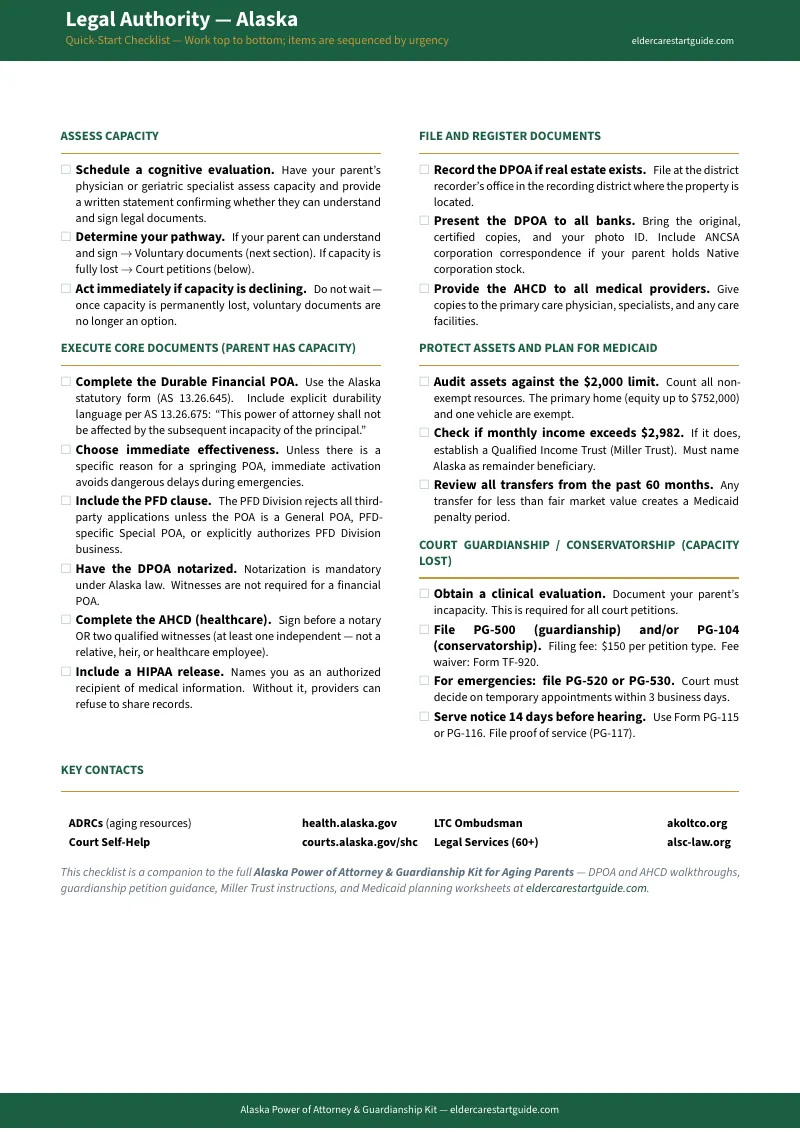
- Quick-Start Checklist — A printable, single-page action list that extracts the most time-sensitive items from the full guide. Start here when you're in crisis mode and need to know what to do today, this week, and this month.
Who This Kit Is For
- Adult children who just learned they need "power of attorney" and don't know where to start under Alaska law
- Families facing a hospital discharge where the parent can't go home alone and nobody has legal authority to sign admission papers
- Caregivers whose parent has early-stage dementia and can still sign — but the window is closing
- Siblings who need a documented process to avoid disputes about who controls what
- Families in rural or bush communities who can't easily reach an elder law attorney in Anchorage
- Anyone trying to navigate the ALI Medicaid waiver, Miller Trust, or PFD filing process without paying thousands in attorney fees
Why Not Just Use Free Court Forms?
The Alaska Court System provides free guardianship forms. Nolo has generic power of attorney templates. You can download them right now.
Here's what those resources don't tell you:
- The exact durability language your POA must contain under AS 13.26.675(a) to survive your parent's incapacity — and what happens to a non-durable document the day they can no longer sign
- How the PFD Division decides whether your power of attorney is valid for filing — and why their rejection criteria differ from every other state agency
- What to do when a bank refuses your DPOA, and how to use Alaska's statutory acceptance framework to force the issue
- The specific sequence for the ALI waiver application — the ADRC intake, SDS assessment, Miller Trust setup, and the monthly income arithmetic that determines whether your parent has $200 or $100 left for personal needs
- Which witness restrictions under AS 13.52.010(d)-(e) will invalidate your advance directive if you don't follow them exactly
The forms are step one of a twenty-step process. This kit covers all twenty.
Satisfaction Guarantee
If the kit doesn't give you a clearer path forward, email [email protected] and we'll make it right.
— Less Than One Hour of an Alaska Elder Law Attorney's Time
Initial consultations with Alaska elder law attorneys run $250 to $500. A full guardianship proceeding — including court fees, visitor investigations, attorney fees, and surety bonds — can cost $5,000 or more.
This kit won't replace an attorney for complex estate litigation or contested guardianship proceedings. But for the standard POA execution, institutional acceptance, ALI waiver navigation, and guardianship compliance that most Alaska families need, it covers the process at a fraction of the professional fee.
Start with the free checklist to see if the approach fits your situation. The full kit goes deeper with the complete 11-chapter guide, quick-start checklist, and 10 standalone printable tools — including execution checklists for the notary, petition checklists for the court clerk, a Medicaid eligibility reference card, and an official forms directory for your care binder.