The Hospital Gave You 48 Hours to Choose a Nursing Home — and the Free Checklists Won't Tell You Which Contract Clause Could Make You Personally Liable for the Bill
The discharge planner says your parent can't go home. You've got a list of three facilities. You Google "nursing home checklist" and print the Medicare.gov PDF. It tells you to check whether the hallways are well-lit and whether the food smells appetizing.
It does not tell you that the admission agreement you're about to sign contains a "Responsible Party" clause designed to make you — the adult child — personally liable for tens of thousands of dollars in nursing home charges if your parent's insurance runs out. It does not tell you that the facility's five-star overall rating masks a two-star health inspection score. It does not tell you that the "staffing" numbers on the marketing brochure measure budgeted positions, not the actual nurses on the floor at 3 a.m. on a Saturday.
You are not choosing a hotel. You are entering a regulated healthcare system with its own legal framework, its own financial traps, and its own language — and the free checklists from AARP and Medicare.gov were designed to evaluate physical comfort, not to protect your family's finances or your parent's clinical safety.
The Facility Defense System
This toolkit is built around the structural problem that every free resource ignores: the nursing home admission process is a legal and financial transaction disguised as a healthcare decision. You are signing contracts with corporate entities that employ attorneys specifically to shift financial risk from the facility onto the family. The clinical quality data you need is publicly available — but published in formats designed for regulators, not for a stressed adult child with 48 hours to make a decision.
The Facility Defense System gives you a structured, sequential framework to evaluate any nursing home in any jurisdiction — not by asking whether the lobby looks nice, but by auditing the three things that actually determine whether your parent will be safe and your family will be protected: the clinical quality data behind the ratings, the specific contractual provisions that create personal liability, and the cost structures that determine whether savings will last.
What's Inside
- Quality Rating Audit Worksheet (standalone printable) — side-by-side comparison grid that breaks CMS five-star ratings into their three component scores (health inspections, staffing, quality measures), decodes Australian ACQSC star ratings by their four weighted sub-categories, and translates UK CQC tier ratings and Canadian provincial inspection reports into actionable quality indicators. A five-star overall rating with a two-star inspection score gets flagged, not celebrated.
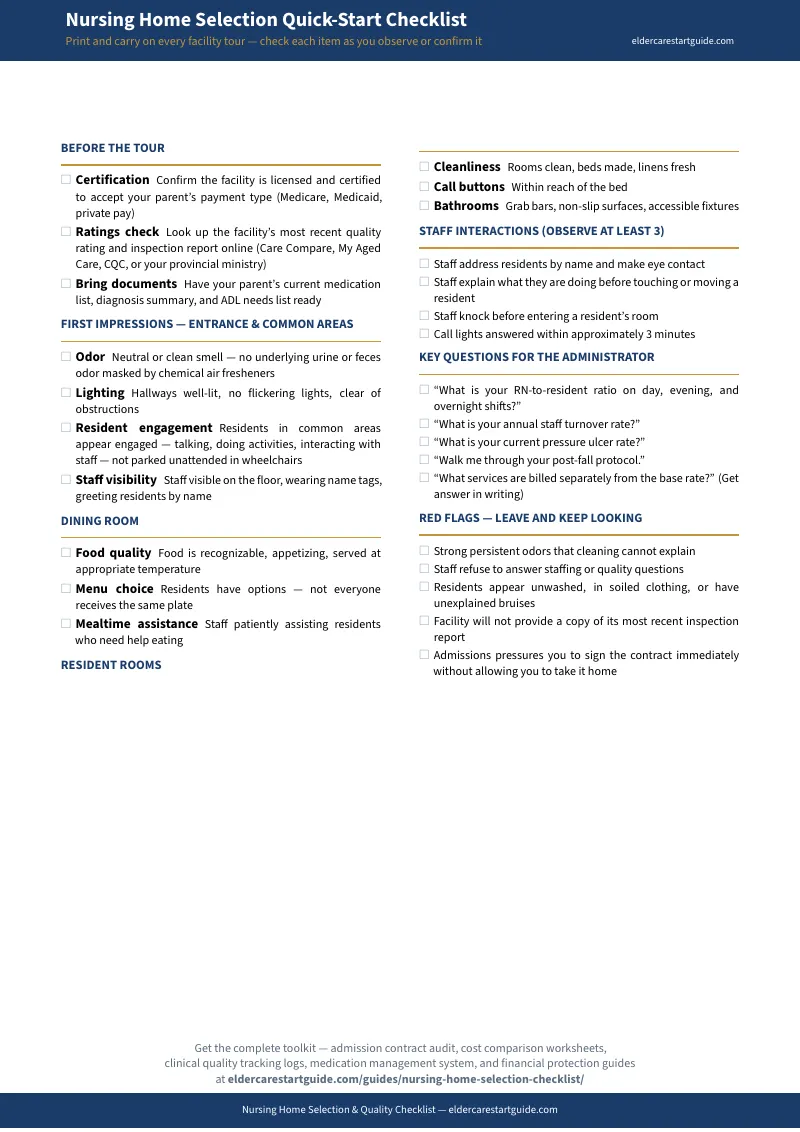
- Tour Observation Sheet (standalone printable) — a structured, print-and-carry observation sheet built around clinical indicators, not surface impressions. Staff-to-resident ratios at different times of day, call light response timing, staff interaction tests, dining area assessment, room condition checks, and the specific diagnostic questions to ask the administrator. You observe once; the worksheet captures what matters.
- Admission Contract Audit Checklist (standalone printable) — line-by-line contract review guidance that shows you exactly how to identify, cross out, and neutralize the "Responsible Party" clause, mandatory arbitration provisions, and personal guarantor language before you sign. Includes the precise legal annotation to add next to your signature confirming you are signing solely as an agent under a Power of Attorney, with zero personal financial liability.
- Facility Comparison Matrix (standalone printable) — weighted scoring system for comparing shortlisted facilities across 10 dimensions including clinical quality, staffing, contract terms, and financial transparency. Multiply each score by its weight and sum for a total that forces systematic comparison rather than emotional first impressions.
- Cost Comparison Worksheet (standalone printable) — a structured spreadsheet for comparing up to three facilities across base monthly rates, ancillary charges (laundry, beauty services, specialized therapy, medication administration), and a complete funding sources table covering Medicare timelines, Medicaid, VA benefits, and long-term care insurance.
- Family Meeting Worksheet (standalone printable) — pre-written family meeting agenda with ground rules and a care responsibility division table that explicitly assigns tasks to each sibling. When the argument shifts from emotional perceptions to documented ADL scores and assigned responsibilities, the conversation changes.
- Post-Admission Care Monitoring Log (standalone printable) — weekly visit log, 30/60/90-day clinical quality tracking, and a concern escalation record with the five-level escalation pathway from direct staff through to the Long-Term Care Ombudsman.
- Medication Management Log (standalone printable) — master medication list for tracking every medication from admission onward, polypharmacy review questions, and the five critical questions to ask before consenting to any new psychotropic medication.
- Financial Protection Worksheet (standalone printable) — asset inventory template, compliant spend-down checklist with permissible expenditures, and the six scenarios that require an elder-law attorney consultation. Designed so you walk into an attorney's office with everything organized, compressing a multi-hour discovery phase into a focused, efficient review.
- Legal Authority Checklist (standalone printable) — every legal document you need before entering the admissions office: POA, healthcare proxy, advance directive, insurance cards, medication list, and the contract signature annotation that protects you from personal financial liability.
Who This Is For
- The adult child who just received a hospital discharge notice and has days — not weeks — to evaluate facilities, understand contracts, and make a placement decision under extreme pressure
- Families researching nursing homes proactively while a parent is still independent, who want to evaluate quality ratings, tour facilities methodically, and understand the financial landscape before a crisis forces the decision
- The primary caregiver whose siblings disagree about whether nursing home placement is necessary, and who needs an objective clinical framework to depersonalize the conversation
- Anyone who has been told to "just sign the paperwork" by a facility admissions coordinator and wants to understand what they are actually agreeing to before they put pen to paper
- Families navigating the Medicaid spend-down process who need to understand which assets are protected, which transfers trigger penalties, and how to execute a compliant spend-down without losing the family home
Why the Free Resources Leave You Exposed
Medicare.gov's Care Compare database publishes quality ratings for every certified facility in the United States. It is an excellent tool. It is also a raw data interface designed for healthcare administrators, not for a family in crisis. It will not tell you that a five-star facility's overall rating was mathematically boosted by strong quality measures even though its health inspection score — the domain most directly tied to resident safety — earned two stars.
Then there are the "free" placement referral services — A Place for Mom, Caring.com — that position themselves as compassionate advisors. Their business model runs on commissions: facilities pay referral fees of 50% to 100% of the first month's rent (typically $3,000–$6,000) when a family signs a contract through their network. Their advisors can only recommend facilities that pay into that network. Your contact information is shared with corporate sales teams, and the calls start immediately. They will never tell you to cross out the personal guarantor clause, because their job is to close placements, not to protect your family.
This toolkit has no referral partners, no commission agreements, and no facility network. The only interest it serves is yours.
Satisfaction Guarantee
If the admission contract templates, tour observation sheets, or quality rating audits don't give you at least one critical insight you wouldn't have found on your own, email us for a full refund. No forms, no waiting period.
Stop Signing What You Don't Understand
Download the free Quick-Start Checklist for the one-page print-and-carry tour companion — or get the complete Nursing Home Selection and Quality Checklist for and have every contract defense, quality audit, cost comparison, and monitoring template you need to protect your parent and your family's finances through the entire placement process.