
Tennessee Has an Income Cap, a Capitation Trap, and No Lady Bird Deeds — And Most Families Learn This After the Crisis Hits
Your parent needs more help than you can provide. You've started searching for options in Tennessee, and within the first hour you're buried in acronyms — TennCare CHOICES, PAE scores, QITs, ACLFs, FAAR reports — with no clear picture of what your parent actually qualifies for or what any of it costs. The state's elder care system is split across the Health Facilities Commission, the Bureau of TennCare, the Area Agencies on Aging and Disability, and three competing Managed Care Organizations. Each agency controls a different piece of the puzzle, and none of them explain how their piece connects to the others.
Meanwhile, the financial rules are unforgiving. Tennessee is a strict income-cap state: if your parent's gross monthly income exceeds $2,982, they're locked out of TennCare CHOICES entirely unless you establish a Qualified Income Trust and fund it every single month. The 60-month lookback penalizes every uncompensated transfer at $8,846.10 per month of ineligibility. And after death, Tennessee's estate recovery program doesn't just bill for actual care received — it bills for the full capitation premiums the state paid to the MCO, which can be thousands more than the care your parent actually used. The family home that everyone assumed was protected? Tennessee doesn't recognize Lady Bird deeds or Transfer on Death deeds, so the probate estate is fully exposed.
The Tennessee Care Decision Framework
This guide maps every step of the care decision through Tennessee's specific agencies, thresholds, and licensing rules — from the first signs of decline through facility placement, TennCare CHOICES enrollment, and estate protection. Every dollar figure, phone number, and clinical threshold is verified against Tennessee's 2026 regulations.
What makes this different from a government portal or a referral service: it connects the systems that Tennessee treats as separate silos. Your parent's Pre-Admission Evaluation score, their CHOICES enrollment group, the ACLF licensing status of the facility you're touring, and the HFC inspection history of that facility all interact — and families routinely discover mid-crisis that the assisted living community they chose doesn't accept TennCare, or that their parent's income is $47 over the cap and nobody mentioned a QIT. The guide shows how these pieces fit together so you sequence each decision before it becomes an emergency.
What's Inside
- The Complete Guide (42 pages) — eight chapters covering the full care decision: recognizing decline with clinical markers, comparing Tennessee's care settings with 2026 cost data, securing legal authority (POA, advance directives, conservatorship), navigating TennCare CHOICES enrollment and the 26-point acuity scale, protecting the family home from estate recovery, vetting facilities through HFC and CMS records, handling hospital discharge crises, and building your professional team
- Care Needs Assessment Worksheet — a standalone printable evaluation of your parent's ADLs, IADLs, and cognitive concerns that mirrors the PAE categories, so you walk into the clinical screening already knowing where your parent stands on the 26-point scale
- Care Setting Comparison Card — home care, adult day care, assisted living (ACLF), memory care, and nursing home compared side by side with Tennessee-specific 2026 costs, TennCare CHOICES coverage by enrollment group, and a decision checklist for each setting
- Financial Snapshot & Lookback Audit — a fillable worksheet for income, countable assets, the $2,982 income cap test, QIT planning, spousal resource allowance ($162,660 for 2026), and a 60-month transfer audit using Tennessee's $8,846.10 monthly penalty divisor
- Facility Vetting Checklist — a printable checklist for desktop research (HFC facility database, state Abuse Registry, FAAR reports, CMS Five-Star ratings) and on-site tours with the questions to ask about ACLF licensing, staffing ratios, TennCare beds, and tiered acuity charges
- Facility Tour Comparison Scorecard — a side-by-side scorecard to rate and compare up to three facilities on cleanliness, staffing, licensing, inspection history, resident activity, and overall impression
- Crisis Roadmap — a one-page survival guide for the 24-to-72-hour hospital discharge window: the Medicare 3-day qualifying stay rule, how to file a QIO appeal with Acentra Health, PASRR screening requirements, and how to resist a rushed placement
- Essential Contacts Directory — verified phone numbers and web portals for every Tennessee agency: AAAD intake (1-866-836-6678), TennCare Connect (1-855-259-0701), Long-Term Care Ombudsman (1-877-236-0013), HFC complaints (1-877-287-0010), Adult Protective Services (1-888-277-8366), and all three MCOs
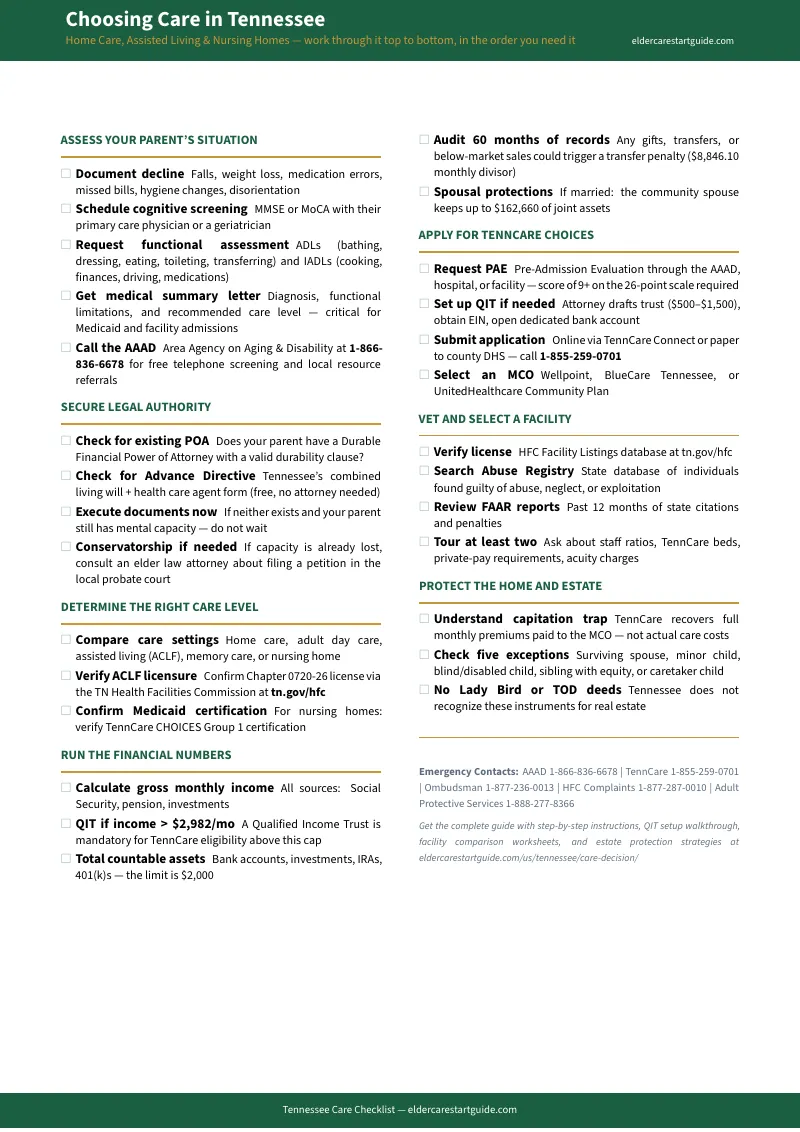
- 20-Item Decision Checklist — the free checklist covering key actions from needs assessment through facility selection and estate protection
Who This Is For
- Adult children watching a parent's gradual decline — missed medications, weight loss, minor falls that go unreported — who need a structured framework to evaluate whether it's time for outside help and which type of care fits
- Families in a hospital discharge crisis, with a social worker pushing for a facility decision within 24 to 72 hours and no time to research Tennessee's licensing categories or inspection records
- Anyone comparing home care vs. assisted living vs. nursing home care in Tennessee and trying to understand the real cost differences — home care averages $70,928 annually while assisted living averages $67,140 — and what each setting can legally provide
- Families facing a TennCare CHOICES application who need to understand the income cap, the QIT requirement, the 26-point PAE scoring, and the difference between Group 1, Group 2, and Group 3 benefits
- Siblings who disagree about what level of care is appropriate and need a clinical scoring framework — not competing opinions — to resolve the argument
- Out-of-state adult children coordinating care from Atlanta, Charlotte, or Chicago who need to understand Tennessee's specific agencies, licensing rules, and complaint processes without being physically present
Why Free Resources Leave You Stuck
Tennessee's government websites — tn.gov/hfc, tn.gov/tenncare, the AAAD directories — publish facility lists, licensing rules, and program descriptions. But they're written for surveyors and agency administrators, not for a family member trying to figure out what their parent needs at 10 p.m. on a Tuesday. You can find the TennCare CHOICES eligibility rules buried across multiple pages, but you won't find a step-by-step walkthrough connecting the PAE assessment to the income cap test to the QIT setup to the MCO enrollment — because no single state agency owns that entire sequence.
Commission-based referral services like A Place for Mom and CarePatrol will match you with assisted living communities for free — because the facilities pay them a commission on each placement. They don't help with home care coordination, TennCare applications, or nursing home vetting. Their recommendations are shaped by which facilities pay referral fees, not by your parent's clinical needs or your family's financial situation.
Elder law attorneys and geriatric care managers in Tennessee provide expert guidance — at $250 to $500 per hour. For families with complex Medicaid planning or contested conservatorships, professional counsel is essential. But you shouldn't be paying attorney rates to learn the difference between CHOICES enrollment groups or understand how the 60-month lookback works. Using this guide to organize your records and understand the system before your first consultation can save hours of billable time.
Satisfaction Guarantee
If the guide doesn't help you identify at least one care setting, eligibility rule, or vetting step you weren't already aware of, email us for a full refund. No forms, no waiting period.
Start Navigating Tennessee Elder Care with Confidence
Download the free checklist to get the care decision overview — or get the full toolkit for and have all the printable PDFs: the complete 42-page guide, standalone worksheets, comparison tools, vetting checklists, and contact directories you need to choose the right care for your parent in Tennessee.