
The Bank Just Refused You. The Hospital Needs a Signature You Can't Legally Give. Every Agency Door Is Locked — and Your Parent Can't Hand You the Key.
Your father had a stroke last Tuesday. The hospital social worker needs someone authorized to sign the rehab transfer papers. His bank won't let you access the checking account to cover the ambulance bill. The county caseworker says you can't even start the MLTSS Medicaid application without a valid Power of Attorney on file. You're his daughter. You've been managing his medications for three years. And you have zero legal authority to do any of it.
You looked online. You found a free Power of Attorney form. You printed it. But here's what that form won't tell you: under N.J.S.A. 46:2B-8.2(b), a New Jersey Power of Attorney is not durable by default. Unless the document contains explicit, state-mandated language declaring that the authority survives your parent's subsequent incapacity, it self-destructs the moment they lose capacity — exactly when you need it most. The free form you printed almost certainly doesn't have that clause.
And even if it does, New Jersey requires that sensitive powers — making gifts, creating trusts, changing beneficiaries, transferring property — be individually and explicitly authorized in the document. Generic "all-acts" language is legally insufficient. Without these specific "hot powers," you can't establish a Qualified Income Trust, can't execute Medicaid-compliant asset transfers, can't protect the family home. The document looks complete. It isn't.
The New Jersey Legal Authority Navigation System
This isn't a blank form you fill in and hope for the best. The New Jersey Legal Authority Navigation System maps both paths to legal authority — voluntary private documents when your parent can still sign, and full court guardianship when capacity is already gone — with every statute, filing fee, county contact, and deadline specific to New Jersey law in 2026.
The critical mistake most families make: they assume a generic online POA covers everything. They download a template from a national legal site, get it notarized, and feel protected. Then the bank rejects it because it lacks the hot-powers clauses. The Medicaid caseworker rejects the application because the agent has no authority to create a QIT. The nursing home refuses to discuss care plans because there's no valid healthcare proxy on file. Each rejection costs weeks — and in elder care, weeks cost money.
The guide puts you in the right order: assess capacity, execute the right documents with the right clauses, file them in the right places, and then — only then — tackle the MLTSS Medicaid application or guardianship filing with every prerequisite already satisfied.
What You Get — 12 Printable PDFs
- Complete Guide (34 pages) — The full system covering both paths to legal authority: voluntary POA documents (when your parent can still sign) and court-ordered guardianship (when capacity is already lost). Includes MLTSS Medicaid coordination, asset protection strategies, and county-by-county filing references.
- POA Drafting Worksheet — Clause-by-clause review sheet for your Durable Financial POA: mandatory durability language, all five hot powers under N.J.S.A. 46:2B-8.13a, execution checklist with notary and witness steps. Bring this to the signing appointment.
- Healthcare Directive Worksheet — Both components of New Jersey's Advance Directive (Proxy Directive + Instruction Directive) with representative designations, treatment decisions, and execution checklist. Includes the critical rule: burial/cremation authority requires notarization.
- HIPAA Authorization Guide — Standalone privacy release covering authorized recipients, information scope, and distribution checklist. Name every family member who needs medical records access — without this form, federal law blocks you even with a valid POA.
- Guardianship Filing Checklist — Complete pro se filing sequence for Superior Court, Chancery Division, Probate Part. Three phases: pre-filing preparation, filing documents (Packet CN 10558), and post-filing through hearing. Print and check off each step.
- Surrogate Qualification Checklist — The 30-day post-judgment process: Acceptance of Guardianship, monitoring training, surety bond, Letters of Guardianship, and immediate post-qualification tasks (EIN, dedicated account, inventory filing within 90 days).
- MLTSS Application Checklist — Step-by-step for both eligibility tracks (clinical via ADRC, financial via County Welfare Agency), plus QIT setup instructions for income over $2,982/month.
- Asset Protection Worksheet — Penalty-free transfer strategies, legitimate spend-down transactions, spousal protection calculator (CSRA, MMMNA), and home equity assessment. All using 2026 NJ figures.
- County-by-County Filing Reference — All 21 New Jersey county Surrogate's Courts with office locations, phone numbers, and standard fee schedules. No hunting through twenty-one county websites.
- Medicaid Thresholds Reference — One-page fridge sheet with every 2026 financial limit: income caps, asset limits, spousal protections, transfer penalties, guardianship costs, and when each threshold updates.
- Court Forms Reference — Every guardianship form number (CN series), Medicaid authorization forms, Social Security Representative Payee forms, and key state agency contacts in one printable sheet.
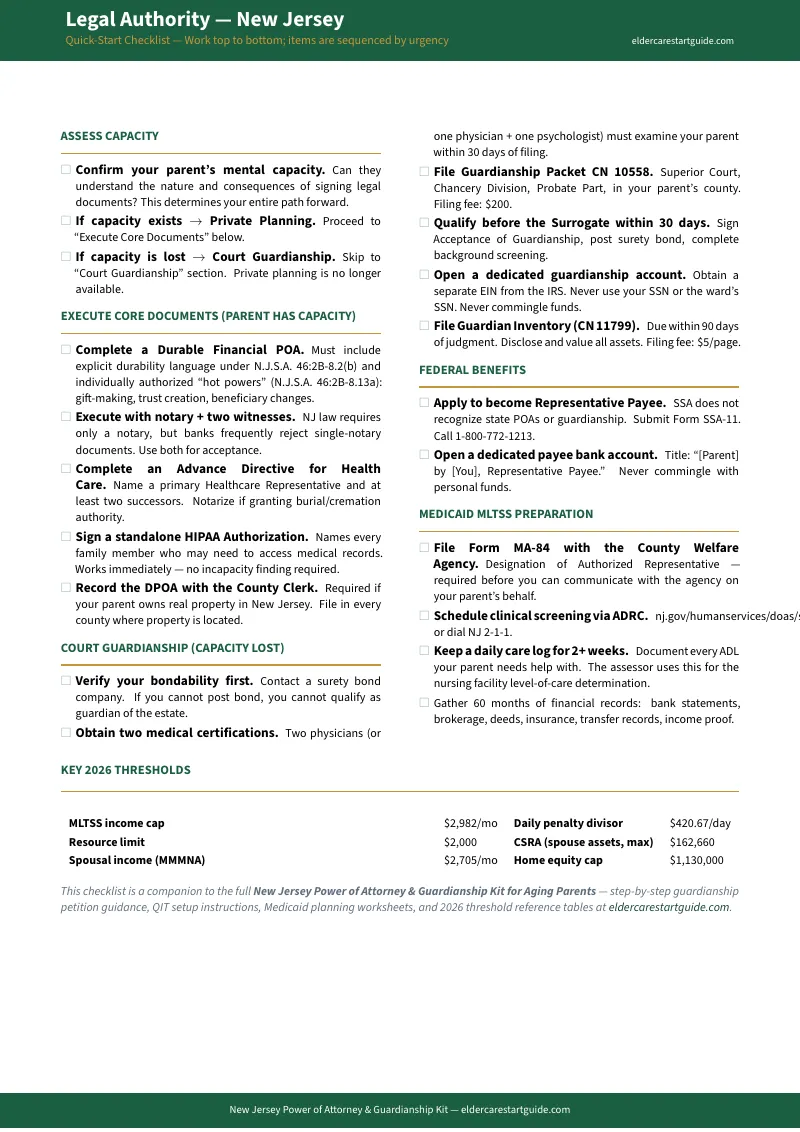
- Quick-Start Checklist (Free Download) — 20 prioritized action items organized by capacity status: what to do tonight, this week, and this month.
Who This Guide Is For
- Adult children in New Jersey whose parent can still sign documents but hasn't — and who want to get the POA, healthcare proxy, and HIPAA authorization done correctly before a medical crisis closes the window
- Families whose parent has already lost capacity and who need to file for guardianship without spending $5,000–$15,000 on a private elder law attorney
- Caregivers who have been managing a parent's daily care for years but keep getting blocked by banks, hospitals, and government agencies demanding legal documentation they don't have
- Families starting the MLTSS Medicaid application process and discovering that every form, phone call, and RFI response requires an agent with specific, documented authority
- Out-of-state siblings coordinating a New Jersey parent's legal affairs remotely and needing every filing address, court form number, and Surrogate's fee schedule in one place
- Anyone who downloaded a free POA template online and wants to verify whether it actually meets New Jersey's requirements — or whether it's missing the durability clause and hot powers that make it usable
Why Free Templates Aren't Protecting Your Family
Nolo, FormSwift, and DocDraft offer New Jersey POA forms for a few dollars or free. They generate clean-looking documents. But they provide forms in a vacuum — no guidance on which hot-powers clauses your parent's bank will require, no instructions for coordinating the POA with a Medicaid application, no explanation of why the document needs to be recorded with the County Clerk if your parent owns real property.
The elder law firms in Bergen, Essex, and Middlesex counties publish authoritative blog posts about POA and guardianship. Each one ends with a call to schedule a $300–$500/hour consultation. Their content is designed to demonstrate expertise, not to give you a complete sequence of steps you can follow without hiring them.
The NJ Courts Self-Help Center provides the official guardianship forms packet. It's free, accurate, and overwhelming — raw PDF forms with no context, no strategy, and no explanation of how to handle the Surrogate's qualification process after the judge signs the order.
This guide fills the gap between the template that gives you a form without instructions, the law firm that gives you instructions only through a $2,000–$10,000 retainer, and the court portal that gives you forms without strategy.
Satisfaction Guarantee
If this guide doesn't give you a clear, actionable path to securing legal authority over your parent's affairs in New Jersey, email [email protected]. We read every message.
— Less Than Thirty Minutes of an Elder Law Attorney's Time
New Jersey elder law attorneys charge $200 to $500 per hour. A basic estate planning package starts around $1,050 for one person. An uncontested guardianship proceeding runs $3,500 to $7,000 in legal fees alone. A single procedural mistake — a POA missing the durability clause, a guardianship filing without the second physician's certification, a Medicaid application submitted without the QIT documentation — delays everything by weeks and can cost thousands in penalties or lost benefits.
This guide won't replace an attorney when you genuinely need one (and it tells you exactly when that is — contested guardianships, complex multi-state estates, and trust litigation all need counsel). But it will prevent the most expensive mistakes, eliminate weeks of research, and ensure you walk into any meeting — with the bank, the Surrogate's Court, the CSSA caseworker, or an elder law firm — already knowing what New Jersey law requires.
Download the free Quick-Start Checklist to see the 20 most urgent action items. When you're ready for the complete system, the full guide is waiting.