
Your Parent Has Dementia. Illinois Has 14 Different Programs. Nobody Tells You the Order.
Your parent wandered out of the house at 2 a.m. Or the hospital says they can't discharge to home without a safety plan. Or you just watched them try to use the TV remote to make a phone call. You know something has to change — but when you search "dementia care Illinois," you get the Department on Aging, the Department of Healthcare and Family Services, regional Care Coordination Units, the Supportive Living Program, the Community Care Program, two different Medicaid waiver pathways, and a dozen lead-generation sites trying to sell you a facility placement.
Meanwhile, the clock is running. Every month without Medicaid coverage is another $6,100 to $7,908 in private-pay memory care or nursing home bills. Every week without Power of Attorney is another week where the bank can refuse your calls and the hospital can lock you out of decisions. Every assessment you're unprepared for is a score that comes back too low to qualify for the state programs your parent actually needs.
The Illinois Dementia Care Navigation System
This isn't a list of phone numbers with a cover page. The Illinois Dementia Care Navigation System maps the entire state care system in the order you actually need it — from the first safety crisis through legal authority, state program enrollment, facility evaluation, Medicaid qualification, and long-term financial planning.
The guide is built around the fact that Illinois runs its dementia care system through two separate agencies (the Department on Aging for seniors 60+ and HFS for the Supportive Living Program), accessed through a network of regional Care Coordination Units that most families don't know exist. One wrong entry point — calling a facility instead of a CCU, applying for standard Medicaid instead of the SLP waiver, signing a nursing home contract before the spend-down is structured — can cost months of coverage and tens of thousands of dollars.
What You Get
- The Complete Illinois Dementia Care Guide — 11 chapters covering the full journey from diagnosis through long-term placement. Every dollar figure, asset limit, program threshold, and agency contact is Illinois-specific and updated for 2026.
- The $17,500 Asset Separation Worksheet — A structured tool for categorizing your parent's assets into exempt (primary home up to $752,000, one vehicle, prepaid burial up to $8,434) and countable (checking, investments, cash-value life insurance) according to Illinois AABD and Medicaid guidelines. Get this wrong and the application bounces.
- Medicaid Spend-Down Tracker — Illinois doesn't use Miller Trusts. Instead, families track qualifying medical expenses to meet a monthly threshold. This tracker organizes receipts and bills for clean DHS submission through the ABE Portal.
- Supportive Living Facility Site-Selection Checklist — Questions to verify whether a facility is actually HFS-approved for the Supportive Living Program, what the $874/month room and board rate covers, and what it doesn't. Not every memory care facility in Illinois participates — and the ones that don't cost $6,100+ per month out of pocket.
- CCU Assessment Preparation Guide — The 29-point Determination of Need (DON) scoring system is what case managers use to decide whether your parent qualifies for state-funded services. The guide explains every scoring criterion so you can document your parent's actual needs accurately — not the sanitized version they perform when company comes over.
- Power of Attorney Companion — Step-by-step walkthrough of the Illinois statutory short forms for Healthcare POA and Property POA, including witnessing and notarization requirements. Plus the Health Care Surrogate Act fallback if capacity is already gone — and the hard truth about when court-ordered guardianship ($3,000–$10,000 in fees) becomes the only option.
- Family Caregiver Payment Guide — How to get paid through the Community Care Program for care you're already providing. Structured as fair-market compensation to survive the five-year Medicaid look-back audit.
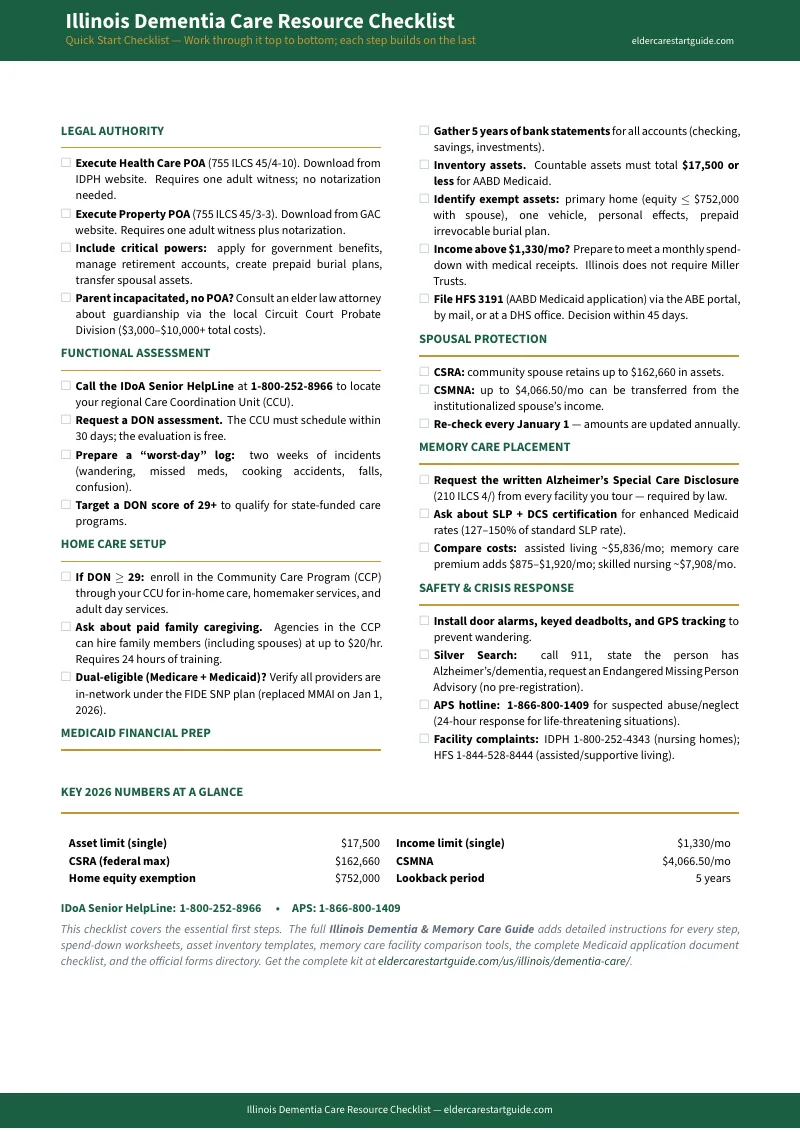
- Quick-Start Checklist (Free Download) — 20 action items across 7 sections. Know exactly what to do tonight, this week, and this month — from immediate safety steps through legal documents, financial preparation, and state program enrollment.
Who This Guide Is For
- Adult children in Illinois navigating a parent's dementia diagnosis — from early-stage planning through memory care placement
- Families facing a hospital discharge with no safe return-to-home plan and a discharge planner pressuring them toward expensive private-pay facilities
- Caregivers burning out on 20+ hours per week of unpaid care who want to access the Community Care Program or get paid as a family caregiver
- Community spouses terrified of losing the family home or life savings to private-pay memory care costs
- Anyone who needs to understand whether Medicaid covers memory care in Illinois (short answer: only through the Supportive Living Program, and only at approved facilities)
Why Googling "Illinois Dementia Care" Doesn't Work
The free information exists — scattered across three state agencies, two Medicaid waiver programs, 13 regional Care Coordination Units, and dozens of attorney marketing blogs that end every article with "call us for a consultation."
Here's what free sources won't give you:
- The specific order of operations — which agency to call first, which application depends on which assessment, and what happens when you do steps 3 and 4 in the wrong sequence
- How to prepare for the DON assessment so the score reflects your parent's actual care needs, not their best day
- Which memory care facilities actually participate in the Supportive Living Program — and which ones will charge you $6,100+ per month because they don't
- How to structure family caregiver payments to survive the five-year Medicaid look-back, not just "pay your child for care"
- The difference between the Community Care Program (Department on Aging, 60+, DON assessment) and the Supportive Living Program (HFS, any age, NFLOC requirement) — and why applying to the wrong one wastes months
The gap between knowing the programs exist and knowing how to use them in the right order is where families lose coverage, lose time, and lose money.
Satisfaction Guarantee
If this guide doesn't give you a clear, step-by-step path through the Illinois dementia care system, email [email protected]. We read every message.
— Less Than One Hour of an Elder Law Attorney's Time
Illinois elder law attorneys charge $400–$500 per hour. A standard Medicaid planning retainer runs $6,000 to $15,000. Meanwhile, a single month of private-pay memory care costs $6,100 to $7,908.
This guide won't replace an attorney when you need one — and it tells you exactly when that is (complex asset trusts, contested guardianship, high-net-worth estate planning). But it will save you weeks of research, prevent the application mistakes that trigger coverage delays, and ensure you walk into any conversation — with a CCU case manager, a facility administrator, a Medicaid caseworker, or a lawyer — knowing exactly how the Illinois system works.
Download the free Quick-Start Checklist to see the 20 most urgent action items. When you're ready for the complete navigation system, the full guide is waiting.