
Your Parent Needs Help. Delaware Law Says You Have No Standing.
You're managing medications, coordinating doctors, fielding calls from the bank — and then ChristianaCare's discharge planner tells you she can't discuss your mother's placement options because you're "not legally authorized." The assisted living facility needs a signed admission agreement. The ASSIST portal needs someone authorized to apply for Diamond State Health Plan Plus. Your parent's bank won't let you pay their mortgage.
Being the devoted child means nothing under Delaware law. Not at the hospital. Not at the bank. Not on the Medicaid application. Until you have the right legal documents executed under Delaware's strict signing rules — or a court order from the Court of Chancery — you're locked out of every decision that matters.
The Delaware Legal Authority System
This isn't a blank form with "sign here" arrows. The Delaware Legal Authority System maps the exact sequence of actions, filings, and registrations you need — starting from wherever your family is right now.
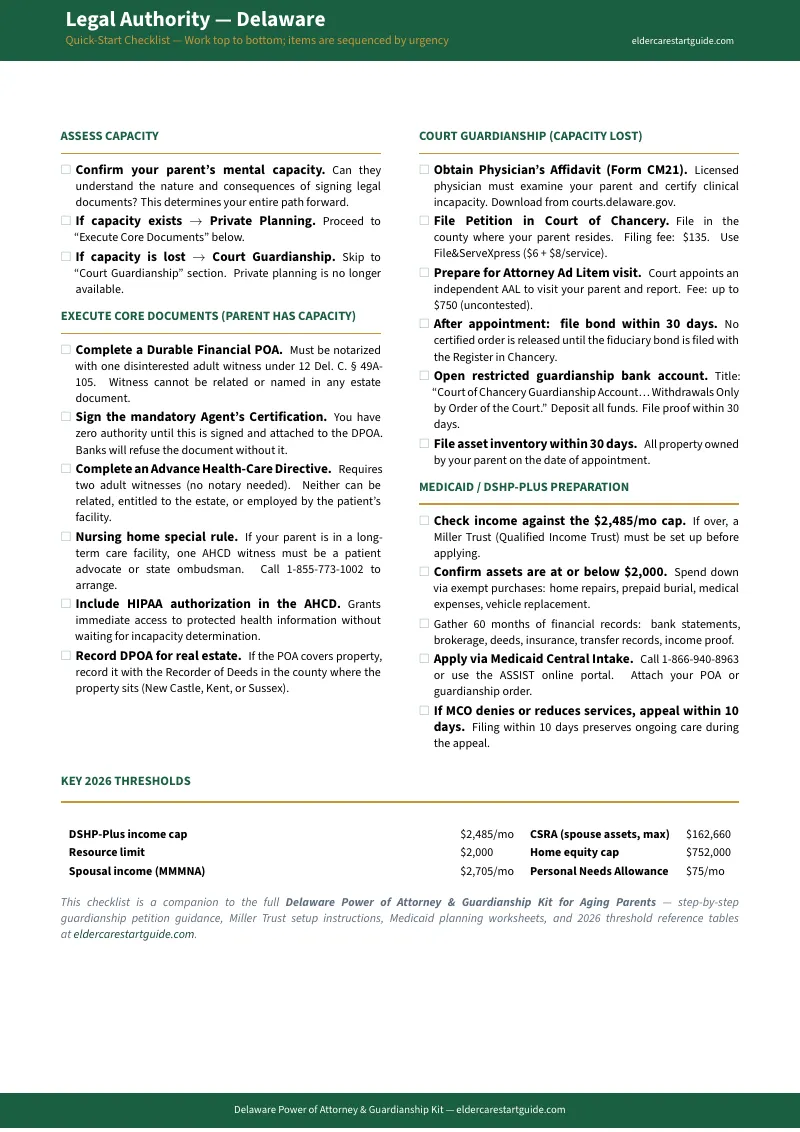
If your parent still has cognitive capacity, the kit walks you through executing Delaware's Durable Financial Power of Attorney under Title 12, Chapter 49A (including the mandatory Agent's Certification that must be signed and attached before any Delaware bank will honor the document), plus the Advance Health-Care Directive under Title 16, Chapter 25 with its strict two-witness requirement — and the special rule requiring a patient advocate or ombudsman witness if your parent lives in a nursing facility.
If capacity is already gone, the kit covers the Court of Chancery guardianship pathway: the distinction between Guardian of the Person and Guardian of the Property, working with the court-appointed Attorney Ad Litem, restricted bank account requirements, annual reporting obligations, and emergency guardianship for imminent danger situations.
What You Get
- The Complete Delaware POA & Guardianship Guide — 13 chapters covering both legal pathways, from initial capacity assessment through ongoing court administration. Every statute number, agency name, filing requirement, and deadline is Delaware-specific and current for 2026.
- Delaware Execution Requirements Walkthrough — The detail that invalidates more documents in Delaware than anything else. Your Financial POA requires notarization plus one disinterested witness who isn't related and has no estate interest. Your Advance Directive requires two witnesses — and if your parent is in a care facility, one must be a patient advocate or state ombudsman. The guide explains exactly who qualifies.
- Mandatory Agent's Certification — Under 12 Del. C. § 49A-105(c), your Financial POA grants zero authority until the agent signs and attaches a formal certification. Skip this step and every bank in Delaware will refuse to honor your document. The guide walks you through execution.
- Diamond State Health Plan Plus (DSHP-Plus) Coordination — Delaware's Medicaid long-term care program runs through managed care organizations. The guide covers the $2,982 monthly income cap, the $2,000 asset limit, the ASSIST portal application process, the Functional Level of Care assessment, and how to set up a Miller Trust (Qualified Income Trust) when your parent's income exceeds the cap.
- Court of Chancery Guardianship Process Map — Step-by-step through the petition filing, the mandatory Physician's Affidavit (exam within three months), the court-appointed Attorney Ad Litem, the distinction between contested and uncontested proceedings, restricted bank accounts, surety bond requirements, and annual reporting.
- Delaware ADRC & Regional Services Directory — Contact information for the Delaware Aging and Disability Resource Center, Division of Medicaid and Medical Assistance, and county-level aging services so you know exactly where to call.
- 5 Printable Worksheets — Pathway Assessment (which legal route applies), Document Execution Tracker (track each document from draft through signing and notarization), Witness Qualification Checklist (confirm your witnesses meet Delaware's requirements before signing day), Guardianship Cost Estimator (budget the court pathway before you start), and Services Directory fridge sheet (one-page contact reference for ADRC, Medicaid, courts, and legal aid).
- Quick-Start Checklist (Free Download) — 20 actionable items organized by pathway. Know exactly what to do tonight, this week, and this month — whether you're on the voluntary POA track or heading to court.
Who This Kit Is For
- Adult children in Delaware who need legal authority to manage an aging parent's healthcare, finances, or living arrangements
- Families facing a hospital discharge at ChristianaCare, Bayhealth, or Beebe Healthcare with no signed POA — and a care facility demanding someone "authorized" to sign admission paperwork
- Caregivers whose parent has early-stage cognitive decline and want to execute documents while the capacity window is still open
- Families whose parent has clearly lost capacity and must navigate the Court of Chancery guardianship process
- Out-of-state children (in Pennsylvania, Maryland, or New Jersey) managing a parent's affairs in Delaware who need documents that satisfy Delaware's execution requirements
- Anyone who needs to understand DSHP-Plus eligibility, the Miller Trust requirement, and the 60-month lookback before it's too late to plan
Why Free State Forms Aren't Enough
Yes, Delaware publishes optional statutory POA forms under 12 Del. C. § 49A-301. The forms are not the problem. The problem is that a blank form doesn't tell you:
- That your Financial POA is legally invalid without the mandatory Agent's Certification — a separate document the agent must sign before exercising any authority
- Which "hot powers" (gift-making, trust amendments, beneficiary changes) can disqualify your parent from Medicaid if exercised incorrectly
- How to handle a parent with fluctuating capacity — the "lucid interval" strategy for executing documents on good days
- That the Advance Directive requires a patient advocate or ombudsman witness if your parent is already in a care facility
- How to coordinate POA execution with a DSHP-Plus application on the ASSIST portal so you don't accidentally trigger a lookback violation
- How to sign a care facility contract as an agent without making yourself personally liable for the monthly bills
The gap between having a blank form and having a system is the gap between a document that gets rejected at the bank counter and one that works the first time.
Satisfaction Guarantee
If the kit doesn't give you a clear, actionable path to legal authority for your parent in Delaware, email [email protected]. We read every message.
— Less Than One Hour of a Delaware Elder Law Attorney's Time
Delaware elder law attorneys charge an average of $423 per hour. A standard estate planning package in Wilmington runs $2,500 or more. The full court guardianship pathway can cost $3,000–$15,000 in attorney fees — plus the $750 Attorney Ad Litem fee the court assigns whether you want it or not.
This kit won't replace an attorney when you need one (and the guide tells you exactly when that is). But it will save you hours of research, prevent the most common execution mistakes, and ensure you walk into any conversation — with a bank, a hospital, a care facility, or a lawyer — knowing exactly what Delaware law requires.
Download the free Quick-Start Checklist to see the 20 most urgent action items. When you're ready for the complete system, the full kit is waiting.