
Your Parent Needs Help at Home. Delaware's System Can Pay for It — If You Know How to Apply.
Your parent fell last week. Or maybe they didn't fall — they just stopped cooking, stopped bathing, stopped remembering to take their pills. Either way, you're now the person figuring out what happens next.
You called the Delaware ADRC. They gave you a phone number and a website. You searched for "Delaware Medicaid home care" and found out the program is called DSHP Plus, that it runs through three different managed care companies, and that your parent needs to meet something called Nursing Facility Level of Care — but nobody told you what that actually means or how to prove your parent qualifies.
Meanwhile, you priced out private home care. Over $77,000 a year in Delaware. And your parent's savings won't last twelve months at that rate.
The DSHP Plus Navigation System
This is not a list of eligibility limits you can find on the DHSS website. It is the process around the limits — the part that $475/hour elder law attorneys explain in billable consultations and that the Delaware ASSIST portal never covers.
The guide walks you through every step from the first hospital discharge to securing state-funded home care, establishing legal authority, choosing the right MCO, funding home modifications, and shielding the family home from estate recovery — organized in the order you will actually need them.
Delaware has a structural advantage most families never learn about: the DSHP Plus waiver is a legal entitlement with no waiting list. Once your parent qualifies, services start. No lottery, no 12,000-person queue. But qualifying requires navigating an asset limit of $2,000, an income cap of $2,982/month with zero spend-down flexibility, and a 60-month look-back audit — and one mistake can trigger a penalty period or an outright denial.
What's Inside
- 72-Hour Crisis Response Checklist — Your parent is being discharged and someone just said "you need to arrange care." This chapter tells you exactly who to call (ADRC: 1-800-223-9074), what to request from the hospital social worker, and how to fast-track a Nursing Facility Level of Care assessment before your parent ever leaves the hospital room.
- DSHP Plus Eligibility Walkthrough — The clinical and financial eligibility requirements explained in plain language. How the Uniform Assessment Instrument works, what Activities of Daily Living the state evaluates, the exact income cap ($2,982/month for institutional-level care), the $2,000 asset limit, and the specific exemptions for your parent's home, one vehicle, and prepaid burial trusts.
- Miller Trust Setup — Step by Step — Delaware is an income-cap state. If your parent's Social Security and pension exceed $2,982 by even one dollar, they are denied — period. No spend-down, no deductible. The guide walks through establishing the Qualified Income Trust that Delaware requires: the trust language, the dedicated bank account, the monthly disbursement order (Personal Needs Allowance first, then patient liability to the MCO), and naming the State of Delaware as remainder beneficiary.
- MCO Selection Strategy — Your parent will be assigned to one of three Managed Care Organizations: Highmark Health Options, AmeriHealth Caritas, or Delaware First Health. This chapter compares their service authorization processes, home care hour allocations, provider networks, and member satisfaction — because the MCO you choose determines how many care hours your parent actually receives.
- The Delaware ASSIST Application — Screen by Screen — The complete application process through Delaware's online portal, from document gathering (60 months of bank statements, income verification, property deeds) through submission to the Division of Medicaid and Medical Assistance. Covers how to respond to information requests without triggering an administrative denial, and the processing timeline you should expect.
- Home Modification Funding Map — DSHP Plus covers safety modifications up to $6,000 per project, $10,000 per benefit year, and $20,000 over the lifetime of enrollment. The guide maps the approval process for ramps, grab bars, walk-in tubs, stairlifts, and transfer aids — plus alternative funding through the Statewide Emergency Repair Program (SERP) when you've hit the waiver cap.
- Consumer-Directed Care — Getting Paid to Provide Care — Delaware allows family members, including adult children and spouses, to be hired and paid as caregivers through Medicaid funds. The guide covers the Family Caregiver Contract template, Sandata Electronic Visit Verification (EVV) registration, and how to structure compensation to satisfy both the look-back audit and state compliance requirements.
- Estate Recovery Shield — Delaware's Medicaid Estate Recovery is limited to probate assets only. The guide details which ownership structures pass outside probate and are therefore protected (joint tenancy, beneficiary designations, funded trusts), the spousal co-residency exemption, the caregiver-child exemption, and the Undue Hardship Waiver process for families that don't fit the standard exceptions.
- Legal Authority Chapter — The Delaware Durable Personal Power of Attorney under Title 12, Chapter 49A: the statutory form, the notarization requirement, the one-disinterested-witness rule, and the 365-day DMV transaction limit. The Advance Health Care Directive. And the full guardianship process for families who waited too long — emergency temporary guardianship, permanent guardianship, bonding, and annual court reporting.
- Appeals and Fair Hearings — When DSHP Plus denies, reduces, or terminates services, you have 30 days to appeal. The guide covers the Managed Care internal grievance process, escalation to a Division of Medicaid and Medical Assistance Fair Hearing, how to invoke "aid paid pending" to keep services running during the appeal, and the documentation that wins reversals.
Plus: 9 Standalone Printable PDFs
- Financial Eligibility Pre-Screen — Map your parent's income and assets against Delaware's 2026 thresholds to determine if a Miller Trust is needed and how much spend-down is required
- 60-Month Lookback Audit — Track every gift, transfer, and large purchase over the past five years to flag potential penalty triggers before the state finds them
- Level-of-Care Self-Assessment — Evaluate your parent's ADL and cognitive deficits against the NFLOC criteria Delaware uses to determine clinical eligibility
- Document Preparation Checklist — Every document you need before filing the ASSIST application, organized by category with status tracking
- MCO Comparison Worksheet — Side-by-side comparison of Highmark, AmeriHealth Caritas, and Delaware First Health on the factors that matter for home care
- 72-Hour Crisis Response — A fridge sheet with exact steps and phone numbers for the first 72 hours after hospitalization
- Miller Trust Setup Guide — Step-by-step Qualified Income Trust instructions to take to your attorney and bank
- Key Contacts & Resources — Every state agency phone number, online portal, and 2026 financial threshold on one page
- Estate Recovery Shield — Which assets Delaware can reach and which ownership structures are fully protected under the probate-only rule
Plus: Printable Quick-Start Checklist
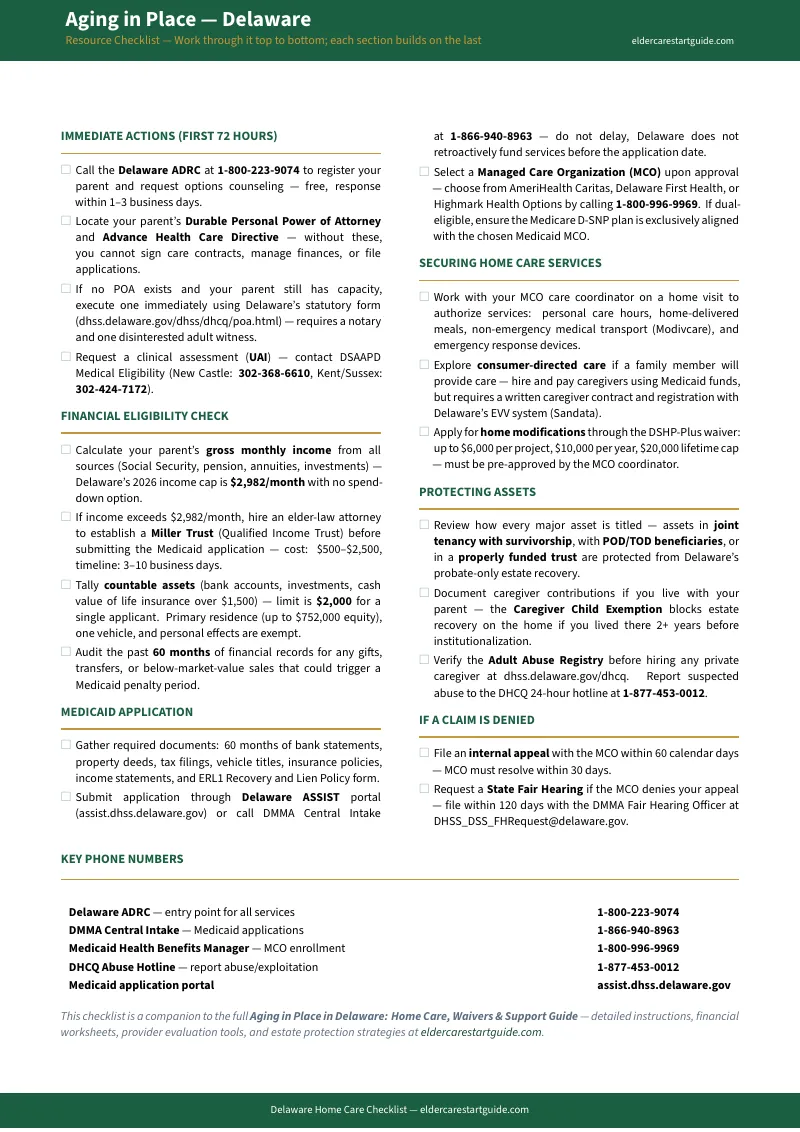
- Delaware Aging in Place Checklist — A one-page action list with the 20 most critical items: establish legal authority, call the ADRC, gather 60 months of financial records, calculate countable assets, arrange the clinical assessment, file through ASSIST. Every threshold, phone number, and deadline at a glance.
Who This Is For
- Adult children whose parent is being discharged from the hospital and someone needs to figure out how to pay for home care that costs $77,000 a year
- Families whose parent's income exceeds $2,982/month and they need a Miller Trust set up correctly — not a generic template that gets rejected
- Caregivers who want to get paid through Delaware's consumer-directed care program but don't know how to set up the EVV compliance or write the caregiver contract
- Families who need to choose between Highmark, AmeriHealth Caritas, and Delaware First Health — and have no basis for comparison
- Anyone terrified that Delaware Medicaid will seize their parent's home after death — and who wants to understand what estate recovery actually reaches
- Out-of-state siblings coordinating Delaware Medicaid applications remotely with no idea where to start
Why Not Free Government Resources?
The DHSS publishes eligibility limits. The Delaware ADRC offers options counseling. Brevy and Medicaid Planning Assistance websites list state-specific thresholds.
Here is what none of them provide:
- A step-by-step Miller Trust setup with the trust language, bank account instructions, and disbursement order Delaware requires — not a "consult an attorney" note
- An MCO comparison so you can choose between Highmark, AmeriHealth Caritas, and Delaware First Health based on home care hours and authorization processes — not the state's marketing brochures
- The consumer-directed care setup process with the Family Caregiver Contract template and Sandata EVV registration steps — not a paragraph saying "family members may be eligible"
- The estate recovery rules broken down by asset type, with the specific exemptions that shield the family home — not a legal disclaimer
Government sites administer rules. Elder law firms explain them for $475 per hour. This guide bridges the gap — translating hundreds of pages of Delaware policy into a sequence you can execute in an evening.
Satisfaction Guarantee
If the guide doesn't give you a clearer path forward, email [email protected] and we'll make it right.
— Less Than One Hour of a Delaware Elder Law Attorney's Time
An initial consultation with a Delaware elder law attorney runs $475 per hour. A full Medicaid planning engagement easily costs $3,000 to $15,000. A guardianship proceeding adds $3,000 to $7,000 in court and legal costs.
This guide won't replace an attorney for contested guardianships or multi-million-dollar estate planning. But for the Miller Trust setup, ASSIST application, MCO selection, home modification funding, and estate recovery protection that most Delaware families need, it covers the ground at a fraction of the cost — and if you do need an attorney, you'll walk in with an organized file instead of a box of unsorted bank statements.
Start with the free checklist to see if the approach fits your situation. The full guide goes deeper — every threshold, every strategy, every form, every phone number.