
Your Parent Needs Long-Term Care. Arizona's System Feels Designed to Drain Everything First.
You just found out that nursing home care in Maricopa County averages over $8,600 a month. Your parent's savings will last about six months at that rate — maybe less if memory care is involved.
So you start researching Arizona's Medicaid long-term care program, ALTCS. And you discover a system that feels like it was built to disqualify your parent: a $2,000 asset limit. A $2,982 monthly income cap with zero flexibility — one dollar over and the application is automatically rejected. A five-year lookback period that can penalize you for gifts you forgot about. And after all that, if your parent does qualify, the state can potentially come after the family home once they're gone.
The state website gives you dense policy manuals. Elder law firms give you a $300/hour consultation pitch — and the flat-fee ALTCS plans run $6,000 to $10,000. The "free" planning services from senior-care placement sites are paid by facility commissions, so their advice naturally steers your parent into institutional care whether it's the right fit or not.
Nobody gives you a clear, step-by-step path from "my parent needs help" to "approved and protected."
The ALTCS Approval System: A Start-to-Finish Roadmap That Replaces Guesswork with Sequence
The Arizona Medicaid Long-Term Care & Asset Protection Guide is built around one idea: the ALTCS process is not unknowable — it's a sequence. Medical screening, financial qualification, asset conversion, trust setup, application filing, post-approval management. Each step has specific rules, specific thresholds, and specific documents. When you know the sequence, the system stops being overwhelming and becomes a checklist.
This guide translates the AHCCCS Eligibility Policy Manual into plain-English instructions organized in the exact order you need to follow them. No legal jargon. No vague "consult a professional" hand-waving. Concrete steps, current numbers, and clear decision points.
What's Inside
ALTCS Eligibility Breakdown
The 2026 income cap ($2,982/month gross), the $2,000 countable asset limit, and the married-couple rules that change both numbers. A clear table showing exactly which assets count and which are exempt — because most families disqualify themselves by misunderstanding what "countable" means.
PAS Medical Screening Preparation
How the state's 60-point Pre-Admission Screening works, what triggers a supervisor review at 55-59 points, and how to prepare your parent's medical documentation so cognitive decline is properly captured — not masked during the interview.
Legal Spend-Down Strategies
Seven approved methods to convert countable assets into exempt ones without triggering lookback penalties: mortgage payoff, home safety modifications, vehicle replacement, irrevocable prepaid funeral plans (up to $15,000 with Goods and Services agreements), debt elimination, and Medicaid-compliant annuities. Each strategy includes when to use it, what paperwork to keep, and the exact AHCCCS policy reference.
Miller Trust (Income Only Trust) Setup
Arizona is an income-cap state — you cannot "spend down" excess income on care bills. If your parent's gross monthly income exceeds $2,982, the only solution is an Income Only Trust. The guide walks through setup from opening the $0-balance bank account to calculating the monthly share of cost, personal needs allowance ($149.10), Medicare premiums, and spousal income shifts.
Home Protection Blueprint
The real rules on TEFRA liens, estate recovery, and how to use Arizona Beneficiary Deeds to transfer the home outside of probate. When the state can place a lien (permanent institutionalization 90+ days, no protected relative in the home), when they cannot, and what "narrowest possible estate" actually means for your family.
Spousal Protection Calculations
The 50% Community Spouse Resource Allowance split (minimum floor $32,532, maximum ceiling $162,660), the Minimum Monthly Maintenance Needs Allowance ($2,705/month baseline, up to $4,066.50), and how to shift the applicant's pension and Social Security to the well spouse without triggering an eligibility denial.
The Complete Application Package
Every document you need — 60 months of bank statements, property deeds, insurance policies, medical records — organized into a filing-order checklist. How to use the Health-e-Arizona Plus portal. The dual timeline (financial review and PAS medical interview). What happens after submission and how to follow up without slowing the process down.
Appeals Process
The 35-day appeal window, how to draft a formal written appeal, what evidence to bring to a State Fair Hearing, and the most common denial reasons (usually a missing document, not true ineligibility).
8 Printable Standalone Worksheets
Every major decision point has its own fill-in worksheet you can print and use independently: an Eligibility Calculator (income and asset tests), Spousal Protection Calculator (CSRA and MMMNA), Spend-Down Planner (approved strategies with tracking), Miller Trust Setup Guide (checklist and monthly distributions), Five-Year Lookback Audit (flag transfers before you apply), Application Document Checklist (every document organized by category), Home Protection Worksheet (TEFRA liens, estate recovery, Beneficiary Deeds), and a PAS Self-Assessment (estimate the medical screening score).
Printable Checklist
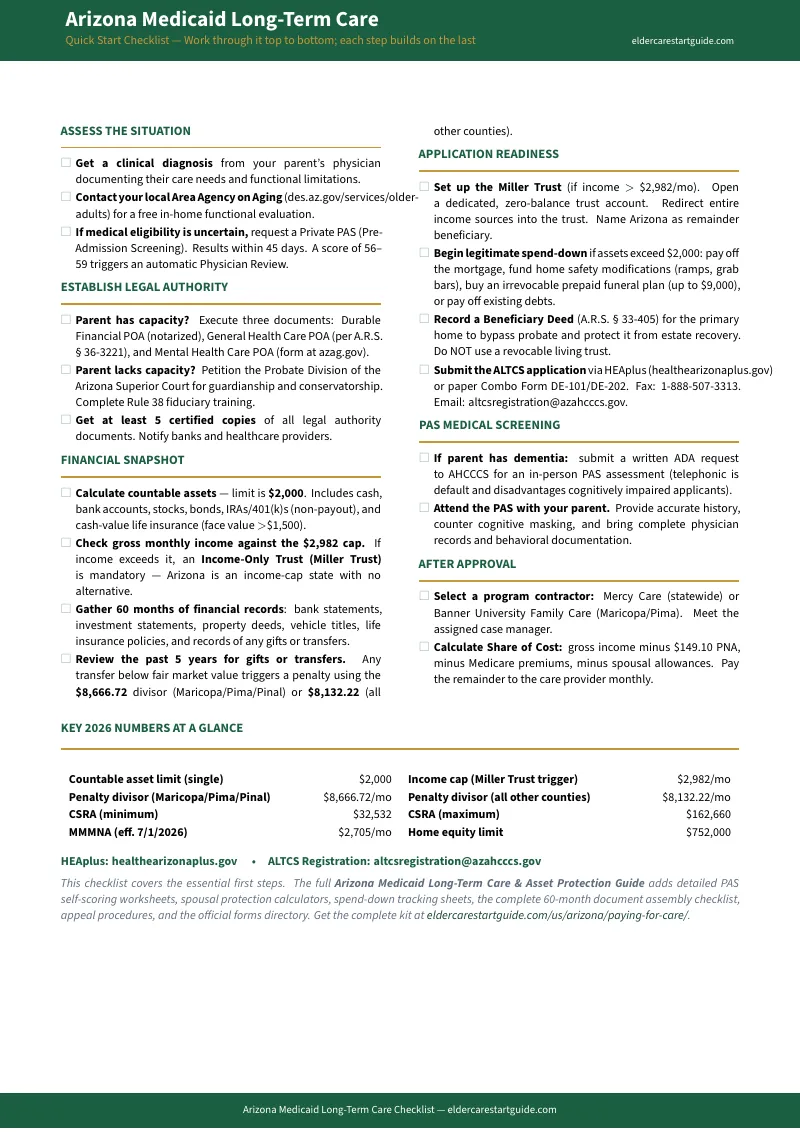
A step-by-step tracking sheet that covers the entire process from "gather financial records" to "confirm program contractor assignment." Print it, check items off, know where you stand.
Who This Guide Is For
- Adult children managing a parent's hospital discharge, nursing home placement, or assisted living transition in Arizona
- Spouses protecting their own financial security while qualifying a partner for ALTCS
- Families planning ahead after an Alzheimer's, Parkinson's, or dementia diagnosis — the five-year lookback means early action matters
- Anyone whose parent earns slightly over $2,982/month or has modest savings above $2,000 and needs a clear eligibility path
Why Not Just Use Free Resources?
Free resources exist — and they're good at what they do. AHCCCS.gov gives you eligibility policy. Area Agency on Aging counselors give you referrals. Legal aid gives you basic document help.
What none of them give you is strategy. State caseworkers verify eligibility — they don't help you achieve it. Non-profit counselors are legally barred from giving asset protection advice. And the "free" ALTCS planning services from facility placement companies are funded by commissions from the very nursing homes and assisted living communities they recommend.
This guide has no facility commissions, no consultation upsell, no sponsored recommendations. It's a one-time purchase that covers the full ALTCS process — financial qualification, asset protection, trust setup, application filing, and appeals — in one document you own permanently.
When You Need an Attorney Instead
This guide is built for the standard case: a parent with a primary home, modest savings, and straightforward finances. If your parent has multiple properties, active business interests, complex trust portfolios, or made large gifts (over $10,000) within the past five years, an elder law attorney is the safer path. The guide includes a decision framework that helps you determine which route fits your situation before you spend anything.
Get Started Today
Download the free Arizona ALTCS Eligibility Checklist to see if your parent is likely to qualify. It covers the key financial and medical thresholds in a one-page format you can review tonight.
When you're ready for the full roadmap — spend-down strategies, Miller Trust setup, home protection, application checklists, and the appeals process — get the complete guide for . That's less than half an hour of an elder law attorney's time, for a resource you can reference throughout the entire ALTCS process.