California Rewrote the Rules on January 1, 2026 — Most Families Are Still Planning Under the Old Ones
Your parent needs long-term care. Skilled nursing facilities in California run $10,000 to $15,000 a month. Medicare's skilled nursing benefit covers rehabilitation for at most 100 days — then the private-pay clock starts. You've been Googling "Medi-Cal eligibility" and finding guides that tell you to spend down to $2,000 in assets before the state will help. That number hasn't been correct since 2022.
Here's what actually happened: California eliminated all asset limits during 2024 and 2025. Then Assembly Bill 116 reinstated them on January 1, 2026 — but at $130,000 for an individual and $195,000 for a couple, not the old $2,000/$3,000 caps. The lookback period is 30 months, not 60. Every transfer made during 2024–2025 is permanently shielded from review. California doesn't recognize Miller Trusts. And the estate recovery program is limited to probate assets only — meaning a Transfer on Death deed recorded for $5 at the county recorder can shield a million-dollar home.
Most national Medicaid guides don't cover any of this. They're written for income-cap states that use Miller Trusts, 60-month lookbacks, and expanded estate recovery. Following that advice in California means families spend down savings they didn't need to touch, set up legal instruments the state doesn't recognize, and miss protections that exist nowhere else in the country.
The Medi-Cal Financial Navigation System
This guide maps the complete financial, clinical, and legal pathway through California's Medi-Cal long-term care system — from understanding Assembly Bill 116's reinstated limits through smart spend-down execution, spousal protections, program selection, the application process, and post-death estate recovery defense. Every dollar figure, form name, agency, and deadline is specific to California's 2026 regulatory framework.
What separates this from DHCS fact sheets and law firm blog posts: it connects the systems that California treats as separate processes. Your parent's income and asset assessment, their Share of Cost calculation, IHSS authorization through the county social worker, the Assisted Living Waiver's 15-county restriction and waitlist, spousal impoverishment protections that require specific Community First Choice Option enrollment to activate, and the estate recovery claim that arrives after death — all of these interact. Filing one step out of sequence or missing one enrollment designation can leave your family paying thousands in private-pay bills that Medi-Cal should have covered. The guide shows how these pieces connect so you can sequence each decision correctly.
What's Inside — 12 PDFs
- The Complete Guide (19 chapters) — walks through the AB 116 reinstated asset limits, income thresholds, exempt vs. countable classification, the 30-month lookback, spend-down strategies, spousal protections, Share of Cost mechanics, IHSS, the Assisted Living Waiver, other HCBS programs, the application process, legal documents, conservatorship, hospital discharge, appeals, estate recovery defense, and when to hire a professional
- Asset Inventory Worksheet (standalone printable) — classify every asset as exempt or countable and calculate whether a spend-down is needed against the $130,000 limit
- 30-Month Lookback Calculator (standalone printable) — the phased ramp-up from 0 months in January 2026 to the full 30 months in July 2028, the 2024–2025 permanent transfer shield, and penalty period math using the $14,440/month divisor
- Share of Cost Calculator (standalone printable) — the exact Medically Needy formula for both at-home and nursing facility SOC calculations, with key term definitions
- Spousal Protection Planner (standalone printable) — CSRA calculation (up to $162,660), MMMNA income allocation ($4,066.50/month), the 90-day retitling window action tracker, and the CFCO enrollment check
- Emergency Spend-Down Strategies (standalone printable) — state-approved methods with documentation requirements that satisfy county caseworkers, plus a tracking table for every action taken
- Non-Probate Protection Checklist (standalone printable) — every step to keep assets out of probate and block estate recovery under California's SB 833 probate-only standard
- Estate Recovery Defense Worksheet (standalone printable) — five probate bypass structures, permanent bars on recovery, the homestead waiver, and the 90-day/60-day after-death timeline
- Application Filing Checklist (standalone printable) — every document needed for the county welfare office, organized in submission order, with post-submission steps
- Care Options Comparison (standalone printable) — side-by-side comparison of every California care program (Private Pay, Medicare, Institutional Medi-Cal, ALW, HCBA, IHSS, PACE, VA A&A, MSSP) with costs, waitlists, and limitations
- Key Deadlines Tracker (standalone printable) — application milestones, post-approval deadlines, appeal windows, and estate protection dates in one printable page
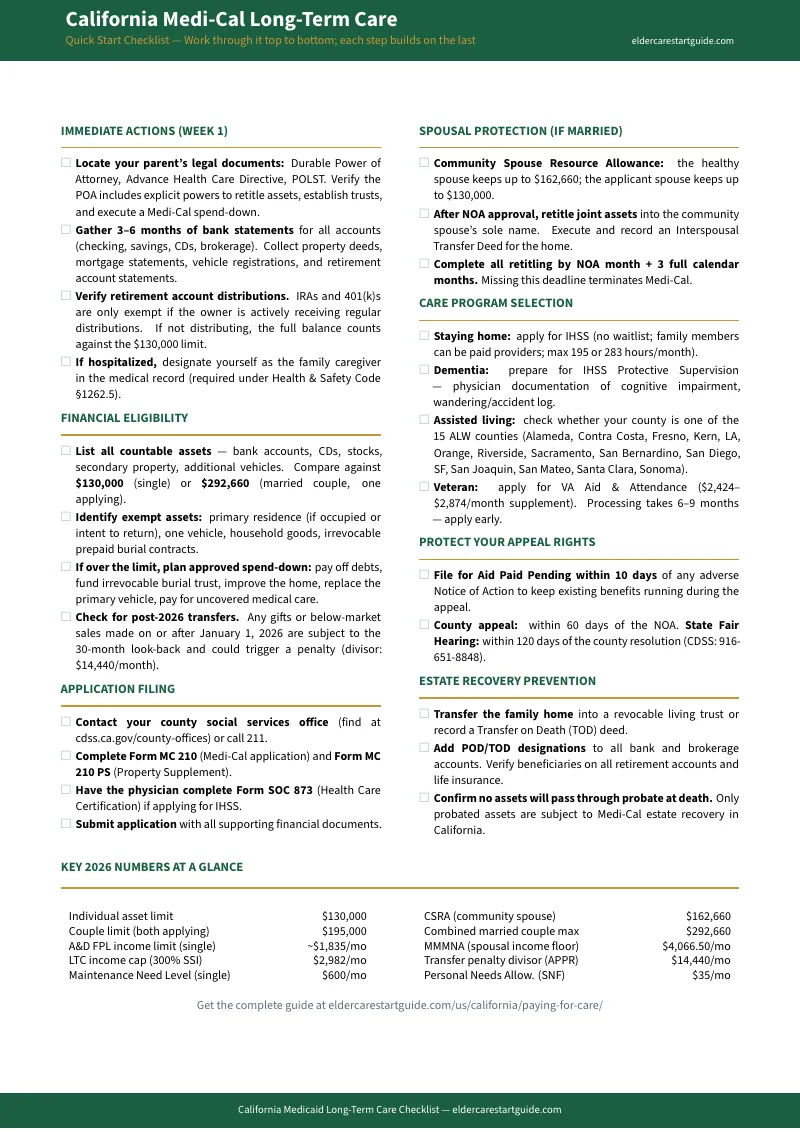
- 20-Item Quick-Start Checklist (free download) — the most urgent action items in priority order, from gathering financial records to protecting the family home
Who This Is For
- Adult children whose parent is facing a hospital discharge with Medicare about to end and no plan for paying the nursing home's $10,000+/month private rate
- Families who've been told their parent "makes too much" or "has too many assets" for Medi-Cal — without anyone explaining the $130,000 limit, the Share of Cost pathway that has no upper income limit, or the $162,660 in assets the community spouse can protect separately
- Community spouses terrified of losing the family home or being left with too little income after the institutionalized spouse's Share of Cost payment takes most of the household money
- Families researching IHSS for in-home care who need to understand why the Community First Choice Option enrollment is the difference between spousal protections applying or not
- Proactive planners whose parent is still healthy and want to record a Transfer on Death deed, execute a spend-down, or establish an irrevocable trust before the lookback window fully opens in July 2028
- Families who made gifts or property transfers during 2024–2025 and need to understand exactly how the permanent transfer shield works before applying
- Siblings who need a neutral, documented reference to resolve disagreements about spend-down strategy, whether to pay a caregiving sibling, or when to move from home care to facility placement
Why Free Resources Leave You Stuck
California's DHCS website publishes eligibility charts and program descriptions. County welfare offices process applications. But their staff are legally prohibited from advising you on asset protection strategy, spend-down sequencing, lookback penalty mitigation, or estate planning. They can hand you an application form. They cannot tell you how to restructure your parent's assets to qualify, whether your parent's IRA is countable, or whether the Transfer on Death deed your parent recorded in 2023 is properly formatted.
National publishers like Nolo, AARP, and LegalZoom write their California pages from templates built for states with 60-month lookbacks, Miller Trust requirements, and expanded estate recovery. California has none of these. Following generic Medicaid advice in a state with a 30-month lookback, a Medically Needy SOC pathway instead of income caps, and probate-only recovery creates real financial risk: families miss the transfer shield window, set up trusts the state doesn't require, or panic about estate recovery that wouldn't have applied.
Elder law attorneys navigate all of this — at $371 to $422 per hour, or $2,000 to $12,000+ for comprehensive crisis planning. Using this guide to organize your documents, understand the rules, and identify your parent's specific pathway before that first consultation can save significant billable hours. And for families with straightforward situations — no lookback violations, no complex property issues, no contested guardianship — the guide itself is enough.
Satisfaction Guarantee
If the guide doesn't help you identify at least one eligibility pathway, asset protection strategy, or application step you weren't already aware of, email us for a full refund. No forms, no waiting period.
Start Protecting Your Parent's Care and Savings Today
Download the free checklist to get the eligibility overview — or get the full guide for and have every worksheet, calculator, template, and filing reference you need to navigate California's Medi-Cal long-term care system from first crisis to approved application.