Your Parent's Bank Just Said No — Now What?
You called to pay your parent's hydro bill. The branch manager asked for a power of attorney. You printed the free form from the government website, had your parent sign it at the kitchen table, and brought it back to the bank.
Rejected.
Missing a continuing clause. Wrong witness. No capacity documentation. The teller cannot tell you what specifically is wrong — just that their compliance team will not accept it.
Meanwhile, the bills are piling up. And if your parent ends up in hospital tomorrow, you will face a second gatekeeping system that moves even faster: Ontario Health atHome placement coordinators who can select a long-term care home and begin admission — with or without your consent — under Bill 7 rules.
The Authority Establishment System
This is not a blank form with instructions to "consult your lawyer." It is a complete action system built specifically for Ontario families — covering the legal drafting, the institutional acceptance protocols, and the care placement defence that government portals, digital will platforms, and hospital social workers either cannot or will not walk you through.
Ontario has two separate powers of attorney under the Substitute Decisions Act — one for property, one for personal care — and each has its own execution rules, witness restrictions, and activation triggers. The kit covers both, in the exact sequence a family needs to move through: draft, sign, register with institutions, and then use that authority when banks, hospitals, or placement coordinators push back.
What's Inside
Continuing Power of Attorney for Property (CPOA) Walkthrough
The full execution sequence — from choosing an attorney to satisfying witness requirements to including the specific clauses that prevent bank rejections. Covers when the CPOA takes effect (immediately upon signing unless restricted), what "continuing" actually means in Ontario law, and why the free OPGT forms routinely fail at branch compliance desks.
Power of Attorney for Personal Care (POAPC) Walkthrough
Ontario does not have "living wills" or "advance directives" — your parent's care preferences go directly into the POAPC. The guide covers how to document wishes about tube feeding, resuscitation, palliative care, and housing preferences in a format that clinicians and substitute decision-makers can actually act on under the Health Care Consent Act.
Capacity Preservation Protocol
Ontario uses a "functional capacity" standard — your parent can legally sign a POA even with early-stage dementia, provided they understand the nature of the document at the time of signing. The kit includes the step-by-step process for evaluating, documenting, and proving capacity, plus a physician confirmation letter template that pre-emptively shuts down future challenges from other family members or institutions.
Bank Acceptance and Escalation Guide
The specific scripts and escalation pathways for when a branch manager refuses your document. Based on the Canadian Bankers Association's published obligations — which require banks to accept provincially compliant POAs and cannot force families onto proprietary bank forms. Covers requesting written reasons, escalating to senior compliance, and the court remedies available under the SDA if the bank persists.
Bill 7 Care Placement Defence Checklist
When a parent is designated Alternate Level of Care in hospital, placement coordinators can select a long-term care home within 70 kilometres and initiate admission without family consent. You get 24 hours to respond to a bed offer and 5 days to move in. The checklist covers your rights during this process, the appeal pathway through the Consent and Capacity Board, and how to manage the daily hospital charges that apply if you refuse.
OPGT Guardianship Alternative Guide
If capacity is already lost and no POA exists, the Office of the Public Guardian and Trustee becomes statutory guardian. The guide explains how to apply to replace the OPGT as guardian, what management and guardianship plans the court requires, and the realistic cost ($5,000 to $15,000) and timeline (6 to 12 months) so you can compare it against getting the POA done now.
HCCA Consent and SDM Hierarchy Navigator
Every Ontarian has an automatic substitute decision-maker under the Health Care Consent Act — even without a POAPC. The guide maps the full hierarchy, explains how a POAPC overrides it, and shows families how to prevent the sibling disputes and care stalemates that land at the Consent and Capacity Board.
Fiduciary Accounting Ledger
Structured templates for tracking every financial transaction, managing property, and reporting to siblings — because the fastest way to destroy a family during a care crisis is unclear record-keeping and allegations of misuse.
7 Standalone Printable Tools
Every major section of the guide is also extracted as a standalone PDF you can print and bring to the bank, the hospital, or the doctor's office: bank escalation scripts, capacity assessment worksheet with physician letter template, Bill 7 defence checklist, fiduciary accounting ledger, SDM hierarchy reference card, decision flowcharts, and an official forms and resources directory.
Who This Is For
- Adult children setting up decision-making authority for a parent who can still sign — before a crisis forces the expensive court route
- Families dealing with a parent's progressive cognitive decline who need to know if signing is still legally possible
- Anyone whose bank just rejected a power of attorney and needs to know their escalation rights
- Families facing a hospital discharge under Bill 7 rules who need to establish legal authority fast
- Siblings who need a clear, documented decision-making structure to prevent conflict and Consent and Capacity Board referrals
Why Not Free Government Forms?
The OPGT and CLEO provide free POA forms online. They are legally valid blanks — and that is all they are. They do not include continuing clauses that satisfy bank compliance teams. They do not explain the witness restrictions that invalidate a document. They do not tell you what to do when the branch manager says no, when the placement coordinator selects a care home without your input, or when your parent's fluctuating capacity creates a signing window that may close permanently.
Digital will platforms like Willful and Epilogue generate clean documents for capable adults planning ahead. They do not address active cognitive decline, bank rejection protocols, Bill 7 discharge timelines, or the clinical consent rules under the HCCA that govern what actually happens at the bedside.
A traditional elder-law lawyer covers all of this — for $900 to $2,500. This kit costs .
100% Satisfaction Guarantee
If the kit does not help you establish legal authority for your parent more confidently, email us and we will refund you — no questions, no time limit.
Get Started Now
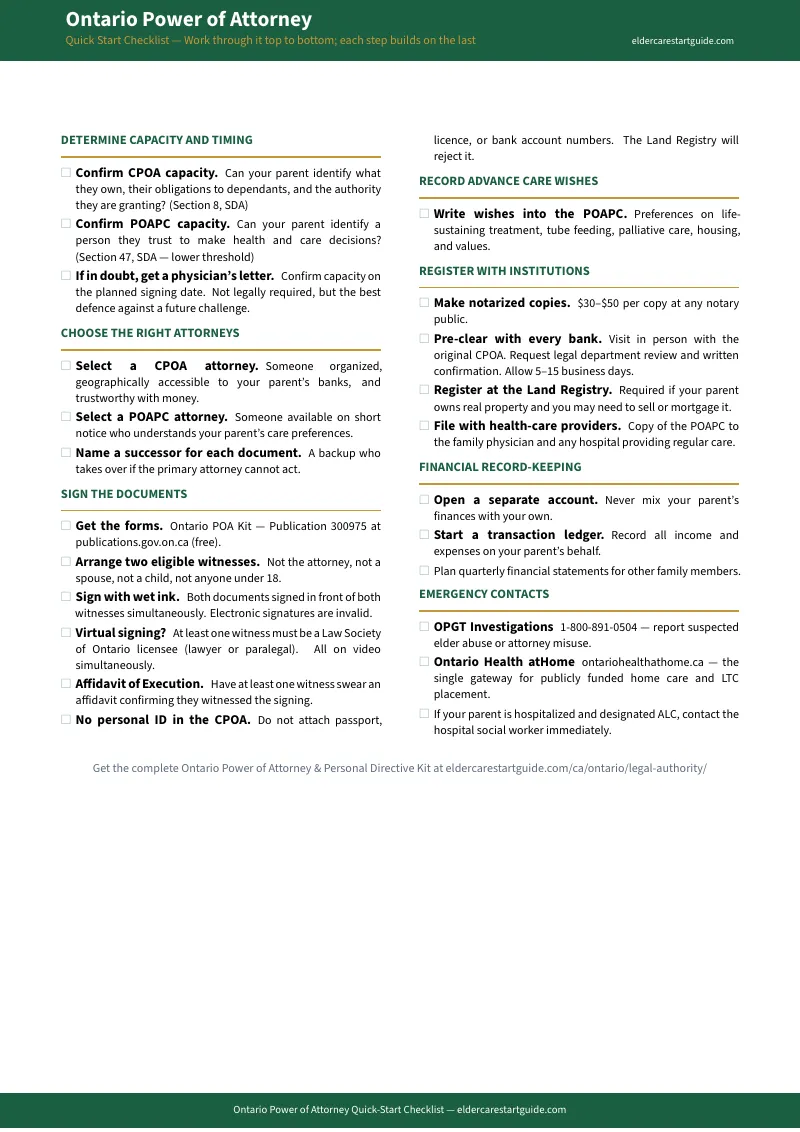
Download the free checklist to see the key steps at a glance — or get the complete Authority Establishment System for and start drafting, signing, and registering the documents your family needs before the next institutional gatekeeper says no.