Two Programs. Zero Communication. And Your Parent Is Caught in the Middle.
Medicare says Medicaid should pay. Medicaid says Medicare should pay. The hospital discharge planner is telling you to figure it out by Friday — or your parent starts paying $10,000 a month out of pocket for nursing care that should be covered.
You're not a healthcare administrator. You didn't study insurance law. But right now you're the only person standing between your parent and a billing disaster that could drain their savings in weeks.
The information exists — scattered across Medicare.gov, your state Medicaid portal, three different federal agencies, and a stack of legal statutes nobody wrote in plain English. A SHIP counselor can answer one question at a time. An elder-law attorney will charge you $300–$600 an hour to explain the basics. Neither will hand you a start-to-finish plan for what to do on Monday morning.
The Dual-Eligible Coordination Blueprint
This isn't a glossary of insurance terms. The Dual-Eligible Coordination Blueprint is an operational roadmap — the step-by-step sequence of filings, screenings, enrollment decisions, and asset-protection strategies that keeps both programs working together instead of against each other.
It bridges the gap that government portals can't: Medicare.gov explains federal benefits in isolation. Your state Medicaid site explains state rules in isolation. This guide shows you exactly how the two programs interact at every friction point — hospital discharge, nursing home billing, prescription coverage, annual redetermination, and estate recovery.
What You Get
- 13-Chapter Coordination Guide (42 pages) — Covers the full dual-eligible lifecycle: coordination of benefits, financial inventory, federal screenings (Extra Help + MSP), state Medicaid application, Miller Trust setup, asset spend-down strategies, D-SNP enrollment, redetermination prep, care coordination, appeals, spousal protections, and knowing when to hire a professional.
- Who-Pays-First Decision Map (standalone printable) — The exact payment hierarchy for every scenario: inpatient hospital, skilled nursing, home health, prescription drugs, durable medical equipment. No more guessing which program covers what.
- QMB Balance Billing Defense Kit (standalone printable) — A copy-and-paste stop-billing letter citing the Balanced Budget Act of 1997 (42 U.S.C. § 1396a(n)(3)(B)), plus the step-by-step escalation path to report illegal billing to 1-800-MEDICARE and the CFPB. If your parent has QMB status, providers cannot bill them for Medicare cost-sharing — period.
- State-by-State Asset Reference (standalone printable) — 2026 Medicaid asset limits for every state (the standard $2,000 threshold, California's $130,000 limit, New York's $33,038 cap, and every variation in between), plus the countable vs. exempt asset rules so you know exactly what qualifies.
- Legal Spend-Down Strategies (standalone printable) — Medicaid-compliant spend-down methods, irrevocable funeral trusts, personal debt payoff, caregiver compensation agreements, home protection strategies, and the Caregiver Child Home-Transfer Exemption (42 U.S.C. § 1396p(c)(2)(A)(iv)) — with a tracking ledger to document every transaction.
- D-SNP Enrollment Playbook (standalone printable) — How to compare plans, screen brokers for commission bias, maximize supplemental benefits (transportation, dental, vision, OTC allowances), and use the monthly Integrated Care Special Enrollment Period that replaced the old quarterly window in 2025.
- Redetermination Preparation Checklist (standalone printable) — Every document you need assembled before the state sends the annual renewal packet. Includes the tracking calendar, ex-parte verification process, the deemed continued eligibility grace period, and the appeal timeline if coverage is terminated.
- 4 Printable Worksheets (standalone printables) — Financial Inventory Worksheet (eligibility status + asset inventory + income detail), Coordination of Benefits Tracker (claims log + QIT disbursement tracking), D-SNP Plan Comparison Matrix (side-by-side evaluation of up to 3 plans), and Monthly Care Coordination Log (appointments, medications, and care team contacts).
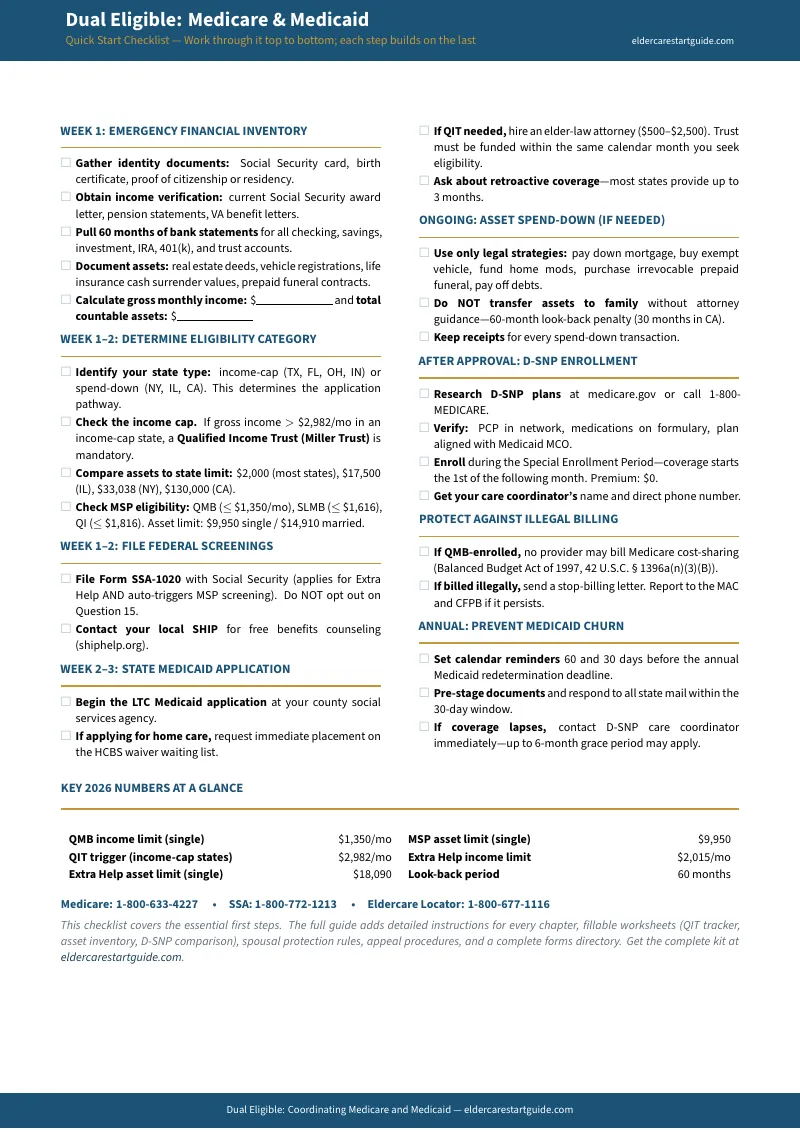
- Quick-Start Checklist (Free Download) — 20 actionable items organized across 8 time-based sections. Know exactly what to gather, who to call, and what to file — starting tonight.
Who This Blueprint Is For
- Adult children managing a parent's healthcare who just discovered their parent qualifies for both Medicare and Medicaid — and have no idea what that means operationally
- Caregivers facing a hospital discharge deadline with a parent transitioning from Medicare-covered skilled nursing to Medicaid-funded long-term care
- Families who need to spend down a parent's assets to qualify for Medicaid without triggering a look-back penalty or losing the family home
- Anyone whose parent is enrolled in a D-SNP (or should be) and needs to understand how to maximize benefits, screen plans, and switch during open enrollment
- Caregivers who received a Medicaid redetermination notice and need a structured checklist — not scattered government FAQ pages — to respond correctly within the 30-day window
Why Free Resources Don't Solve This
Medicare.gov will explain your parent's federal benefits. Your state Medicaid portal will explain the state asset limits. But neither site shows you what happens when Medicare's 100-day skilled nursing coverage expires and you need to transition your parent to Medicaid long-term care — on a deadline, with a billing department pressuring you to go private-pay.
SHIP counselors are volunteer-run and legally prohibited from advising on asset protection strategies. Online articles from insurance companies are designed to funnel you into Medicare Advantage plan enrollment — they don't cover Medicaid spend-down, estate recovery, or billing disputes because those topics don't generate plan commissions.
Legal publishers take you just far enough to realize you're in over your head, then direct you to their attorney directory at $300–$600 per hour. This guide doesn't replace an attorney when you need one — Chapter 13 tells you exactly when that is. But it ensures you don't spend your first three billable hours learning vocabulary and organizing bank statements.
Satisfaction Guarantee
If this blueprint doesn't give you a clear, actionable path to coordinating your parent's dual benefits, email [email protected]. We read every message.
— Less Than 10 Minutes of an Elder-Law Attorney's Time
Elder-law attorneys charge $300–$600 per hour. Certified Medicaid planners charge $3,000–$8,000 flat fee. Geriatric care managers charge $150–$350 per hour. Walking into any of those offices unprepared means spending your first session — and up to $1,800 — just learning terms and organizing records.
This blueprint is the preparation that makes every professional dollar count. And for many families, it covers enough ground that you can handle the coordination yourself.
Download the free Quick-Start Checklist to see the 20 most urgent action items. When you're ready for the complete coordination system, the full blueprint is here.