
The Hospital Says Your Parent Is Ready to Leave. You Know They're Not.
Your parent went into Queen's, Straub, Maui Memorial, or one of Hawaii's community hospitals after a fall, a stroke, or a sudden cognitive decline. Now a discharge planner is telling you the acute stay is ending — often within 24 to 48 hours. And you're the one who has to figure out what happens next.
Where do they go? Will Medicare cover rehab? Why does the nurse keep saying "observation"? Can the hospital really send a frail parent home to a house that isn't set up for their care? What if they need a nursing home — and how do you pay for it without losing the family home?
Hospital social workers mean well, but they work under intense pressure to clear the bed, and they're barred from managing your family's financial planning. Hawaii's state portals hand you regulatory definitions, not action plans. Elder law attorneys charge $300–$500 an hour. And the national "senior living advisor" sites — A Place for Mom, Caring.com — are lead-generation funnels that route your phone number to placement services earning facility commissions.
The Island Discharge Defense System
This toolkit replaces the panic with a step-by-step system built specifically for Hawaii families — not a national Medicare overview with "Hawaii" pasted in. The Commence Health appeal process, Med-QUEST managed care thresholds, Kupuna Care eligibility, and Hawaii's own probate-only estate recovery rules, organized in the order a crisis actually unfolds.
It's built for the adult child who became the family's care coordinator overnight — whether you're on O'ahu, on the Neighbor Islands managing everything from a rural community, or coordinating from the mainland while your parent sits in a hospital thousands of miles away.
What's Inside
Discharge Rights and Appeal Scripts
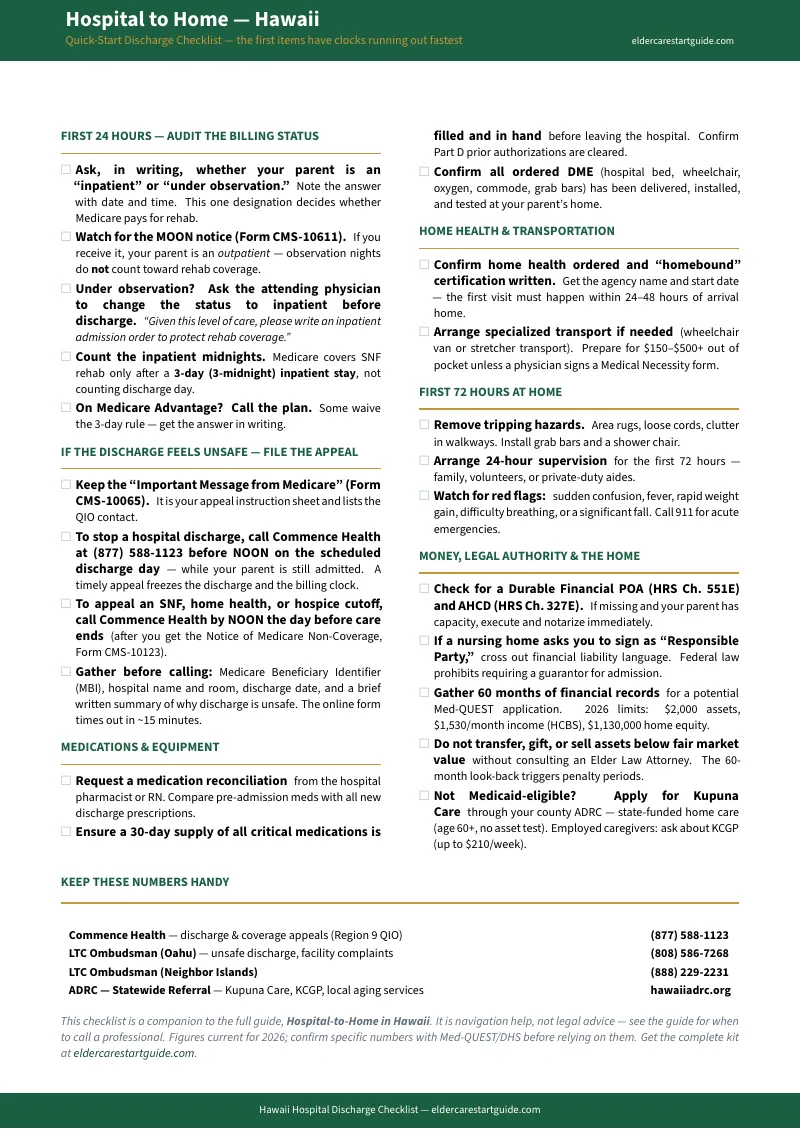
The exact process to challenge an unsafe discharge through Commence Health, Hawaii's federally contracted Region 9 BFCC-QIO, including the direct appeal line (877-588-1123), the noon-same-day filing deadline, and the automatic stay that pauses the discharge — and stops the billing clock — while a QIO physician reviews the case. Plus word-for-word scripts for demanding a care-team meeting and a written discharge plan. You cannot be forced to accept a discharge you believe is unsafe.
The Observation Status Trap — and How to Escape It
If your parent spent three nights in a hospital bed but was classified as "observation" instead of "inpatient," Medicare Part A won't cover a single day of skilled nursing rehab — because observation days don't satisfy the three-midnight rule. The MOON notice you were handed is the warning sign. This section explains how to verify status, the script for asking the attending physician to write an inpatient order, and how to appeal the billing designation before a recovery turns into bills of $8,000–$12,000 per month at private SNF rates.
The "Responsible Party" Strikeout Template
Skilled nursing admissions coordinators routinely push adult children to sign as the "Responsible Party" or "guarantor." Here's what they don't tell you: Hawaii has no filial responsibility statute — HRS § 577-7 defines parents' duties to minor children, but no corresponding law forces adult children to support indigent parents. Federal law (42 USC § 1396r) bans any Medicaid-certified facility from requiring a third-party payment guarantee. This section gives you the exact wording to write in the contract margin so you sign solely as agent under Power of Attorney — with zero personal liability.
Med-QUEST Eligibility Workbook
Hawaii's Medicaid long-term care program operates through Med-QUEST managed care plans. This workbook walks you through the 2026 limits — the $2,000 single-applicant asset ceiling, the medically needy spend-down pathway (no income cliff, no Miller Trust), spousal impoverishment protections (CSRA up to $162,660, MMMNA of $2,643.75–$4,066.50/month), and the $1,130,000 home equity exemption. It shows you what counts, what doesn't, and how to legally reposition assets before a crisis forces your hand.
Kupuna Care and KCGP Benefits Navigator
Hawaii's non-Medicaid aging programs are powerful but hard to find and harder to navigate. Kupuna Care funds home-delivered meals, personal care, and adult day care for residents 60 and older. The Kupuna Caregivers Program (KCGP) reimburses up to $210 per day for respite or personal care so working family caregivers can stay employed. This navigator maps eligibility, shows you how to access both through your county ADRC, and explains what happens when these programs interact with Medicare home health and Med-QUEST.
Estate Recovery Defense Guide
After a parent on Med-QUEST passes, the state can seek recovery of long-term care expenditures — but Hawaii uses a probate-only definition of the estate. Property that transfers outside of probate — joint tenancy with right of survivorship, POD bank accounts, revocable trusts — is legally exempt. This guide explains the spousal and dependent deferrals, the Caregiver Child Exception (two-year residency rule), and the exact documentation path to protect the family home.
Hawaii Resource Directory
Every contact you'll need in one printable page: the Hawaii ADRC intake line, all four county Area Agencies on Aging (Honolulu Elderly Affairs Division, Maui County OA, Hawaii County OA, Kauai Agency on Elderly Affairs), Commence Health's appeal line, local home health agencies, adult day health centers, and non-emergency medical transport for inter-island transfers.
First 72 Hours at Home Survival Guide
The highest-risk window for medication errors, falls, and readmission. A day-by-day checklist covering medication reconciliation, durable medical equipment delivery, home safety setup, follow-up appointment scheduling, and how to arrange home-delivered meals and respite through your county agency — the details that keep a discharge from becoming a bounce-back.
Who This Is For
- Adult children in Hawaii managing a parent's hospital discharge — first time or fifth time, the pressure is the same
- Out-of-state family members coordinating remotely for a parent at Queen's, Straub, Maui Memorial, Hilo Medical, or any Hawaii hospital
- Families facing the observation-status surprise who just learned Medicare won't pay for rehab
- Families approaching Med-QUEST who need to understand the $2,000 asset limit, medically needy spend-down, and spousal protections before savings run out
- Multi-generational Hawaii families worried about estate recovery reaching the family home after a parent passes
Why Free Tools Don't Cover This
National sites like A Place for Mom and Caring.com maintain big facility directories — but their business model depends on routing your phone number to sales advisors who earn commissions from placements. They won't tell you how to file a Medicare appeal, prepare for Med-QUEST eligibility, or refuse a guarantor signature.
UHELP's Fundamental Elder Law Hawai'i Handbook is comprehensive and authoritative — but it's written in dense academic legalese and explicitly states it's "not a do-it-yourself guide." It doesn't give you checklists, phone scripts, or the step-by-step timeline for the 24-hour discharge appeal window.
Medicare.gov and AARP explain federal discharge rights accurately — but in abstract language that never connects to Commence Health's Hawaii phone number, your county ADRC, or the specific Med-QUEST thresholds that apply here.
This toolkit connects those fragmented pieces into a single action plan with the Hawaii-specific details already filled in.
Satisfaction Guarantee
If the toolkit doesn't give you the clarity and confidence to manage your parent's transition, email us for a full refund. No forms, no hoops, no time limit.
— Less Than a Single Hour of Professional Help
A Hawaii elder law attorney charges $300–$500 per hour. A geriatric care manager runs $150–$250 per hour. A Medicaid planner runs $2,000–$5,000. This toolkit handles the procedural and administrative work you can do yourself, and tells you exactly when it's time to bring in a professional.
Download the free Hawaii Hospital Discharge Checklist to start, or get the complete toolkit with the full guide, worksheets, scripts, and Hawaii resource directory.