
Your Parent Is Being Discharged in 48 Hours. Nobody Handed You a Plan.
The hospital social worker just told you your mother can't go home alone — and that her bed is needed by Thursday. You've never heard of the EPD Waiver, DC Care Connect, or the interRAI assessment. You're a federal employee, a lawyer, a professional who manages complexity every day, yet the District's aging-care system has left you staring at a phone number and a stack of jargon, wondering how you're supposed to build a safe home in 72 hours.
Or maybe the letter came first: the Economic Security Administration says your father's income is "$400 too high" for Medicaid — but he still can't afford $6,000 a month in private care. Or you've read the words "estate recovery" and now you're terrified that accepting home care means the District will put a lien on the family home your parents spent forty years paying off.
You are not disorganized. You are navigating one of the most fragmented public-care systems in the country, where the rules live across three different agencies — DACL, DHCF, and the ESA — and half the PDFs online still quote financial figures from years ago.
Introducing the D.C. Aging-in-Place Blueprint
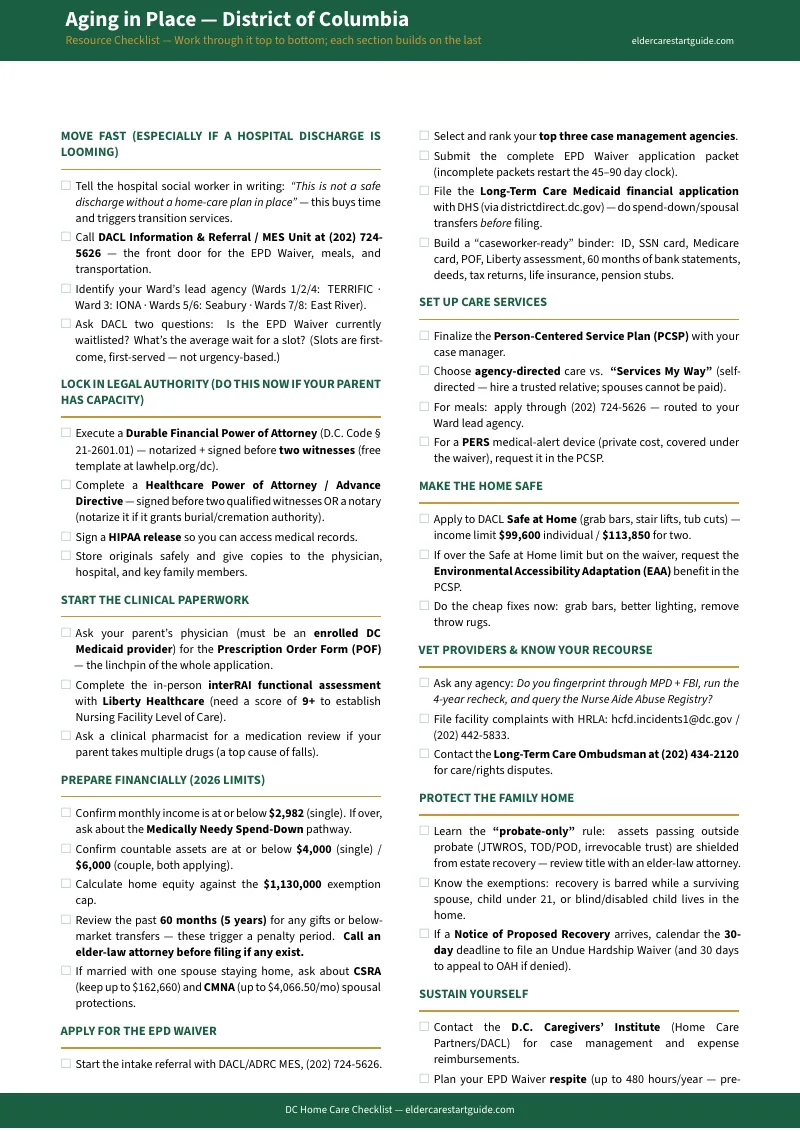
This is the guide the District's own websites should have given you: a single, chronological system that turns thousands of pages of D.C. municipal regulation into a sequenced, day-by-day path to getting your parent safe at home — with the funding secured and the family home protected.
The difference isn't more information. It's sequence. The government portals tell you the rules; they never tell you the order. Submit a Medicaid application without a Prescription Order Form signed by an enrolled D.C. provider first, and you trigger weeks of administrative delay. This guide is built around the exact chronological execution path — so you do each step in the order that actually works.
What's Inside
A 13-chapter guide plus 8 standalone printable tools — worksheets, checklists, and reference cards you can bring to appointments, hand to a caseworker, or tape to the fridge:
- The EPD Waiver Application Roadmap — The 7-step application sequence with every form, agency, and deadline mapped out, plus a caseworker-ready binder checklist. For the caregiver racing a discharge deadline.
- The Financial Eligibility Worksheet — Fill in your parent's numbers against the 2026 D.C. thresholds: the $2,982 monthly income limit, the $4,000 asset limit, the $1,130,000 home-equity exemption, spousal protections (CSRA/CMNA), and a result flowchart.
- The Spend-Down Expense Tracker — For families whose income is just over the line: a monthly ledger showing exactly what counts toward the Medically Needy deductible and how to submit it to DHCF.
- The Estate Recovery Defense Worksheet — The truth about the lien you're afraid of: the asset-by-asset exposure analysis under D.C.'s probate-only rules, automatic protections, and the strict 30-day hardship waiver deadlines.
- The "Services My Way" Implementation Guide — How to get paid to care for your own parent: registering as a Participant-Directed Worker, establishing your parent as the common-law employer, and drawing wages directly through D.C. Medicaid.
- The Legal Authority Checklist — Durable POA, advance directives, and HIPAA releases with DC-specific witness and notary rules — handled before a cognitive crisis locks you out.
- The Provider Vetting Scorecard — Side-by-side comparison grid for evaluating home care agencies, the DC background-check questions to ask, and every complaint contact.
- The Home Safety Assessment — Room-by-room fall-prevention walkthrough with D.C. funding sources (Safe at Home program, EPD Waiver EAA benefit).
- The Key Contacts Fridge Sheet — Ward-by-ward lead agencies, transportation programs, and every phone number on one page. Print it and keep it by the phone.
Who This Is For
- The adult child facing an unsafe hospital discharge in the next few days
- The middle-class family caught in the spend-down gap — too much income for Medicaid, too little for private care
- The proactive planner protecting a valuable D.C. home from estate recovery before a diagnosis becomes a crisis
- Anyone doing the caregiving work without yet having the legal authority to sign for it
Why Not Just Use the Free Government Sites?
Because you've already tried. DACL, DHCF, and DHS each hold a piece, none of them hold the sequence, and the intake line at 202-724-5626 drops you into a phone queue, not a plan. The rules are free; the roadmap is what you're missing — and the cost of getting the order wrong is measured in weeks of delay while your parent sits in an unsafe home.
And no, this is not a substitute for an elder-law attorney — it's what makes one affordable. D.C. elder-law attorneys bill $300–$600 an hour, and their first billable hours go to requesting the exact documents this guide helps you assemble yourself: five years of bank statements, the property deed, the medical certifications. Walk in organized and you spend your legal dollars on strategy, not paperwork. National directories like A Place for Mom won't help either — they're paid to steer you toward assisted living, not to keep your parent home.
Try It Risk-Free
If this guide doesn't give you a clearer, faster path than the government portals did, email us and we'll refund you — no forms, no friction. You're already carrying enough.
Start free: download the District of Columbia Aging-in-Place Resource Checklist — a one-page map of every program, agency, and phone number, yours at no cost. When you're ready for the full step-by-step system, the complete Blueprint is one click away for .