
Your Parent Needs Help. Texas Won't Let You Give It — Until You Have the Right Paperwork.
Your parent fell. Or a hospital discharge planner just told you they can't go home alone. Or you drove to the bank to pay their mortgage and the teller said, "We can't talk to you about this account."
You're doing everything — driving to appointments, managing medications, fielding calls from siblings — but you have zero legal authority to sign a single document on your parent's behalf. Texas law doesn't care that you're the one showing up every day. Without the right legal instruments in place, banks will lock you out, hospitals won't share test results, and Medicaid offices will reject your application.
The Texas Legal Authority Roadmap
This kit is not a stack of blank forms. It's the process around the forms — the part that $300/hour attorneys explain in a one-hour consultation and that free government websites leave out entirely.
It covers two paths: proactive planning (when your parent can still sign) and court-supervised guardianship (when capacity is already gone). And it connects both paths to the Medicaid long-term care system you will almost certainly need to navigate, including the STAR+PLUS program, Qualified Income Trusts, and Lady Bird deed protection.
What's Inside
The kit includes a 14-chapter guide plus 8 standalone printable worksheets and tools — 9 PDFs total:
- Capacity Assessment Protocol — A plain-language framework for determining whether your parent can still legally sign a power of attorney, with documentation steps that protect against future challenges from siblings or institutions.
- Statutory Durable POA Walkthrough — Not just the form. Which authority blocks to initial (and the two that most families skip, which later prevents them from setting up a Miller Trust or executing a Lady Bird deed). How to choose between immediate and springing activation. Where to get the form notarized.
- Medical POA + Advance Directive Package — Texas Health and Safety Code Chapter 166 compliance. Witness eligibility rules (who can't sign). How the medical POA, living will, and out-of-hospital DNR work together — and which one hospital staff actually look for during an emergency.
- Bank Acceptance Playbook (standalone printable) — The seven-business-day statutory timeline under Texas Estates Code Chapter 751. The Agent's Certification form that bypasses most branch-level objections. A written demand template that forces the bank to escalate to corporate legal or accept your document.
- Guardianship Process Guide — When and how to file for guardianship in Texas probate court. The mandatory Physician's Certificate of Medical Examination. Attorney ad litem appointment. Temporary emergency guardianship for crisis situations. Annual reporting and bonding requirements.
- Alternatives to Guardianship — Supported Decision-Making Agreements under Texas Estates Code Chapter 1357. Representative payee status. Community administration for spouses. When each alternative works and when guardianship is unavoidable.
- STAR+PLUS Medicaid Roadmap — The 2026 income cap ($2,982/month), what happens when your parent exceeds it, and how to set up a Qualified Income Trust (Miller Trust) to maintain eligibility. The Form H1200 application. The HCBS interest list process. What "STAR+PLUS" actually covers versus what it doesn't.
- Lady Bird Deed Guide — How to protect the family home from the Medicaid Estate Recovery Program (MERP) using an enhanced life estate deed. When to use one, when not to, and the specific DPOA authority required if your parent can no longer sign the deed themselves.
- Fiduciary Recordkeeping System — A transaction ledger and documentation protocol that satisfies Texas Estates Code Chapter 751 requirements. Designed to prevent sibling disputes by making every financial decision transparent and auditable.
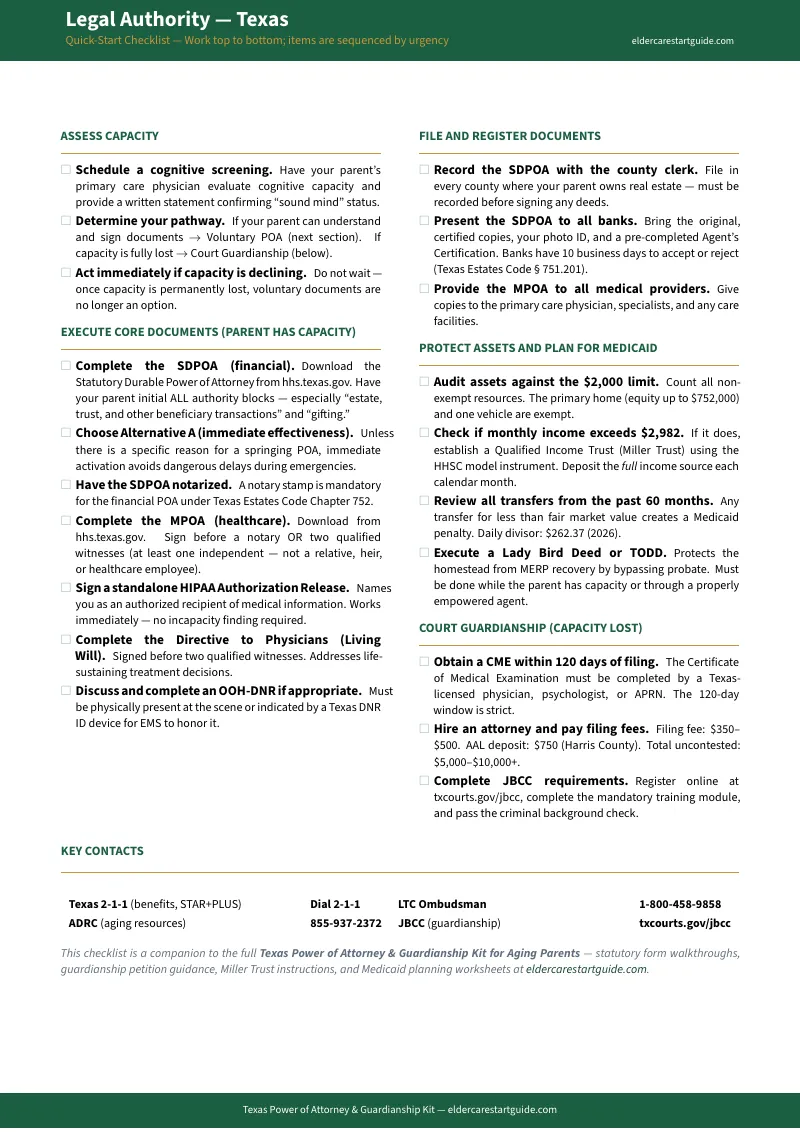
- Quick-Start Checklist — A printable, single-page action list that extracts the most time-sensitive items from the full guide. Start here when you're in crisis mode and need to know what to do today, this week, and this month.
Standalone Printable Worksheets
- Financial Snapshot Worksheet — Map your parent's countable assets and monthly income against 2026 Texas Medicaid limits, including spousal protections
- QIT Monthly Disbursement Tracker — Track Qualified Income Trust deposits and disbursements each month to maintain Medicaid eligibility
- 60-Month Look-Back Audit — Map all transfers from the past 5 years and calculate potential penalty periods before HHSC does
- Bank Presentation Log — Document every attempt to present your SDPOA to financial institutions, creating the paper trail for escalation
- Agent's Transaction Ledger — Record every financial transaction made on your parent's behalf to satisfy fiduciary duty requirements
- Decision Flowchart — A visual guide to which legal instrument you need based on your parent's current capacity and situation
Who This Kit Is For
- Adult children who just learned they need "power of attorney" and don't know where to start
- Families facing a hospital discharge where the parent can't go home alone and nobody has legal authority to sign admission papers
- Caregivers whose parent has early-stage dementia and can still sign — but the window is closing
- Siblings who need a clear, documented process to avoid disputes about who controls what
- Families dealing with a bank that won't honor their existing power of attorney
- Anyone trying to navigate STAR+PLUS Medicaid enrollment and the Miller Trust process without paying thousands in attorney fees
Why Not Just Use Free Forms?
Texas provides free statutory power of attorney forms. TexasLawHelp.org has them. You can download them right now.
Here's what those forms don't tell you:
- Which of the 13 authority categories to initial — and how skipping "estate, trust, and other beneficiary transactions" will prevent you from setting up the Miller Trust your parent needs for Medicaid eligibility six months from now
- What to do when Bank of America's branch manager refuses to honor the form you just had notarized — and how Texas Estates Code Subchapter E forces them to respond within seven business days
- How to determine whether your parent can still legally sign, or whether you've already crossed the threshold into guardianship territory
- The exact sequence of steps for the STAR+PLUS application, the QIT bank account, and the monthly income transfers that keep your parent qualified
The forms are step one of a twenty-step process. This kit covers all twenty.
Satisfaction Guarantee
If the kit doesn't give you a clearer path forward, email [email protected] and we'll make it right.
— Less Than One Hour of an Elder Law Attorney's Time
The average initial consultation with a Texas elder law attorney runs $300 to $500. A full guardianship proceeding can cost $5,000 or more in court fees and legal representation.
This kit won't replace an attorney for complex litigation or multi-million dollar trust planning. But for the standard power of attorney execution, institutional acceptance, and Medicaid navigation that most Texas families need, it covers the process at a fraction of the cost.
Start with the free checklist to see if the approach fits your situation. The full kit goes deeper with complete guides, checklists, worksheets, and step-by-step institutional playbooks.