
The Hospital Says Your Parent Is Ready to Leave. You Know They're Not.
Your parent went into Billings Clinic, Benefis, St. Patrick, or Bozeman Health after a fall, a stroke, or a sudden decline. Now a discharge planner is telling you the acute stay is ending — often within 24 to 48 hours. And you're the one who has to figure out what happens next.
Where do they go? Will Medicare cover rehab? Why does the nurse keep saying "observation"? Can the hospital really send a frail parent home to a house that's hundreds of miles away and completely unprepared? What if they need a nursing home — and how would you ever pay for it without losing the family ranch?
Hospital social workers mean well, but they work under intense pressure to clear the bed, and they're legally barred from managing your family's financial planning. Montana's state portals hand you regulatory definitions, not action plans. Elder law attorneys charge $300–$500 an hour. And the national "senior living advisor" sites are lead-generation funnels that route your phone number to placement services earning facility commissions.
The Big Sky Discharge Defense System
This toolkit replaces the panic with a step-by-step system built specifically for Montana families — not a national Medicare overview with "Montana" pasted in. Montana appeal contacts, Montana Medicaid thresholds, the Big Sky Waiver process, and Montana's own repealed responsibility law, organized in the order a crisis actually unfolds.
It's built for the adult child who became the family's care coordinator overnight — whether you're in Missoula, out on a ranch in Phillips County, or managing everything from another state while your parent sits in a hospital hundreds of miles from home.
What's Inside
Discharge Rights and Appeal Scripts
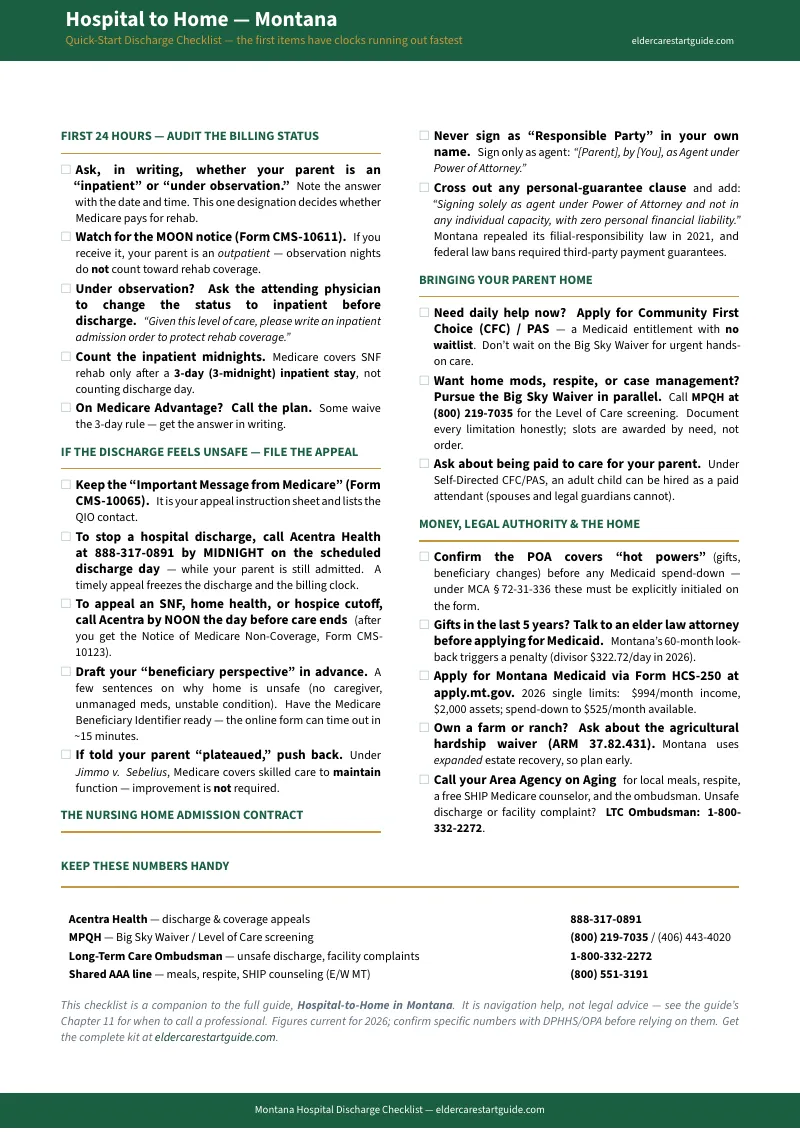
The exact process to challenge an unsafe discharge through Acentra Health, Montana's federally contracted Region 8 BFCC-QIO, including the direct appeal line (888-317-0891), the noon-next-day filing deadline, and the automatic stay that pauses the discharge — and stops the billing clock — while a QIO physician reviews the case. Plus word-for-word scripts for demanding a care-team meeting and a written discharge plan. You cannot be forced to accept a discharge you believe is unsafe.
The Observation Status Trap — and How to Escape It
If your parent spent three nights in a hospital bed but was classified as "observation" instead of "inpatient," Medicare Part A won't cover a single day of skilled nursing rehab — because observation days don't satisfy the three-midnight rule. The MOON notice you were handed is the warning sign. This section explains how to verify status, the script for asking the attending physician to write an inpatient order, and how to appeal the billing designation before a recovery turns into a five-figure bill.
The "Responsible Party" Strikeout Template
Skilled nursing admissions coordinators routinely push adult children to sign as the "Responsible Party" or "guarantor." Here's what they don't tell you: Montana repealed its filial responsibility law (MCA § 40-6-301) in 2021, and federal law (42 USC § 1396r) bans any Medicaid-certified facility from requiring a third-party payment guarantee as a condition of admission. This section gives you the exact wording to write in the contract margin so you sign solely as agent under Power of Attorney — with zero personal liability.
The Big Sky Waiver Eligibility Workbook
Montana's Big Sky Waiver (BSW) funds in-home care, equipment, and home modifications so your parent can avoid a nursing home — but it's slot-limited with a waitlist, and slots are awarded by medical and safety risk, not by who's been waiting longest. This workbook walks you through the 2026 Medicaid limits ($994/month single income cap, $2,000 asset limit, $525/month Medically Needy spend-down), what counts and what doesn't, and how to legally spend down onto exempt items like home modifications.
MPQH Level-of-Care Preparation Kit
Mountain Pacific Quality Health (MPQH) performs the mandatory level-of-care screening that decides whether your parent qualifies for waiver services. Most families undersell the need because they describe their parent on a good day. This preparation kit and form-letter set — with MPQH's intake lines — helps you document the physical, cognitive, and functional limitations the state-contracted nurses need to see, on the worst days, not the best.
MERP Estate Recovery Defense Guide
After a parent on Medicaid passes, Montana's DPHHS Estate Recovery Unit can come after the family home, farm, or ranch — and Montana uses expanded recovery that reaches beyond probate to joint tenancies, right-of-survivorship transfers, and beneficiary deeds. This guide explains the spousal and dependent deferrals, the three-year statute of limitations on non-probate claims, and the exact documentation path (ARM 37.82.431) to claim an agricultural hardship waiver and keep a working ranch in the family.
Montana Resource Directory
Every contact you'll need, mapped for a frontier state: all of Montana's Area Agencies on Aging (including Rocky's Agency on Aging and Southwest Montana Aging and Disability Services), regional Office of Public Assistance locations, tribal elder services (including CSKT Elder Services on the Flathead Reservation), home health agencies, and non-emergency medical transport for long rural transfers home.
First 72 Hours at Home Survival Guide
The highest-risk window for medication errors, falls, and readmission. A day-by-day checklist covering medication reconciliation, durable medical equipment delivery, home safety setup, follow-up appointment scheduling, and how to arrange home-delivered meals and respite through your regional agency — the details that keep a rural discharge from becoming a bounce-back.
Who This Is For
- Adult children in Montana managing a parent's hospital discharge — first time or fifth time, the pressure is the same
- Out-of-state family members coordinating remotely for a parent in Billings, Missoula, Great Falls, Bozeman, Kalispell, or rural and tribal Montana
- Families facing the observation-status surprise who just learned Medicare won't pay for rehab
- Families approaching Medicaid who need to understand Montana's $994 income cap, $2,000 asset limit, and the Big Sky Waiver before savings run out
- Ranch and farm families worried about estate recovery taking the land after a parent dies
Why Free Tools Don't Cover This
National sites like A Place for Mom and Caring.com maintain big facility directories — but their business model depends on routing your phone number to sales advisors who earn commissions from placements. They won't tell you how to file a Medicare appeal, prepare for the MPQH screening, or refuse a guarantor signature.
Medicare.gov and AARP explain federal discharge rights accurately — but in abstract language that never connects to Acentra Health's Montana phone number, your regional Area Agency on Aging, or the specific Medicaid thresholds that apply here.
Montana's own DPHHS and Aging Services pages contain the real rules — scattered across dozens of dense administrative pages that are nearly impossible to parse when you're standing in a hospital hallway deciding where your parent will sleep tomorrow.
This toolkit connects those fragmented pieces into a single action plan with the Montana-specific details already filled in.
Satisfaction Guarantee
If the toolkit doesn't give you the clarity and confidence to manage your parent's transition, email us for a full refund. No forms, no hoops, no time limit.
— Less Than a Single Hour of Professional Help
A Montana elder law attorney charges $300–$500 per hour. A geriatric care manager runs $150–$250 per hour — and is nearly impossible to find outside the urban hubs. A Medicaid planner runs $2,000–$5,000. This toolkit handles the procedural and administrative work you can do yourself, and tells you exactly when it's time to bring in a professional.
Download the free Montana Hospital Discharge Checklist to start, or get the complete toolkit with the full guide, worksheets, scripts, and Montana resource directory.