Your Parent Has Dementia. Massachusetts Has 47 Forms, 4 Agencies, and a 60-Month Clock.
The diagnosis hit like a wall. Now you're sitting at a kitchen table covered in printouts from mass.gov, trying to figure out who handles what, which forms to file, and how long your parent's savings will last at $450 a day.
You've searched "MassHealth dementia" and found dense regulatory text. You've called the state hotline and been told to "contact your local ASAP" — without anyone explaining what an ASAP is, what it does, or why it matters. And somewhere in the back of your mind, you know there's a 5-year lookback on asset transfers, but you don't know if the clock already started or if it's too late.
You don't need more government webpages. You need someone to lay out the whole system — in order, in plain language, with every form number and phone number right where you need it.
The Massachusetts Dementia Care Navigation System
This is a step-by-step guide built specifically for Massachusetts families navigating a parent's dementia diagnosis. Not a pamphlet. Not a "helpful overview." A complete process-navigation toolkit with every program name, dollar figure, and form number specific to the Commonwealth and current for 2026.
It follows the exact sequence a Massachusetts family actually faces — from the first diagnosis through MassHealth eligibility, memory care placement, legal authority, and estate recovery after death.
What's Inside
- The MassHealth Eligibility Roadmap — the medically needy spend-down path (no Miller Trust needed in Massachusetts), the $2,000 asset limit, and the 300% SSI income threshold for the Frail Elder Waiver. Includes the full SACA-2 application process and what to expect during the 5-year financial audit.
- The Spousal Asset Protection Worksheet — the 2026 Community Spouse Resource Allowance ($162,660 cap), the MMMNA income rules, and the income-first methodology. Covers the Dermody II annuity rules and why spousal refusal after Freiner is practically dead.
- The Memory Care Evaluation Checklist — what "Special Care Residence" certification actually means (there is no standalone memory care license in Massachusetts), the 90-day skilled nursing limit, staffing requirements, and the 2026 Healey-Driscoll regulatory reforms. Includes a facility comparison scorecard.
- The Guardianship and Rogers Petition Kit — every MPC form number, the $375 filing fee, the 30-day Medical Certificate window, and the substituted judgment standard for antipsychotic authorization. With a table showing which medications require Rogers orders and which don't.
- The Estate Recovery Shield — why Massachusetts's probate-only recovery rule is the most important fact in your planning. The $25,000 auto-waiver, the three hardship waivers (caregiver child, residence, income-based), and how to structure assets to stay outside probate entirely.
- The Home Care Program Decoder — the State Home Care Program vs. the Frail Elder Waiver side by side, with different eligibility rules, different services, and different agencies. Includes the ECOP waitlist reality (capped at 7,322 slots) and how to navigate it.
- The Safety and Emergency Toolkit — Silver Alert pre-registration steps, APS hotline information, wandering prevention strategies, and a home safety audit checklist.
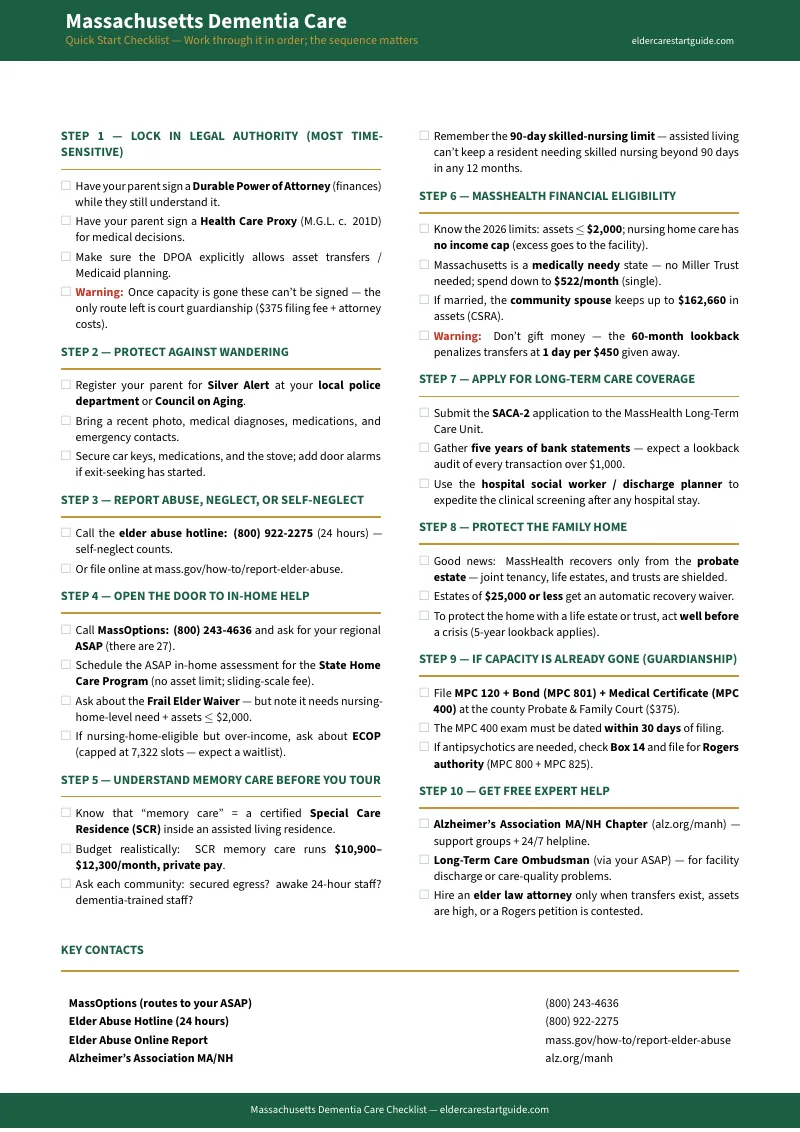
- The Quick-Start Checklist (free version) — the 20 most urgent action items extracted from the full guide, designed to be completed in the first 30 days after diagnosis.
Who This Is For
You're an adult child in Massachusetts — probably a daughter, probably somewhere between 45 and 65 — and you've just been handed a problem that touches medicine, law, real estate, and state bureaucracy all at once. You're already exhausted, and you haven't even started the paperwork.
This guide is for the person who needs to stop searching and start doing — but needs the right order of operations first.
Why Not Free Government Resources?
The regulations are public. The problem isn't access — it's architecture. MassHealth eligibility rules are scattered across mass.gov, the Executive Office of Aging & Independence, 27 regional ASAPs, and the Probate and Family Court system. None of these agencies explain how their piece connects to the others.
A parent with dementia doesn't give you time to become an expert on four bureaucracies. This guide compresses weeks of research into a single document that tells you: here's what to do first, here's the form, here's who to call, here's the deadline.
It also fills the gap between "free information" and "elder law attorney at $425/hour." Walking into that meeting unorganized costs you thousands in billable hours. Walking in prepared — with your parent's assets cataloged, the right questions listed, and the lookback already mapped — turns a 4-hour engagement into a focused 90-minute session.
The Guarantee
If this guide doesn't save you at least one confused phone call to a state agency, email [email protected] and we'll refund the purchase. No forms, no questions.
— Less Than One Hour of Your Parent's Daily Nursing Care
Massachusetts nursing facilities charge an average of $450 per day. This guide costs less than one hour of that daily rate — and it helps you navigate the system that determines who pays the other 23 hours.
The free checklist gives you the first 20 steps. The full guide gives you the complete navigation system — every form, every threshold, every deadline, every phone number.