
Your Parent Needs Care in Wales — And Everyone's Telling You Something Different
The hospital wants the bed back. The council keeps mentioning an "assessment" but nobody explains what happens next. One website talks about a £50,000 limit, another about a £100 weekly cap, and a third uses words like "personal budget" that a Welsh social worker says don't even apply here. Meanwhile your parent is frightened, your siblings disagree, and you're the one who has to decide.
You are not confused because you're failing. You're confused because elder care in Wales runs on its own devolved rulebook — the Social Services and Well-being (Wales) Act 2014 — and almost every guide you find online quietly assumes the English system. The cap is different. The capital threshold is different. Even the terminology is different. Get it wrong and you can hand a council thousands of pounds you never owed, or accept a care decision you had every right to challenge.
The Wales Care Navigator System
This is the guide we wished existed the night the phone rang. Arranging Care for an Elderly Parent in Wales takes the entire maze — the care needs assessment, home care versus a care home, self-funding versus council-funded, and the exact moment to act — and turns it into a clear, sequential plan built specifically for Welsh law.
No 40-page factsheets written to protect a council's budget. No £300-an-hour solicitor's clock ticking while you ask a basic question. Just the calculators, templates, and step-by-step decisions that let you move fast and get it right — before you spend a penny on professionals.
What's Inside — And the Problem Each Part Solves
- The Care Funding Worksheet — Stop guessing what your parent will actually pay. Fill in their savings, property value, and income, and see their position under Welsh rules: the £50,000 residential capital threshold, the £100/week non-residential cap, and the income-only contribution rules Wales applies instead of England's tariff income. Solves: "Will the council take everything?"
- The Property Disregard Tracker — See the precise date your parent's home stops being disregarded, and evaluate whether a Deferred Payment Agreement, renting, or selling is the right route. Solves: "They're going to make us sell the house."
- The Correspondence Templates — Pre-written, ready-to-send letters: a formal Care Needs Assessment request citing the council's legal duty under Section 19, a care-assessment dispute letter, an NHS Continuing Healthcare (CHC) appeal built around the Decision Support Tool, and the new 2026 CHC Direct Payments request. Solves: "I don't know what to say or which law to quote."
- The Sibling Agreement & Meeting Agenda — A structured template that moves the family from emotional argument to a written plan: who does what, who pays what, who decides. Solves: "My brother and I can't agree and it's tearing us apart."
- The Care Provider Evaluation Matrix — A printable checklist mapped to the four Care Inspectorate Wales pillars (Wellbeing, Care & Support, Environment, Leadership) with the exact questions to ask a manager — staff turnover, nursing consistency, Welsh-language "Active Offer" cover. Solves: "How do I tell a good home from a bad one?"
- The Hospital Discharge Steps — A one-page survival guide to the Welsh "Discharge to Recover then Assess" (D2RA) pathways and the Choice of Accommodation protocol, so you're never pressured into a rushed placement you'll regret. Solves: "They want her out by Friday and I don't know my rights."
- The LPA vs. Deputyship Decision Guide — A side-by-side comparison showing why acting now on a Lasting Power of Attorney costs a fraction of a Court of Protection deputyship later, with action steps for each path. Solves: "I'm doing everything but I have no legal authority to."
- The Financial Quick Reference — Every 2026 Welsh elder care financial figure on one printable page — from care home thresholds to LPA fees. Solves: "I can never remember the exact numbers."
Who This Is For
- Adult children in Wales facing a parent's sudden decline, fall, or hospital admission
- Proactive planners who've spotted early frailty or dementia and want to protect assets and set up an LPA before capacity is lost
- Exhausted primary carers who need to understand their right to a carer's assessment and respite
- Long-distance children — often living in England — coordinating Welsh care remotely and drowning in cross-border confusion
Why Not Just Use the Free Resources?
Because "free" has a hidden cost. The public information from gov.wales and your local council is authoritative — and deliberately fragmented, bureaucratic, and written to protect the state's budget, not your parent's. Age Cymru's factsheets are excellent and often 40-plus pages of dense text, with no calculator, no templates, and no plan for someone reading at midnight in a hospital corridor.
The alternative is a solicitor or SOLLA adviser at £215 to £500-plus per hour, by appointment only, unreachable exactly when the crisis hits. This guide sits in the gap: it translates the same official Welsh policy into a plan you can act on tonight, so that if you later pay a professional, you arrive knowing precisely what to ask — and what you no longer need them for.
A Simple Promise
If this guide doesn't give you a clearer, calmer path through the Welsh care system than anything you've found for free, email us and we'll refund you — no forms, no arguments. We built this for families in one of the hardest seasons of their lives, and we won't keep your money if it didn't help.
Start Now — Two Ways
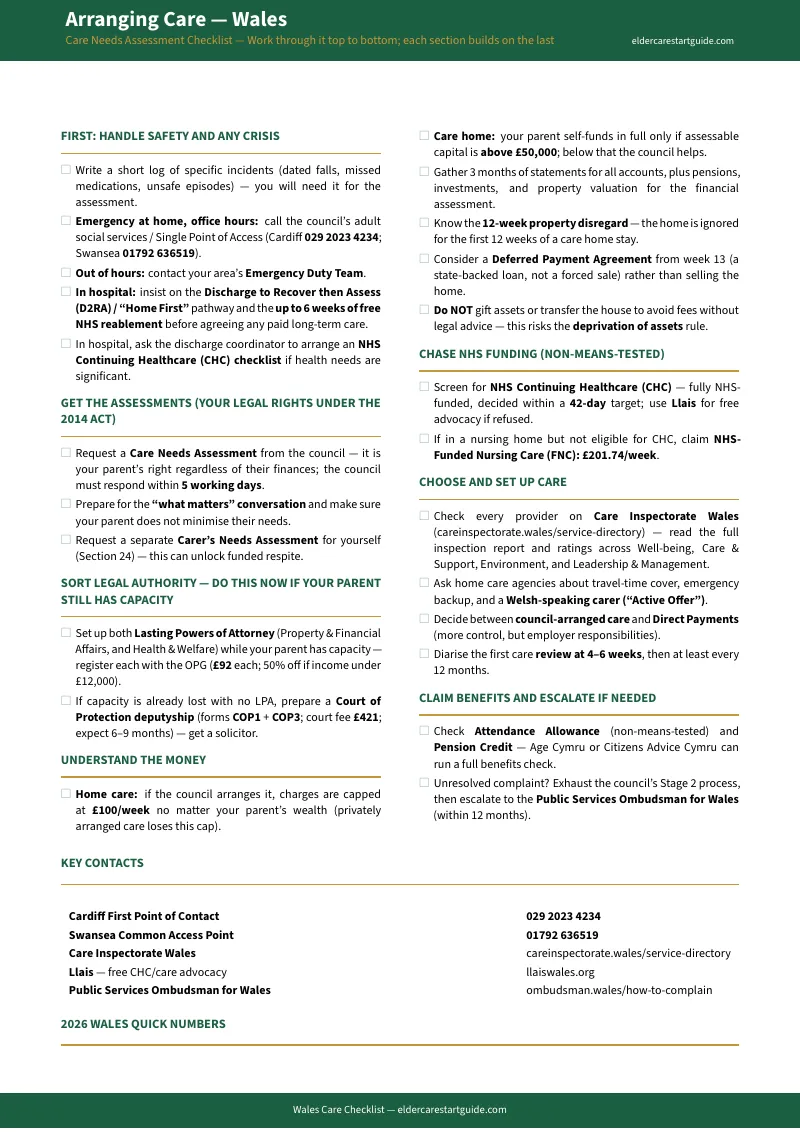
Not ready to buy? Start with the free Wales Care Needs Assessment Checklist — a one-page guide to what the assessment covers and how to prepare, so your parent's first meeting with social services goes right.
Ready to navigate the whole thing? Get the complete Arranging Care for an Elderly Parent in Wales guide — the calculator, the full template library, and the step-by-step plan — for , a fraction of a single hour with a solicitor.