Your parent has dementia and California's system feels built to exhaust you before it helps you.
The hospital discharge planner says your mother can't go home without 24-hour supervision — and they need your decision in 48 hours. Your father was found wandering three blocks away at 11pm. The Medi-Cal asset limit just came back on January 1, 2026, and you have no idea whether your parent's savings — or their house — is safe. Meanwhile you have thirty browser tabs open, a full-time job, and a sibling in another city who thinks you're overreacting.
You are not overreacting. You are drowning in a system that scatters the exact answers you need across a dozen unconnected state websites, none of which will actually tell you what to do next.
The information exists. The roadmap doesn't.
California's own agencies — DHCS, CDSS, Community Care Licensing — publish the rules. But they publish them as dense administrative code, written for caseworkers and lawyers, split across separate portals with no strategic instructions and no fill-in templates. They'll tell you the 2026 Medi-Cal asset limit is $130,000. They will not tell you how to legally spend down to reach it without triggering a look-back penalty. They'll list Title 22 compliance codes for care homes. They won't hand you a 10-minute checklist to use while you're standing in the lobby on a facility tour.
That gap — between the raw rules and a family's step-by-step action plan — is where families lose weeks they don't have.
Introducing the California Memory Care Navigator
This is a complete, self-directed workbook — not another article, not a directory, not a sales funnel for a placement agency. It's the exact worksheets, template scripts, and sequential checklists a California family uses to secure legal authority, maximize paid in-home care hours, protect the family's assets, and vet a memory care facility — without spending thousands on professional retainers you may not need.
Nine files — a 53-page guide plus seven standalone printable tools — organized around the precise moments that force a family to act.
What's inside — 9 files, each one solves a specific problem
The Complete Guide (53 pages)
Twelve chapters covering every stage of the dementia care journey — from securing legal authority and navigating the 2026 Medi-Cal rules to choosing a memory care facility and protecting the family home from estate recovery. Written for the adult child who needs the full roadmap, not just fragments.
Capacity Documentation Log
The problem: You need documented evidence of your parent's cognitive state before they sign legal documents or before a conservatorship filing.
A fillable Probate Code § 811 capacity log to record dated observations of memory, orientation, and judgment — the evidence that makes or breaks legal proceedings.
POA Witness-Verification Cheat-Sheet
The problem: Banks and courts reject Powers of Attorney over avoidable technicalities in California's strict witness rules.
A one-page reference card listing every witness requirement, common rejection reasons, and what to verify before signing — bring it to the attorney's office.
Medi-Cal Spend-Down Ledger & Couples Asset-Allocation Worksheet
The problem: The $130,000 asset limit is back and you're afraid you'll have to drain your parent's savings — or lose the house — to qualify.
A fillable ledger of approved exempt purchases to safely reach the limit, plus a couples worksheet that shields a healthy spouse's assets up to the $162,660 CSRA. Includes the 90-day retitling checklist.
IHSS Protective Supervision Application Kit
The problem: You can't afford to quit your job, and private in-home care runs thousands a month.
A physician prep sheet for the SOC 821 assessment (the form that must mark Rank 5 in all three domains) plus a pre-formatted 7-day behavior and hazard log — the documentation that unlocks up to 283 paid monthly care hours.
RCFE Memory Care Tour Audit
The problem: A facility tour is a sales pitch, and you have no way to tell a genuinely safe memory unit from a nicely decorated one.
A 20-point check-sheet with the exact questions to ask about staff dementia credentials, medication protocols, and real staff-to-resident ratios — plus red flags and a "Before You Sign" checklist.
Emergency Profile & Silver Alert Script
The problem: Sixty percent of people with dementia wander at least once, and you have no plan for the night it happens.
A pre-formatted law-enforcement handout for your parent's medications, diagnosis, physical description, and known locations — fill it in today and keep it on the fridge. Plus a 911 Silver Alert script with the exact words that trigger a California Highway Patrol search without a waiting period.
Who this is for
- The adult child suddenly handed a 48-hour discharge deadline who needs a facility-vetting plan tonight
- The burned-out primary caregiver who has hit the wall and needs paid help through IHSS or a residential placement
- The proactive planner acting early — while a parent still has the capacity to sign legal documents
- The sibling coordinator who needs objective, third-party benchmarks to align a divided family on one plan
Why not just use the free tools?
Free placement services like A Place for Mom? When the service is free, you are not the client — the facility is. These directories are paid commissions of up to 108% of a parent's first month's rent, so they're structurally incentivized to steer you toward expensive private-pay facilities. They will not show you how to secure IHSS hours or walk you through the Assisted Living Waiver, because those programs divert you away from their paying partners. This guide accepts zero commissions and lays out every option — public and private.
State websites? They have the rules but none of the roadmap — no sequencing, no templates, no instructions. You'd be assembling a medical assessment form, an IHSS application, and a facility complaint search from three different portals on your own.
An elder law attorney? Essential for complex cases — but at $300–$800 an hour, their clock shouldn't be burned organizing your parent's financial files. Use this workbook as a pre-legal preparation kit: walk in with your asset inventory, capacity documentation, and questions already organized, and compress a multi-hour engagement into one efficient review.
A fair, simple guarantee
If this guide doesn't give you a clearer, more confident path forward than the free tools you've been fighting with, reply to your receipt at any time and we'll refund you in full. No forms, no friction. You're already dealing with enough of both.
Start where you are
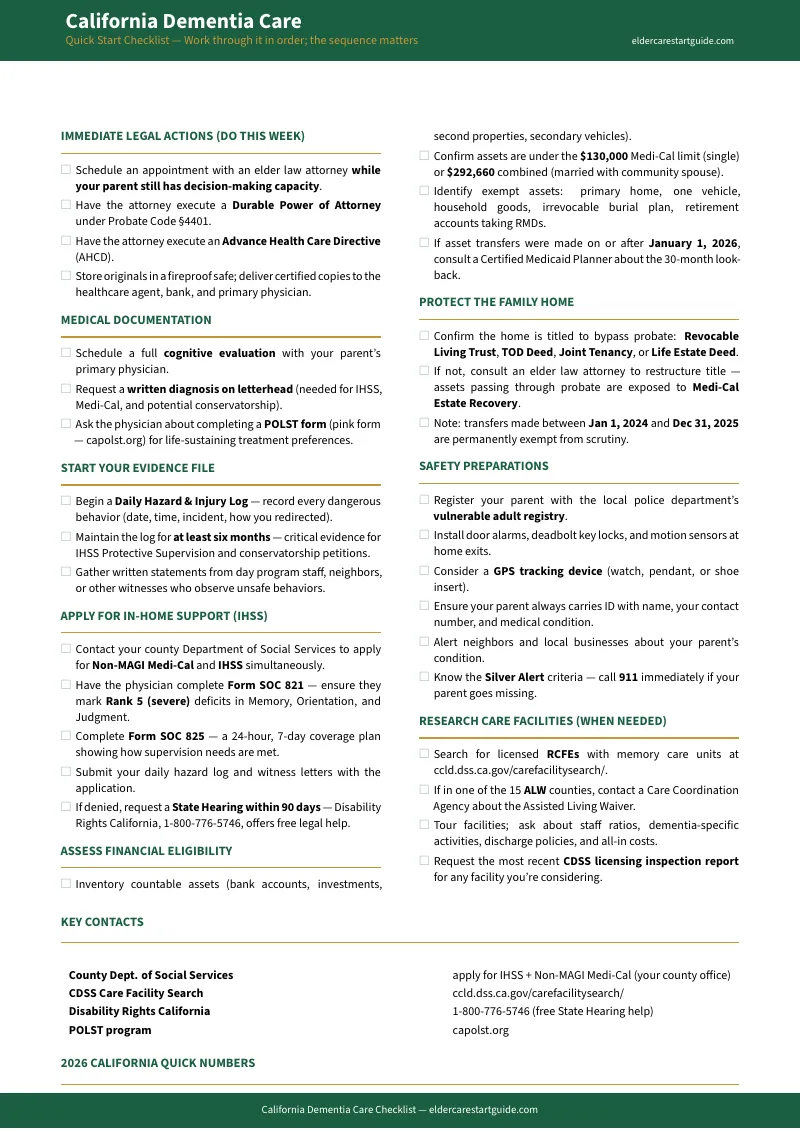
Not ready to buy? Start with the free California Dementia Care Resource Checklist — a one-page map of the state programs, registries, and agencies you'll need. When you're ready to move from "what exists" to "here's exactly how I do it," the full California Memory Care Navigator is — less than a single hour of an elder law attorney's time, and yours to keep.
Get the guide today and stop losing weeks to a system that was never built to help you find your way through it.