A Single Wrong Line on Last Year's Tax Return Can Cost Your Family Thousands in Lost PEI Long-Term Care Subsidy — And Nobody at Health PEI Will Warn You
Your parent can no longer stay safely at home. Maybe a stroke, a fall, or a slow slide into confusion left them in a hospital bed flagged as an Alternative Level of Care patient — a signal that they can't go back to their own house. A Health PEI Home Care coordinator hands you a Long-Term Care Subsidy application, a stack of financial disclosure forms, and a strict 30-day window to produce years of Canada Revenue Agency tax documents. Miss the deadline and the application is cancelled. Get the numbers wrong and your family pays the unsubsidized private rate — over $190 a day, nearly $70,000 a year.
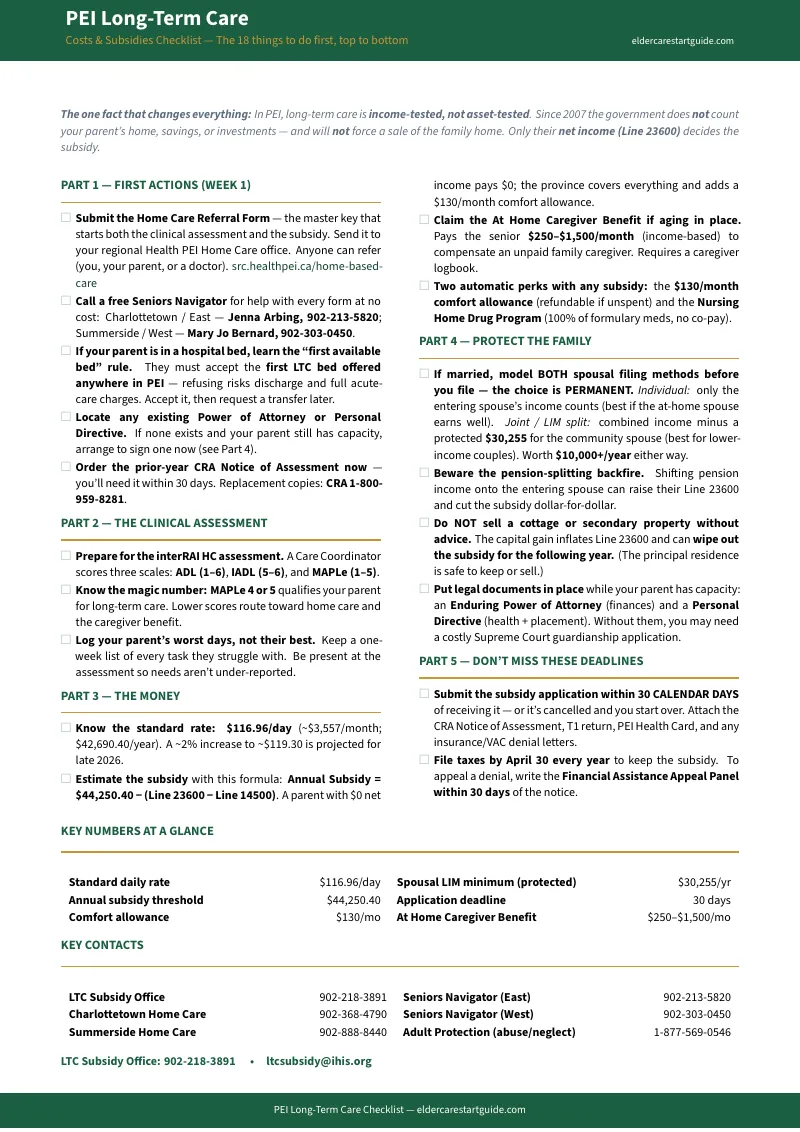
Here's what makes Prince Edward Island's system uniquely stressful and uniquely navigable: since January 1, 2007, PEI uses an income-only test — the family home, bank accounts, and investments are protected from forced sale. But the income that those assets throw off is not protected. Sell a cottage to help pay for care and the capital gain inflates Line 23600 of your parent's tax return, pushing them over the $44,250.40 net income threshold and wiping out their subsidy for the following year. Split a pension to save a little tax and you can accidentally raise the institutionalized spouse's net income and shrink their subsidy dollar-for-dollar. Health PEI publishes the rules. It does not publish the plan.
The PEI Subsidy Strategy System
This guide maps the entire financial, clinical, and administrative pathway through Health PEI's Long-Term Care Subsidization Program — from the first coordinator phone call through the InterRAI HC clinical assessment, the income-based financial review, and the Schedule A rate determination that decides what your family actually pays each month. It is built specifically around PEI's provincial framework and the Long-Term Care Subsidization Act Regulations, not a generic Canadian template with the province name swapped in.
What sets it apart from government brochures and law-firm blog posts: it connects the steps Health PEI treats as separate. The clinical assessment, the income test, the pension-splitting decision, the community spouse's household budget, and the capital gains timing all interact — and getting one wrong can delay a placement, cancel an application, or leave the healthy spouse financially marginalized. The guide shows you how the pieces fit so you can sequence decisions in the right order.
What's Inside
- PEI Subsidization Rate Calculator — a step-by-step worksheet using Line 23600 (Net Income) and Line 14500 (Social Assistance) from your parent's CRA Notice of Assessment, applying the $44,250.40 threshold and the sliding-scale formula so you know your parent's likely monthly contribution before you ever submit a form
- Capital Gains Hazard Guide — shows exactly how selling a cottage or second property triggers a taxable gain that inflates net income and can cost your family an entire year of subsidy, plus how to time asset sales so they don't collide with a subsidy review
- Joint-Averaging Spousal Protection Sheet — explains how a couple's combined net income is split 50/50, why the province won't top up the institutionalized spouse's subsidy to cover the community spouse's household bills, and the pension-splitting warning sheet that stops you from losing subsidy to chase a minor tax saving
- InterRAI HC Assessment Decoder — breaks down the ADL, IADL, and MAPLe clinical scales Home Care coordinators use, so your parent's real limitations are documented honestly instead of masked by pride during the in-home evaluation
- At Home Caregiver Benefit Qualifier — maps the clinical scores that unlock $250 to $1,500 a month to help pay an unpaid family caregiver, with the eligibility rules for both the senior and the caregiver
- Document Organization Checklist — every item the LTC Subsidy Office requires (CRA Notice of Assessment, T1 return, PEI Health Card, proof of any denied private insurance or Veterans Affairs Canada benefits) organized in filing order to beat the 30-day cancellation window
- Estate Recovery Fact Sheet — explains how the Long-Term Care Subsidization Act handles estate recovery, the first-$2,500 exemption, and the 50% cap when there is a surviving spouse, so your family understands its long-term liability
- Appeal Letter Template & Monthly Budget Worksheet — a customizable letter to the Financial Assistance Appeal Panel within the mandatory 30-day window, plus a monthly budget worksheet factoring the $116.96 daily accommodation rate, the $130 comfort allowance, and the uncovered extras (cable, phone, transportation) most families forget
Who This Is For
- Adult children whose parent was just declared an Alternative Level of Care patient in hospital and handed a subsidy packet with a 30-day clock running
- Families who were told their parent "makes too much" for full subsidy and want to see the sliding-scale math for themselves
- A son or daughter acting for a community spouse who is terrified of being left unable to pay the household utilities, taxes, and upkeep once their partner is placed
- Pre-crisis planners watching a parent decline who want to structure tax filings and asset decisions before a formal Health PEI assessment
- Anyone weighing whether to sell the family cottage to fund care — before they accidentally trigger a subsidy-killing capital gain
- Siblings who need one neutral, PEI-specific reference to settle disagreements about how to pay for a parent's care
Why Free Resources Leave You Stuck
Health PEI, the LTC Subsidy Office, and the provincial 211 directory each publish pages describing what their part of the process requires. None of them hand you a calculator for the sliding-scale subsidy, a pension-splitting warning sheet, or a worksheet showing how a cottage sale ripples into next year's net income. They describe eligibility. They don't sequence decisions.
National directories like A Place for Mom and ElderCare.com rank well in search, but they run on US templates built around Medicaid — a system that does not exist in Canada. They miss PEI's income-only test entirely, gloss over the $44,250.40 threshold and the Line 23600 mechanics, and earn their money referring families to private-pay facilities. Following generic advice on the Island can cost you months of unnecessary private-rate bills.
Elder law lawyers at firms like Key Murray Law or Carr, Stevenson & MacKay will walk you through all of this — at CAD 300 to CAD 500 an hour. Arriving with your documents organized, your net income calculated, and the joint-versus-individual application decision already understood can cut a five-hour engagement to one. For many families with a straightforward situation, the guide itself is enough to handle the subsidy application without legal fees at all.
Satisfaction Guarantee
If the guide doesn't show you at least one subsidy strategy, tax trap, or application step you didn't already know, email us for a full refund. No forms, no waiting period.
Start Protecting Your Parent's Care and Your Family's Money Today
Download the free checklist for the one-page cost and subsidy overview — or get the full guide for and have every calculator, worksheet, template, and reference you need to navigate Health PEI's Long-Term Care Subsidization Program from the first coordinator call to an approved Schedule A rate.